




Shooter response training draws captive audience
A live-action event at the NAPT Summit brings in a SWAT team to demonstrate a response to an active shooter on a school bus.

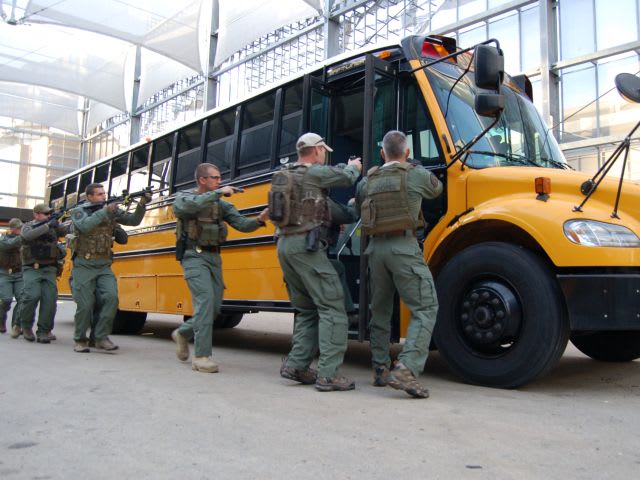
A live-action event at the NAPT Summit brought in a SWAT team to demonstrate a response to an active shooter on a school bus.
A Sunday afternoon session at the National Association for Pupil Transportation (NAPT) Summit packed in a large crowd eager to learn more about how to respond to a violent intruder — and to witness a live-action simulation aboard a school bus.
The timely event began indoors with a presentation by Gary Moore, a retired Missouri Highway Patrol captain who now serves as safety coordinator for the Missouri Center for Education Safety.
Moore’s presentation centered on the January 2013 slaying of Alabama school bus driver Charles Poland, who was shot by an intruder who then took a boy from the bus and held him hostage in an underground bunker for nearly a week.
Moore began by playing a 911 call recording in which a 16-year-old student on the bus calmly described to a dispatcher what was happening as the intruder, Jimmy Lee Dykes, confronted Poland.
In a surprise to NAPT attendees, that student, Tre’ Watts, was in the room with his father. Moore presented the NAPT Heroism Award to Tre’, while the audience gave him a standing ovation.
Moore described how Dykes had tried to “groom” Poland in the days before the encounter by clearing out a turnaround area for Poland’s bus and offering to bring him broccoli and carrots. Dykes apparently expected these gestures to help him, when the fateful day came, to persuade Poland to hand over two boys as hostages, but Poland refused, even to the point of being fatally shot.
According to Moore, Poland could have had a chance to survive Dykes’ scheme if he had been trained on how to handle this type of situation. Moore said that the concept of JDLR — meaning that something “just doesn’t look right” — is particularly helpful in identifying potential threats.
Moore gave an example of a “JDLR success story”: A Wentzville (Mo.) R-IV School District bus driver saw a truck parked next to one of her stops, and the truck matched the description of a vehicle involved in a child abduction. Instead of stopping at the regular stop, the bus driver dropped off those students directly in front of their houses and waited until they got inside. She called in the truck’s license number, and the owner of the truck turned out to be a drug dealer, Moore said.
Moore also detailed practical steps that school bus drivers can take to prevent or respond to violent encounters on the bus. That starts with never letting an unauthorized person on the bus; if parents or others insist on communicating with the driver at a stop, they should be directed to go around to the driver’s window, Moore said.
If an intruder makes it onto the bus, Moore gave this suggestion: Advise the violator that you will discuss the issue outside the bus, away from the students. When the violator steps off, shut the door and report the incident.
Moore listed ways to try to defuse a hostile person, such as projecting a “listening face,” showing concern for the person, speaking in a calm voice, paraphrasing what the person says, and using a transition word, like “however.” For example: “I hear what you are saying and understand; however, I need to get these kids to school.”
In some cases, the school bus driver may need to respond physically. Moore noted that objects on the bus, such as a fire extinguisher or de-icer, could be used to fend off a shooter, first by spraying and then by hitting him with it.
Also, the bus itself could be used as a defensive tool, by accelerating, braking or swerving. This could throw a gunman off of his feet, giving the driver a few seconds to “neutralize” him. Three quick ways to do that, Moore said, are gouging the eyes, striking the throat and striking the groin. With any of those actions, the key is to deliver them decisively.
“If you have to use physical force, be committed to your actions,” Moore said.
The second portion of the event unfolded outside, in a loading bay of the convention center. Attendees who wanted to experience an active shooter scenario firsthand boarded a school bus and put on ear plugs and protective headgear.
With someone portraying a gunman on board, a SWAT team stormed the bus. Some officers were positioned on top of a SWAT vehicle, some used ladders to ascend to the height of the bus windows and others ran on board, commanding attendees to put their hands on their faces (so they could see everyone’s hands). In a matter of seconds, they had taken out the gunman.
More Safety

How to Build a Better School Bus Driver Training Program
Is it time to strengthen your driver training? Here’s how to pick the right talent and improve recruitment, retention, and safety. This video is brought to you by IC Bus.
Read More →
Recent School Bus Accidents Leave 2 Dead, 2 Injured
Four school bus crashes in Florida, Illinois, and Georgia highlight risks in transportation lots, at bus stops, and during student loading and unloading.
Read More →
When Every Second Matters, Clarity Keeps Routes Moving
From routine delays to urgent incidents, strong communication practices help drivers, dispatchers, schools, and families respond with confidence.
Read More →

What Happens When a School Bus Catches Fire — and What Can Help
School bus fires are rare but can be devastating. Learn how advances in fire suppression and asset protection help fleets detect fires earlier, reduce damage, and improve safety.
Read More →
Geotab Launches Tool to Help Fleets Investigate Road Incidents
Geotab Investigations combines telematics data, video, documents, and other evidence to help fleets reconstruct incidents, resolve claims, and determine what happened.
Read More →
Texas Sixth Grader Wins 2026 National School Bus Safety Poster Contest
Sai Darshana Yekolu of Moseley Middle School in Prosper, Texas, was named the newest winner for her artwork, bringing the theme of “Safe Rides, Everyday Heroes” to life.
Read More →
Doing More With Less: How Transportation Directors Can Prioritize Safety Amid Budget Uncertainty
With diesel prices soaring and nearly one-third of transportation directors expecting budget cuts, maintaining student safety has never been more challenging. Download this guide to learn how leading districts are prioritizing risk, funding critical safety technology, and building stronger budget cases with data.
Read More →
Walton County Schools Adds Gatekeeper Stop-Arm Enforcement System
The Florida district will deploy Gatekeeper’s updated Student Protector technology, which now incorporates AI to improve video evidence.
Read More →
How To Build a More Secure School Bus Yard During and After Hours
As thefts and overnight security threats continue, school transportation leaders are combining stronger operational practices with AI-enabled surveillance to better protect buses, facilities, and staff.
Read More →
FMCSA Names New Chief Safety Officer: What School Bus Operators Should Know
Steve Dowling is set to lead the federal agency's efforts to advance commercial motor vehicle safety and reduce crashes, fatalities, and injuries on the nation's roadways.
Read More →