




School Bus Fire Demo Highlights Need for Preparedness
A training event at Stafford County (Va.) Public Schools shows drivers the importance of school bus evacuation training. The concept will come to the NAPT conference this fall.

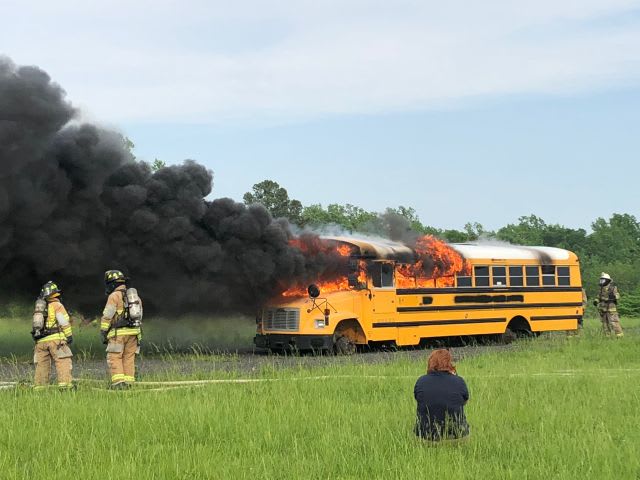
Stafford County (Va.) Public Schools worked with the local fire department to burn an obsolete school bus. The event emphasized the importance of evacuation training.
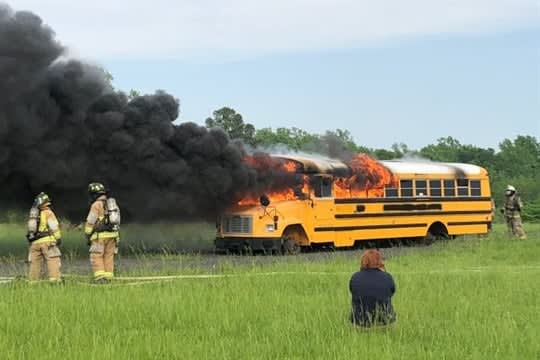
Stafford County (Va.) Public Schools worked with the local fire department to burn an obsolete school bus. The event emphasized the importance of evacuation training.
STAFFORD COUNTY, Va. — A burning school bus is one of the last things most drivers would want to see, but a recent training exercise here used that very sight to highlight the importance of evacuation training.
Barry Sudduth, executive director of fleet and transportation services for Stafford County Public Schools, told SBF that news of recent school bus fires around the country — including a fatal blaze in Iowa in December — prompted his plan to bring the issue before his drivers and monitors at their spring in-service training.
Sudduth shared his idea with the Stafford County Fire and Rescue Department, noting that the school district had an obsolete bus at its disposal.
“I wanted to use it for a training exercise,” Sudduth said. “My goal … was to show how quickly a school bus will go up in flames.”
Before burning the bus, the fire department’s training division developed a pertinent presentation to give to the school bus drivers. Sudduth said the presentation covered “the basics on what to do and what not to do in a fire” as well as specifics on evacuating school buses.”
The training event took place on April 16 at one of Stafford County’s elementary schools that is adjacent to fairgrounds. On the previous day, the organizers had sent out notifications to alert the public about what would be taking place, to prevent any passersby from panicking.
For the demonstration portion of the training, firefighters ignited a bale of hay in front of the bus, which had its tires removed so they wouldn't blow off. The vehicle didn’t take long to succumb to the flames.
“It was about three minutes before [the bus] was fully engulfed,” Sudduth said.
The spectacle made quite an impression on Stafford County’s school bus staff — in a constructive way.
“For the next week, drivers were stopping me on the lot or coming in to see me,” Sudduth said. “I’ve never had that kind of response from a training before.”
The consensus was that the exercise gave the drivers a renewed sense of vigilance — they saw how critical it is that students know what to do and where all of the exits are in case of a fire or other emergency.
Virginia requires school districts to conduct school bus evacuation drills with students twice per year: one in the first semester, and one in the second semester. But Sudduth said that the bus burn prompted many of his drivers to review evacuation plans with their passengers the next day, and witnessing the demonstration may add more urgency to the annual drills.
One of Stafford County Public Schools’ media classes shot video of the event, so the footage can be used for future training sessions without having to burn another bus.
Encouraged by the results of the event, Sudduth saw an opportunity to take the concept to a broader audience. Sudduth is also the current president of the National Association for Pupil Transportation (NAPT), and he shared the idea with the NAPT staff.
Now, planning is underway for a live-action event that will take place during NAPT’s annual conference in Kansas City, Missouri, this fall. Lee's Summit R-7 School District will host the program, which will demonstrate various emergency situations to illustrate their impact on student evacuations.
Executive Director Mike Martin said that NAPT is still working on the logistics, but the plan includes burning three different buses. The live-action event is slated for the Saturday of the conference, Oct. 27.
NAPT has held similarly eye-catching events in past years. Those have included school bus crisis response demonstrations by law enforcement, a simulated school bus-train crash, and blowing up a school bus for security awareness training.
For more information on NAPT's 2018 conference, go to www.naptconference.org.
More Safety

How to Build a Better School Bus Driver Training Program
Is it time to strengthen your driver training? Here’s how to pick the right talent and improve recruitment, retention, and safety. This video is brought to you by IC Bus.
Read More →
Recent School Bus Accidents Leave 2 Dead, 2 Injured
Four school bus crashes in Florida, Illinois, and Georgia highlight risks in transportation lots, at bus stops, and during student loading and unloading.
Read More →
When Every Second Matters, Clarity Keeps Routes Moving
From routine delays to urgent incidents, strong communication practices help drivers, dispatchers, schools, and families respond with confidence.
Read More →

What Happens When a School Bus Catches Fire — and What Can Help
School bus fires are rare but can be devastating. Learn how advances in fire suppression and asset protection help fleets detect fires earlier, reduce damage, and improve safety.
Read More →
Geotab Launches Tool to Help Fleets Investigate Road Incidents
Geotab Investigations combines telematics data, video, documents, and other evidence to help fleets reconstruct incidents, resolve claims, and determine what happened.
Read More →
Texas Sixth Grader Wins 2026 National School Bus Safety Poster Contest
Sai Darshana Yekolu of Moseley Middle School in Prosper, Texas, was named the newest winner for her artwork, bringing the theme of “Safe Rides, Everyday Heroes” to life.
Read More →
Doing More With Less: How Transportation Directors Can Prioritize Safety Amid Budget Uncertainty
With diesel prices soaring and nearly one-third of transportation directors expecting budget cuts, maintaining student safety has never been more challenging. Download this guide to learn how leading districts are prioritizing risk, funding critical safety technology, and building stronger budget cases with data.
Read More →
Walton County Schools Adds Gatekeeper Stop-Arm Enforcement System
The Florida district will deploy Gatekeeper’s updated Student Protector technology, which now incorporates AI to improve video evidence.
Read More →
How To Build a More Secure School Bus Yard During and After Hours
As thefts and overnight security threats continue, school transportation leaders are combining stronger operational practices with AI-enabled surveillance to better protect buses, facilities, and staff.
Read More →
FMCSA Names New Chief Safety Officer: What School Bus Operators Should Know
Steve Dowling is set to lead the federal agency's efforts to advance commercial motor vehicle safety and reduce crashes, fatalities, and injuries on the nation's roadways.
Read More →