




Proposed bill aims to crack down on stop-arm runners
HF 1948 would raise the fine for Minnesota motorists who illegally pass a school bus by $200 in an effort to make it tougher for violators to plea down the charge.

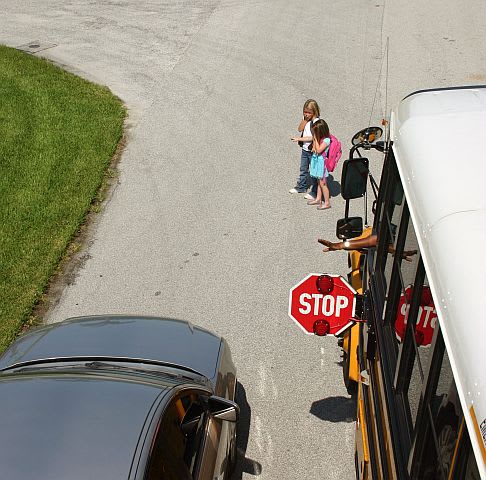
HF 1948 would make it tougher for violators to plea a ticket down to a lesser charge. Minnesota School Bus Operators Association brought the idea for the bill to Rep. Dean Urdahl, who authored the bill. Photo courtesy Brevard Public Schools
MINNEAPOLIS — A proposed bill would increase the fine and penalty for motorists who pass or attempt to pass a school bus when a child is near the outside of the bus and make it tougher to plea down the charge.
The bill, HF 1948, states that a motorist who fails to stop for a school bus on the right side or when a child is outside of the bus on the roadway or adjacent sidewalk used by the bus is guilty of a misdemeanor. The violator could receive a fine of at least $500 and be required to complete a driver improvement clinic.
The current penalty is a $300 fine for a motorist. Rep. Dean Urdahl, who authored the bill, confirmed with SBF that if the bill were to pass, the fine would go up to $500, and ticketed drivers would be required to attend traffic school.
Most importantly, HF 1948 would prohibit courts from lowering the charge, thereby reducing the penalties, Urdahl said.
The idea for the bill was brought to Urdahl for consideration by the Minnesota School Bus Operators Association (MSBOA). As a former teacher, he thought it would be an important step in helping to ensure student safety, he said.
Shelly Jonas, executive administrator for MSBOA, told SBF the organization has been working on this issue for the last two years and contacted Urdahl about authoring the bill, including adding the traffic school requirement and raising the fine, which would make it tougher for a violator to plea down the charge.
“We’ve been trying to focus some of our energies on how to get people charged out,” Jonas explained. “This session we decided to try raising the penalties and make it so that it can’t get pled down to a lesser charge.”
She pointed to a significant disparity between the number of stop-arm violators caught during the nationwide National Association of State Directors of Pupil Transportation one-day stop-arm survey and how many tickets written for the violation have been fully prosecuted.
“We have 300 violations in one day,” she said. “At the end of the year, when we look at how many tickets have been written and fully prosecuted, there’s [about] 300, so something happens between when people go through the stop arm and the end result. These people aren’t getting prosecuted.”
Urdahl echoed her point, adding that the survey showed there are about 72,000 stop-arm violations in a year in Minnesota.
One case in the state that was prosecuted was that of truck driver Allen Morris, who was accused of illegally passing a school bus on the right side and nearly striking a young student last year. Morris pled guilty to a gross misdemeanor and was sentenced to one year in county jail, two years of probation and a $1,000 fine.
HF 1948 was first read in a House committee in mid-March. If passed, the bill would go into effect on Aug. 1.
More Safety

School's Back. Here's What Happened to Traffic, Speeding & Distraction
What happens to traffic when school resumes? New data analysis examines changes in distracted driving, congestion, and speeding around schools.
Read More →
Geotab Expands Fleet Safety Tools With Video Coaching, Risk Insights
New safety and video capabilities aim to help fleet managers assess risk, support drivers, and take targeted action through video coaching, red-light violation detection, and more.
Read More →
How to Build a Better School Bus Driver Training Program
Is it time to strengthen your driver training? Here’s how to pick the right talent and improve recruitment, retention, and safety. This video is brought to you by IC Bus.
Read More →

Recent School Bus Accidents Leave 2 Dead, 2 Injured
Four school bus crashes in Florida, Illinois, and Georgia highlight risks in transportation lots, at bus stops, and during student loading and unloading.
Read More →
When Every Second Matters, Clarity Keeps Routes Moving
From routine delays to urgent incidents, strong communication practices help drivers, dispatchers, schools, and families respond with confidence.
Read More →
What Happens When a School Bus Catches Fire — and What Can Help
School bus fires are rare but can be devastating. Learn how advances in fire suppression and asset protection help fleets detect fires earlier, reduce damage, and improve safety.
Read More →
Geotab Launches Tool to Help Fleets Investigate Road Incidents
Geotab Investigations combines telematics data, video, documents, and other evidence to help fleets reconstruct incidents, resolve claims, and determine what happened.
Read More →
Texas Sixth Grader Wins 2026 National School Bus Safety Poster Contest
Sai Darshana Yekolu of Moseley Middle School in Prosper, Texas, was named the newest winner for her artwork, bringing the theme of “Safe Rides, Everyday Heroes” to life.
Read More →
Doing More With Less: How Transportation Directors Can Prioritize Safety Amid Budget Uncertainty
With diesel prices soaring and nearly one-third of transportation directors expecting budget cuts, maintaining student safety has never been more challenging. Download this guide to learn how leading districts are prioritizing risk, funding critical safety technology, and building stronger budget cases with data.
Read More →
Walton County Schools Adds Gatekeeper Stop-Arm Enforcement System
The Florida district will deploy Gatekeeper’s updated Student Protector technology, which now incorporates AI to improve video evidence.
Read More →