




7 Strategies for Helping Special-Needs Students Adjust to COVID Safety Measures
Over Half of K-12 Students Can Now Attend School In Person, Data Show
More than 51% of students nationwide can receive in-person instruction, and less than 20% attend school virtually. New 3-feet social distancing guidance from the CDC is expected to accelerate on-campus learning.

Nicole Schlosser・Former Executive Editor

Slightly more than 60% of K-5 U.S. students can return to the classroom, according to community data service Burbio.
Infographic courtesy Burbio
3 min to read
More than half of K-12 students nationwide can now receive in-person instruction and less than 20% are learning remotely, and a revised social distancing guideline is expected to further accelerate school reopenings.
As of Sunday, according to Burbio, a community events data service that tracks school openings, 51.2% of K-12 schools in the U.S. are offering in-person learning, 30.7% are offering hybrid plans, and 18.1% of K-12 students are attending virtual-only schools. As School Bus Fleet previously reported, the remote learning-only model continues to decline.
On Friday, the Centers for Disease Control and Prevention (CDC) released guidance that, with universal masking, students should maintain a distance of at least 3 feet in classroom settings.
The CDC’s new 3-feet rule will likely speed up reopenings, especially among schools transitioning from hybrid to in-person models, according to the data service, which also noted that many districts were already using the standard, which was revised from a 6-feet distance rule.
Elementary school students should stay at least 3 feet apart in classrooms where mask use is universal, regardless of whether community transmission is low, moderate, substantial, or high, the CDC recommends. Students attending middle schools and high schools should be at least 3 feet apart in classrooms where mask use is universal and in communities where transmission is low, moderate, or substantial, but 6 feet apart in communities where transmission is high.
Last week, according to Burbio, school districts in Michigan, New York, Indiana, Ohio, Pennsylvania, Wisconsin, and Massachusetts used the practice of 3 feet of distance to convert from hybrid to on-campus learning. (As SBF previously reported, Nevada Gov. Steve Sisolak adopted the reduced social distancing requirement for high school students and increased capacity on school buses from 50% to 66%. The Massachusetts Department of Elementary and Secondary Education eliminated capacity limits and social distancing requirements on some of the state’s school buses in February.)
Additionally, there were state-level changes to guidance in Illinois: the Illinois Department of Public Health revised its recommendation for social distancing for in-person learning from 6 feet to 3 feet for students and fully-vaccinated staff.
Plans at larger districts such as Seattle Public Schools, Portland (Ore.) Public Schools, and Kansas City (Mo.) Public Schools are gradually bringing students back to campus with a mix of hybrid and in-person learning from mid-March to mid-April. Taking a different approach is Albuquerque (N.M.) Public Schools, which is transitioning from all-virtual to completely in person on April 5.
Taking a closer look at K-5 students, just over 60% are back in the classroom, according to Burbio. Meanwhile, about 45% of students in grades 6, 7, and 8 are attending school in person, as are nearly 42% of high school students.
Overall, in-person instruction is increasing faster than hybrid learning across all grade segments, according to the data service.
More Management
How to Build a Better Driver Training Program
Ready to boost up your school bus instructor training? Here’s how to pick the right talent and improve recruitment, retention, and safety.
Read More →
CALSTART and Forth Combine to Form Catalyst Mobility
The new name represents a renewed vision for the nonprofit focused on advancing clean, equitable, and affordable transportation solutions that move people and goods.
Read More →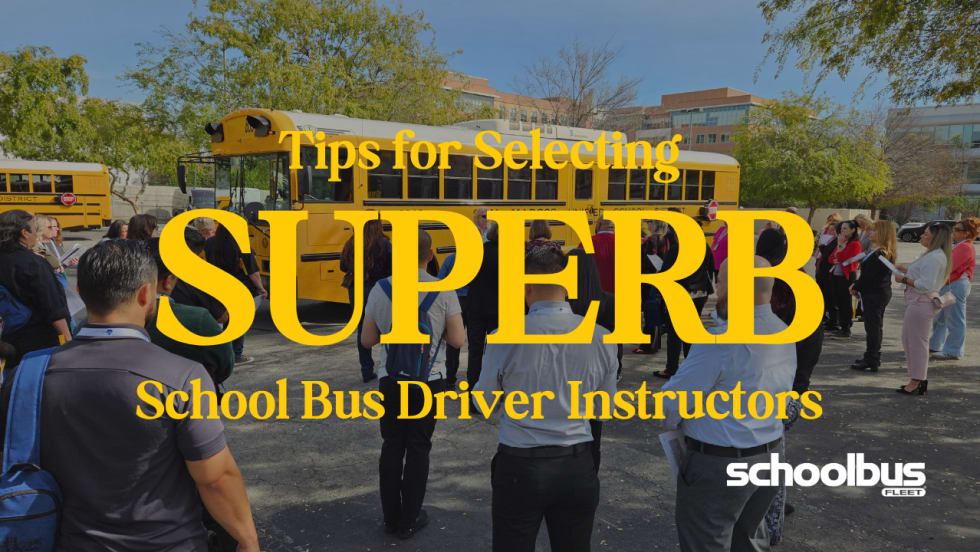
What Makes a Great School Bus Driver Trainer?
Choosing the right school bus driver trainer takes more than experience. Learn six keys to selecting and developing trainers and evaluating program effectiveness.
Read More →


School Bus Contractors Expand Through New Deals, Acquisitions & Partnerships
STA's Canadian division acquires Ontario-based G&L Stevenson Transport while Durham School Services adds a new district contract in California, First Student adds a New Jersey contract, and Minnesota Coaches acquires Halo Transportation.
Read More →
Logan Bus Company Rolls Out AI Phone System for NYC School Bus Families
A summer pilot found that AI agents could handle most routine calls, freeing up time for customer service staff to focus on emergencies and complex family concerns.
Read More →
From Intent to Impact: What I Learned About Leadership from TAPT
A Texas transportation supervisor shares lessons on self-awareness, accountability, managing stress and building trust — and why investing in leadership development matters at every stage of your career.
Read More →
NAPT Names 2026 Award Recipients, Hall of Fame Inductee
Who earned national recognition for their work in student transportation? This year, NAPT named five recipients of its 2026 awards for service, safety, and leadership, plus its newest Hall of Famer.
Read More →
Sponsored•September 2, 2026
2026 State of Student Transportation Report
Driver shortages. Rising costs. Growing safety expectations. More data, but not enough time to act on it. The 2026 State of Student Transportation Report reveals what transportation leaders say is putting the most pressure on their operations—and where they’re investing next. See how your priorities compare.
Read More →
How to De-Escalate an Angry Person: 5 Steps for Handling Workplace Conflict
What makes emotions run high, and how should you handle an angry colleague or parent? Follow these steps for staying calm, listening, showing empathy, and resolving conflict.
Read More →
Sponsored•September 1, 2026
What Readiness Looks Like This School Year
Learn about the challenges shaping the 2026–2027 school year, from persistent driver shortages and budget pressure to technology and readiness gaps. See how school districts are responding and adapting in Zonar’s 2026 Back-to-School Readiness Report.
Read More →