




Watch videos of the new bus boarding procedure at Wake County Public School System
North Carolina approves revised school bus crossing procedure
The state’s board of education approved policy revisions requiring bus drivers to use hand signals to help students safely cross the street and for student safety training to be documented.

Nicole Schlosser・Former Executive Editor
3 min to read
RALEIGH, N.C. — North Carolina approved policy revisions governing school bus riders last week requiring bus drivers to use hand signals to help them safely cross the street and for student school bus safety training to be documented.
The North Carolina State Board of Education’s revised policy now requires all school bus drivers to use standard hand signals to let students know when it’s safe for them to cross the street. The first hand signal will tell students to wait to cross. The second signal, a “thumbs-up,” will let them know that they can cross the street, according to WNCN.
The new hand signal requirement is designed to accomplish two objectives: empowering the bus driver to ensure it is safe for students to step into the street, and making students stop and think, by looking at the school bus driver before they step into the street, according to the North Carolina State Board of Education.
The revision was prompted by statewide incidents in which five students were injured by motorists passing stopped school buses this year.
“Although there were no fatalities this year, it has been a particularly bad year for stop arm violation injuries,” said Derek Graham, North Carolina state director.
Another reason for the revisions: state data since 1998 show that over 3,000 cars per day do not stop for stopped school buses with their stop arms extended, and the state has had a number of fatalities.
“Public awareness has not been enough, so we have been moving for a few years toward implementation of the signal,” Graham explained.
Use of the hand signal is consistent with federal Commercial Driver’s License (CDL) requirements and the National School Transportation Specifications and Procedures. The signal that the North Carolina State Board of Education selected to tell students to wait before crossing the street is similar to one used successfully in New York, Graham said.
Part of the revised policy, in addition to requiring the use of the hand signals, is that school districts will now have to document the school bus safety training they provide to students and the date on which the training was provided. The revision also requires that students who do not ride the school bus also receive safety training.
Implementation statewide is not required until January, so some districts will phase in the training between now and then, but most training will likely take place before school starts next month, Graham said.
Similarly, Wake County Public School System recently implemented a new safety procedure requiring bus drivers to use a switch to extend the bus’ stop arm and turn on the red flashing lights, and then check traffic before deploying the crossing bar and opening the doors, according to WRAL.
Graham noted that the board’s revision is designed to bolster school bus drivers’ efforts to keep students safe.
“Since we know that public awareness efforts alone are not eliminating the problem, this policy revision empowers the school bus driver to get involved and protect kids in spite of the negligent actions of motorists,” Graham said.
More Safety

How to Build a Better School Bus Driver Training Program
Is it time to strengthen your driver training? Here’s how to pick the right talent and improve recruitment, retention, and safety. This video is brought to you by IC Bus.
Read More →
Recent School Bus Accidents Leave 2 Dead, 2 Injured
Four school bus crashes in Florida, Illinois, and Georgia highlight risks in transportation lots, at bus stops, and during student loading and unloading.
Read More →
Sponsored•September 8, 2026
When Every Second Matters, Clarity Keeps Routes Moving
From routine delays to urgent incidents, strong communication practices help drivers, dispatchers, schools, and families respond with confidence.
Read More →

What Happens When a School Bus Catches Fire — and What Can Help
School bus fires are rare but can be devastating. Learn how advances in fire suppression and asset protection help fleets detect fires earlier, reduce damage, and improve safety.
Read More →
Geotab Launches Tool to Help Fleets Investigate Road Incidents
Geotab Investigations combines telematics data, video, documents, and other evidence to help fleets reconstruct incidents, resolve claims, and determine what happened.
Read More →
Texas Sixth Grader Wins 2026 National School Bus Safety Poster Contest
Sai Darshana Yekolu of Moseley Middle School in Prosper, Texas, was named the newest winner for her artwork, bringing the theme of “Safe Rides, Everyday Heroes” to life.
Read More →
Sponsored•August 27, 2026
Doing More With Less: How Transportation Directors Can Prioritize Safety Amid Budget Uncertainty
With diesel prices soaring and nearly one-third of transportation directors expecting budget cuts, maintaining student safety has never been more challenging. Download this guide to learn how leading districts are prioritizing risk, funding critical safety technology, and building stronger budget cases with data.
Read More →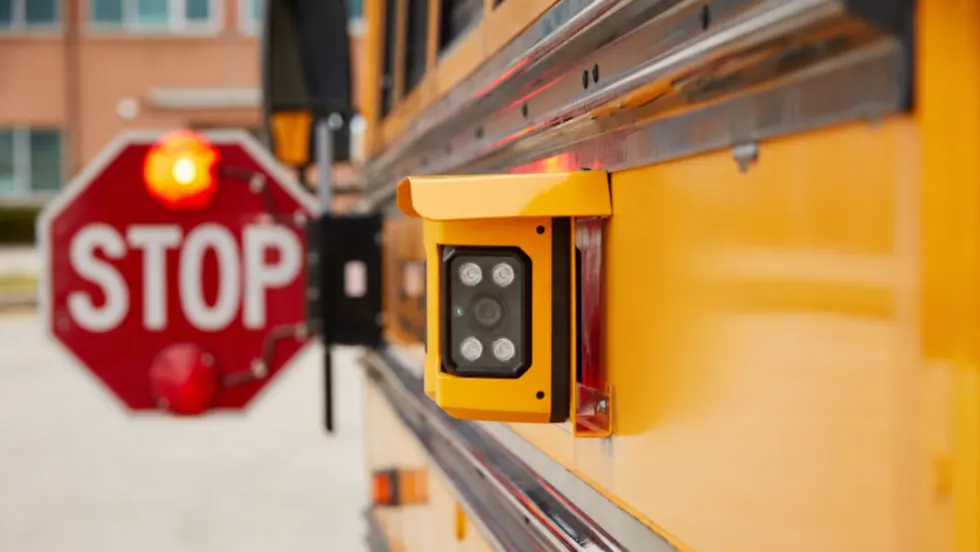
Walton County Schools Adds Gatekeeper Stop-Arm Enforcement System
The Florida district will deploy Gatekeeper’s updated Student Protector technology, which now incorporates AI to improve video evidence.
Read More →
How To Build a More Secure School Bus Yard During and After Hours
As thefts and overnight security threats continue, school transportation leaders are combining stronger operational practices with AI-enabled surveillance to better protect buses, facilities, and staff.
Read More →
FMCSA Names New Chief Safety Officer: What School Bus Operators Should Know
Steve Dowling is set to lead the federal agency's efforts to advance commercial motor vehicle safety and reduce crashes, fatalities, and injuries on the nation's roadways.
Read More →