




Nonprofit helps district add propane buses, save money
Clean Fuels Ohio helped Pike-Delta-York Schools obtain funding to buy three propane buses and build a propane fueling station. The district is seeing annual reductions in fuel and operating costs.

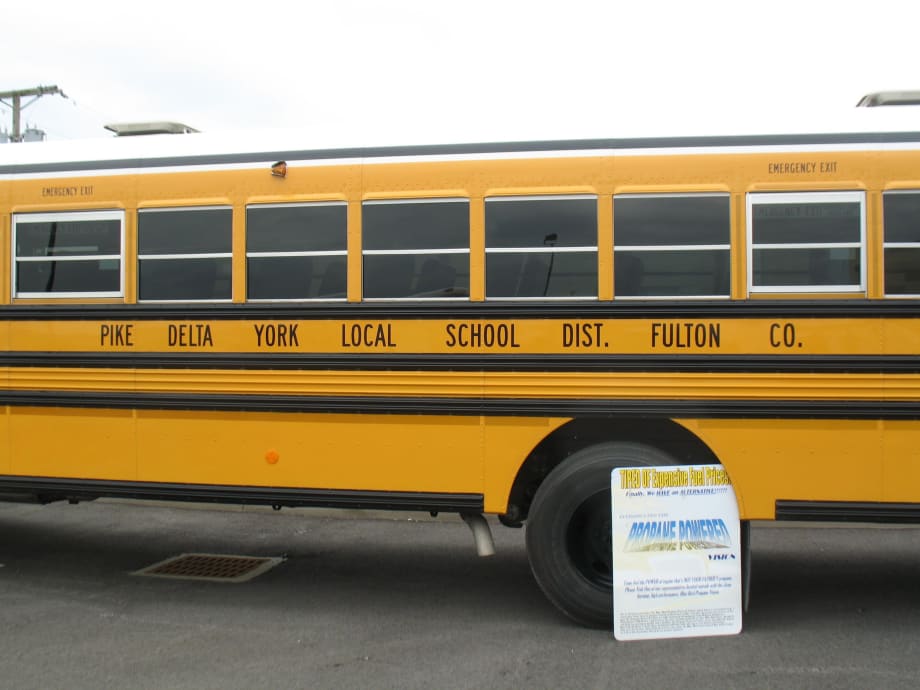
Clean Fuels Ohio helped Pike-Delta-York Schools obtain federal funding to buy three propane buses and build a propane fueling station on their property.
COLUMBUS, Ohio — Pike-Delta-York (PDY) Schools in Northwest Ohio partnered with Clean Fuels Ohio, a nonprofit organization, to find a solution to their financial struggles when it came to keeping their transportation up and running.
A dire projection for transportation funding at PDY, a 1,300-student public school district, opened the door to an investigation of alternatively fueled school buses and a new directive for cost savings, according to Clean Fuels Ohio.
In 2009, the PDY school district was struggling financially. PDY Transportation Supervisor Jim Wolpert was told to get by with his current fleet, or find an alternative way to get what he needed, according to the nonprofit. At the same time, a PDY board member was learning about the benefits of propane autogas at a Propane Education and Research Council conference.
“No one in our region was using alternative fuels at the time, so we had no benchmark to measure against,” Wolpert said. “We learned a great deal from the propane council, and we were able to see several fuels demonstrated by bus manufacturers. But we needed to locate funding sources for our own fleet and fueling infrastructure.”
In addition, the school board and community were skeptical about the costs of converting to alternatively fueled school buses, as well as the reliability of the buses themselves. Ultimately, the district’s proposal for securing three new propane buses was approved by a 3-2 margin by the PDY board of education.
Clean Fuels Ohio helped PDY locate and complete grant applications. “We received notice of federal funding in August 2009, and PDY was one of the first project partners to complete its grants application,” explained Megan Stein, Clean Fuels Ohio grants manager. “We worked with the district to identify which grants would be most advantageous to the school, and then assisted PDY with all the details. Funding was awarded to the district in early 2010.”
A key advantage of the grant funding was that it included funds for the development of a propane fueling station. “We had just had to remove a diesel tank from our property, and were fueling our diesel buses at a nearby retail gasoline station,” Wolpert said. “The grant timing was perfect, because we were able to build a new propane station on our property.”
PDY students are fans of the new propane buses, and the community and school board are also seeing the benefits of the program, especially in the district’s return on investment.
“The kids are truly excited about riding in a bus that uses alternative fuels,” said Wolpert. “They tell their parents, ‘We have a green bus,’ and their parents call me to learn more about the program.”
The PDY program is seeing a reduction in fuel and operating costs annually. The program has been the subject of a lot of discussion among schools in the region, and Wolpert has also fielded calls from Michigan, New York, Texas and Washington on the benefits of propane to other school districts.
Locally, the emphasis is still on the bottom line. “These programs are ultimately funded by the people in our community,” Wolpert said. “There has been a change in thinking about alternative vehicles over the years. In the future, school districts will still be looking to save money, but they’ll also be focused on doing the right thing.”
More Alternative Fuels
Alt-Fuel Moves: Electric Bus Rollouts, Bidirectional Charging & Propane Growth
See which fleets are adding electric and propane school buses as districts and operators invest in charging infrastructure, bidirectional technology, and alternative-fuel expansion.
Read More →
Nobody Told Diesel Prices They Were Supposed to Come Down
With diesel prices surging, school bus fleets have new reason to stress-test fuel costs, consider diversification, and calculate what each route really costs to operate.
Read More →
Why Gasoline School Buses Are Making a Comeback
Gasoline is gaining ground in full-size school buses. See how today’s options stack up against diesel on cost, maintenance, emissions, performance, and more.
Read More →
EPA Opens $180M DERA Funding Round for Diesel Upgrades
The 2026 Diesel Emissions Reduction Act program seeks applications from eligible organizations to accelerate the retirement of legacy diesel vehicles.
Read More →
The Secret Life of an Electric School Bus Battery
Batteries change throughout years of daily routes, but degradation doesn’t necessarily mean the end. Here’s what operators should know about performance, safety, and second life.
Read More →
CALSTART and Forth Combine to Form Catalyst Mobility
The new name represents a renewed vision for the nonprofit focused on advancing clean, equitable, and affordable transportation solutions that move people and goods.
Read More →
Alt-Fuel Moves: New Buses, Charging Hubs & Real-World EV Testing
Propane and electric school bus deployments continue to grow as districts add new vehicles, expand charging infrastructure, and gather more real-world operating data.
Read More →
Fewer Electric School Bus Models Reshape the U.S. Market
WRI’s latest buyer’s guide points to a consolidating electric school bus market, but fewer options may reflect a maturing industry rather than fewer meaningful choices for school bus operators.
Read More →
The Fuel Budget You Can Actually Predict: How Propane Autogas Keeps Money in the Classroom
Learn how propane autogas helps school districts manage fuel costs with predictable pricing, lower maintenance, and reduced emissions from former transportation director Joel Stutheit.
Read More →
Hendrickson, Driventic Introduce New Electric Powertrain for School Buses
ELECTRAAX, the electrified, lightweight drive axle offers integrated ePowertrain efficiency and modular flexibility for Class 6–7 school bus use.
Read More →