





MANAGING THE MILES: Telematics and School Bus Fuel Efficiency
New York School Bus Contractors to Transition to Electric After Settlement
Details on the requirements in the settlement. Plus, a look at what New York law says about idling.
July 11, 2024
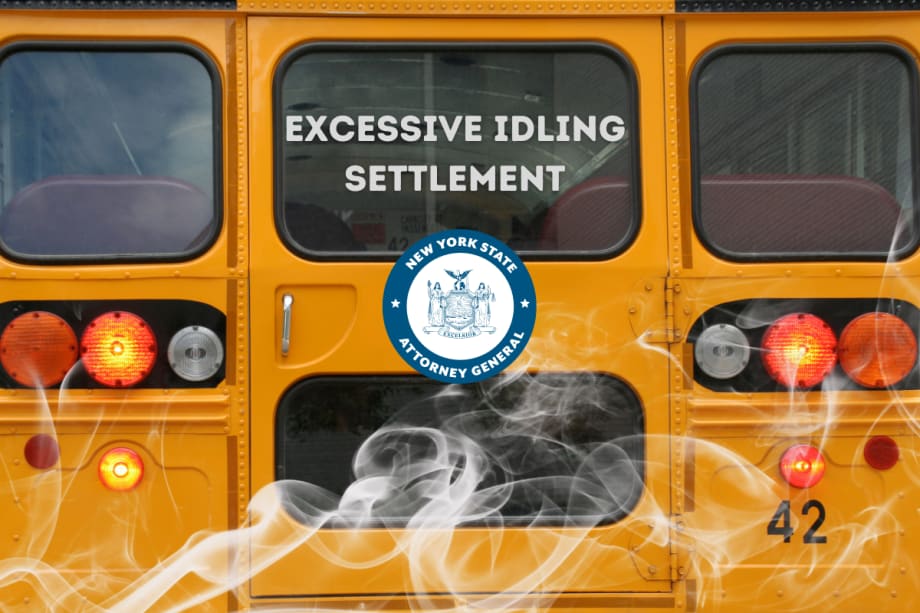
In addition to committing to electrifying their fleets, the four contractors will also install automatic idling shut-off timers on their remaining traditional buses and implement anti-idling training for drivers.
Photo: New York State Attorney General/School Bus Fleet
5 min to read
The New York Attorney General's Office has settled with four bus companies accused of illegal excessive idling at bus yards in communities of color and low-income communities in Brooklyn, Queens, the Bronx, and on Staten Island.
The companies include Consolidated Bus, Logan Bus Company, Pioneer Transportation, and Total Transportation. Each will be required to invest up to $2 million to purchase new electric buses or repower some of their current fleet.
Companies Accused of Excessive Idling
According to a news release, the Office of the Attorney General (OAG) alleged that the four companies violated New York laws by allowing school buses to idle for extended periods of time at their bus yards. Emissions from buses and cars are the largest contributor to air pollution in New York.
Depending on the number of alleged instances of illegal idling, the companies will each invest at least $300,000 and up to $2 million to purchase new electric school buses or repower existing traditional school buses.
The companies will also install automatic idling shut-off timers on their remaining traditional buses and implement anti-idling training for drivers.
"School bus companies play an important role in getting children to and from school safely, but they should be able to do so without polluting our communities,” Attorney General Letitia James said. “New Yorkers are already suffering the health consequences of air pollution, and these bus companies all operate bus yards in low-income communities and communities of color that are already bearing the disproportionate impacts of this pollution. We must do everything we can to protect the health of our children and our planet, and my office will always fight against environmental injustice.”
According to the settlement , in 2018, the OAG began investigating what it alleged to be the unlawful idling. That was made easier by a 2019 requirement from the New York City Department of Education (NYCDOE) for the installation of telematics devices on all school buses that transport New York City public school students.
The devices continuously record engine operation data and bus location when the buses were operating but not moving. Data provided by the fleet management system reportedly indicated that the companies had all repeatedly exceeded idling limits at their bus yards.
Some of the contractors dispute the accuracy and reliability of the data, according to the settlement. Additionally, the contractors contend that they did not break excessive idling laws.
Most of the bus yards are located in areas identified by the New York State Department of Environmental Conservation (DEC) as potential “environmental justice areas,” or neighborhoods that are disproportionately impacted by environmental harms such as air pollution.
The companies’ bus yards are sometimes clustered together in these neighborhoods, exacerbaing their negative impacts on the surrounding community.
What the Law Says
New York law prohibits idling for over five minutes, while New York City law prohibits idling for more than three minutes, or one minute when the vehicle is near a school building. According to the U.S. Department of Energy, manufacturers also generally recommend idling remain limited to five minutes or less.
The OAG investigation focused on instances of idling for periods of more than two hours in the early morning to rule out instances where extended idling might be allowed under the law due to other circumstances, such as traffic or picking up and dropping off students.
Emissions from cars, trucks, and buses are one of the leading sources of air pollution in New York state. Idling is a significant source of these emissions, with an estimated 130,000 tons of carbon dioxide emitted in New York City alone each year.
According to the OAG, emissions from diesel-powered vehicles like buses are particularly harmful to the communities surrounding bus yards because they emit fine particulate matter that has been linked to numerous problems, including asthma, cancer, and heart disease.
The health impacts of air pollution are disproportionately felt in low-income communities and communities of color in New York City, which are often home to bus yards and other high-emission facilities like power plants located in close proximity to residential neighborhoods.
“New York City’s low-income communities and communities of color continue to be overburdened by pollution, causing serious ongoing harm to residents’ health,” said Eddie Bautista, Executive Director at New York City Environmental Justice Alliance. “Excessive idling and other vehicle emissions are major contributors to this pollution, spewing dangerous contaminants into our air and fueling the climate crisis. We applaud Attorney General James for fighting for healthy air in our communities by holding these school bus companies accountable for illegal idling and speeding their transition into a clean electric bus fleet."
Idling Facts and Fiction
The U.S. Environmental Protection Agency recently busted myths related to idling on school buses, with the following facts:
Despite a widely held belief that restarting an engine produces more pollution than idling, continuous idling for more than three minutes emits more particulate matter than a restart. Emissions after a restart contain less carbon monoxide, nitrogen oxides, and other pollutants than if the school bus idled continuously over a 10-minute period.
Keeping an engine running at low speed — idling — causes twice the wear on internal parts as driving at regular speeds.
School bus engines don't need more than a few minutes to warm up.
Idling is not necessary to keep the cabin comfortable. Many buses maintain a comfortable interior temperature for awhile without idling. Additionally, fuel-operated heaters can help keep the cabin comfortable in colder climates.
More Alternative Fuels

CALSTART and Forth Combine to Form Catalyst Mobility
The new name represents a renewed vision for the nonprofit focused on advancing clean, equitable, and affordable transportation solutions that move people and goods.
Read More →
Alt-Fuel Moves: New Buses, Charging Hubs & Real-World EV Testing
Propane and electric school bus deployments continue to grow as districts add new vehicles, expand charging infrastructure, and gather more real-world operating data.
Read More →
Fewer Electric School Bus Models Reshape the U.S. Market
WRI’s latest buyer’s guide points to a consolidating electric school bus market, but fewer options may reflect a maturing industry rather than fewer meaningful choices for school bus operators.
Read More →
The Fuel Budget You Can Actually Predict: How Propane Autogas Keeps Money in the Classroom
Learn how propane autogas helps school districts manage fuel costs with predictable pricing, lower maintenance, and reduced emissions from former transportation director Joel Stutheit.
Read More →
Hendrickson, Driventic Introduce New Electric Powertrain for School Buses
ELECTRAAX, the electrified, lightweight drive axle offers integrated ePowertrain efficiency and modular flexibility for Class 6–7 school bus use.
Read More →
The Mobility House Joins PowerFlex in Fleet Electrification Deal
The acquisition combines intelligent charging software, bidirectional charging expertise, and fleet electrification services to support the growing adoption of electric school buses across North America.
Read More →
Alt-Fuel Moves: Electric School Bus Investments Hit the Road
See which districts across the U.S. are putting electric school buses into service, expanding charging infrastructure, and planning the next phase of fleet electrification.
Read More →
With Fuel Volatility Ahead, School Districts Turn to Propane
While diesel prices peaked above $5 this spring, districts with propane autogas-powered fleets paid under $2 per gallon, according to PERC.
Read More →
EPA Unveils Proposed Changes to 2027 Heavy-Duty Engine Rules
The federal agency has proposed changes to next year’s targets that would eliminate DEF derates, ease warranty requirements, and retain current NOx emissions standards.
Read More →
Alt-Fuel Moves: EV Charging & Infrastructure Projects Gain Momentum
The latest developments include new funding, charging infrastructure, utility investments, and fleet technologies designed to support the transition to electric school buses nationwide.
Read More →