




New York City Advances School Bus Service Oversight Bills
The Student Transportation Oversight Package (STOP) increases reporting requirements for the city’s Department of Education and requires two-way radio and GPS systems on all school buses.

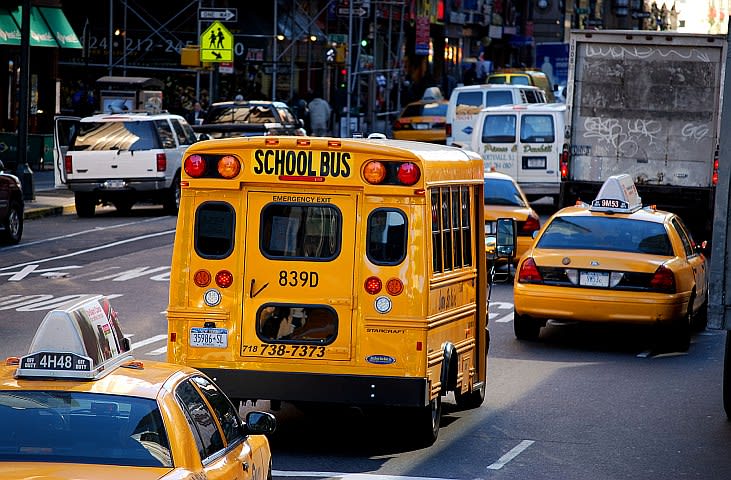
The New York City Council advanced several bills that aim to increase oversight of various aspects of school bus service, including how routing and complaints are handled and requiring GPS on all buses. File photo courtesy Katrina Falk
The New York City Council advanced several bills that aim to increase oversight of various aspects of school bus service, including how routing and complaints are handled and requiring GPS on all buses. File photo courtesy Katrina Falk
NEW YORK CITY — The city council voted on Wednesday to advance several bills that aim to increase oversight of various aspects of school bus service, including how routing and complaints are handled and requiring GPS on all buses.
The Student Transportation Oversight Package (STOP) increases reporting requirements for the New York City Department of Education (DOE), such as mandating that it report on policies and goals related to providing school bus service, the duration of school bus routes, bus delay frequency, and complaints about routes, bus employees, and other school bus services, according to a news release from the New York City Council. The package also includes a bill that requires the DOE to create and distribute a school bus transportation guide.
Another bill in the package requires the placement of two-way radio and GPS systems on school buses. Authorized parents and guardians would also be given access to the real-time location of their child’s school bus whenever it is in use.
All of the city’s 10,000 school buses will need to have the system installed by September, according to WABC, and 6,000 of those buses are currently equipped with the technology.
Additionally, the council advanced legislation that would require the Department of Records and Information Services (DORIS) to list city agency reports on its website, and on legislation that would clarify, for the purposes of enforcing prohibitions against unauthorized commuter van services, that definitions of “for-hire vehicle” and “commuter van” do not include a bus service operating pursuant to a contract with any government.
“Many of our city’s families rely on school buses to get their children to and from school in a safe and timely manner, and they deserve better than the dismal conditions and service they faced at the start of the school year and during Winter Storm Avery,” said Council Member Mark Treyger, chair of the Committee on Education. “This legislation will provide access to comprehensive data about our city’s school transit services, creating the layers of transparency and accountability we need to work towards a safer way of getting our kids to and from school with dignity and respect.”
Below are more details on some of the bills of note in the package:
• Introduction 89-C would require the DOE to report twice a year on the number of school bus routes scheduled to take less than an hour, between one and two hours, and over two hours, and the average length of time scheduled for school bus routes in each community school district. The bill would also require the DOE to share actual school bus transportation times, as recorded by GPS trackers, with the council twice a year.
• Introduction 451-B would require the DOE to distribute a school bus ridership guide in hard copy and electronically to all students and parents. This guide would include a description of eligibility for school bus services, what the services entail, information for parents and students living in temporary housing and students in foster care, and the responsibilities of students and parents using DOE’s school bus services.
• Introduction 926-B would require the DOE to share with parents and post on its website how they can file a complaint about a school bus employee, the process by which the department investigates such a complaint, and the possible results of such an investigation. The bill also requires DOE to share the protocols for school bus services in inclement weather emergencies.
• Introduction 929-B would require the DOE to report twice a year on all of the calls and complaints received from parents and guardians about school bus services; the investigations DOE opened into school bus employees; the number of those investigations that were substantiated; and a description of outcomes taken by DOE in the event of a substantiated investigation.
• Introduction 1148-B would require the DOE to report twice a year on how school bus routes are determined, goals for time limits for bus routes, and any other goals relating to school bus services. This bill would also require the DOE to report twice a year a list of school bus vendors who completed a dry run of their route as required by their contract, and those bus vendors who are not in compliance with their contractual obligations to complete dry runs.
The bill would also require the DOE to share with parents and guardians before the start of the school year their child’s bus route, scheduled arrival and departure times, the vendor assigned to such route, and how a parent can appeal or make a request about the route. The bill would also require the DOE to let parents know daily if their child’s bus is late arriving to or departing school.
• Introduction 1173-B would require the DOE to report twice a year on its school bus services, including vendors providing school bus transportation to students, the number of vehicles and employees used by those vendors, the number of bus routes and transportation sites in use, the number of students using school bus transportation, including the type of students, and the categories of students who are eligible for DOE transportation services. The bill would also require the DOE to report twice a year on the frequency of school bus delays and no-shows.
The package now awaits Mayor Bill DeBlasio’s signature.
More Management

Inside NAPT ACTS 2026: Highlights from Louisville
From federal updates and student behavior strategies to new school bus technology and industry awards, see highlights from NAPT ACTS 2026 in Louisville.
Read More →
Meet the 2025 School Bus Driver Hero Winner: Annette Brown
We caught up with Wa-Nee Community Schools' Annette Brown on site at SBFX, where she was named the 2026 School Bus Driver Hero Award winner. Hear about her reaction, what she loves most about being a school bus driver, and more!
Read More →
Predictability Is Like Ketchup (According to 6-Year-Olds)
To students, a different school bus can feel like a full-blown crisis. One driver reflects on why familiar routines, showing up on time, and being reliably boring matter more than we think.
Read More →
Samsara Launches Free Driver Rewards Program
The new Driver Perks program gives eligible professional drivers access to discounts and offers without adding a cost for participating fleets.
Read More →
How Tax-Exempt Municipal Leases Can Help Finance School Buses
Let’s explore school bus financing options, including municipal leases, vendor payable accounts, and balloon payments, and how they can help stretch fleet budgets.
Read More →
Nominate Rising School Transportation Pros Under 40!
We’re searching for the next generation of leaders making an impact across the K-12 student transportation industry to recognize as SBF’s 2027 Trailblazers. Nominations are open now!
Read More →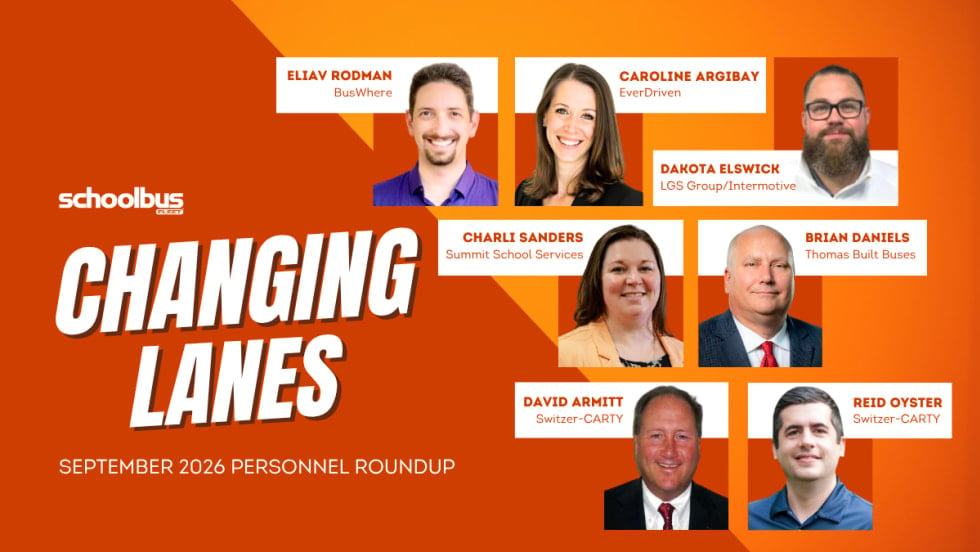
Changing Lanes: BusWhere, EverDriven, InterMotive, Summit School Services, Switzer-Carty & Thomas Built Buses
Check out who's been hired, promoted, and appointed to leadership positions at various school transportation suppliers, contractors, and manufacturers.
Read More →
The Most Expensive Thing You Do Before Selling a School Bus: Wait
When should you sell an aging school bus? Learn how maintenance, mileage, corrosion, specifications, and timing can affect resale value long before the auction.
Read More →
American Student Transportation Partners Acquires AJ Myers and Sons
A new deal brings a 75-year Pennsylvania student transportation provider into one of the nation’s largest private school bus contracting groups.
Read More →
What I Brought Home From SBFX: Relationships, Leadership, and Preparing What's Next
Who could lead your transportation operation tomorrow if you couldn't? Bernando Brown explores succession planning, mentorship, and preparing emerging leaders to step up.
Read More →