




Navistar San Antonio Plant Showcases Latest Manufacturing Tech
Navistar showed off its new San Antonio Manufacturing Plant March 23, holding it up as an example of the latest, most high-tech and sustainable manufacturing techniques.

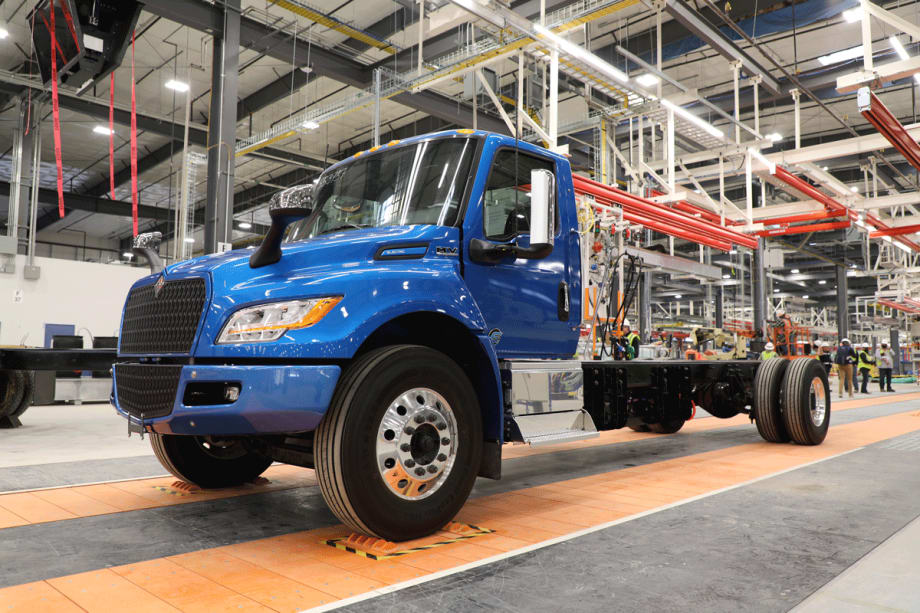
Navistar's new San Antonio Manufacturing Plant will build both electric and internal-combustion Class 6-8 vehicles.
Photo: Navistar
Navistar showed off its new San Antonio Manufacturing Plant to reporters March 23, holding it up as an example of the latest high-tech, sustainable manufacturing techniques. The factory is set to hit full capacity this summer.
The nearly 1-million-square-foot manufacturing facility includes a body shop, paint shop, general assembly shop, and logistics center equipped to produce Class 6-8 vehicles, including electric vehicle models. The plant has been up and running since January, and the first truck off the line was a battery-electric medium-duty International eMV.
Based in Lisle, Illinois, Navistar builds International and IC Bus vehicles.
The company said the San Antonio plant will provide benchmarks in process optimization, real-time production management, and sustainability, according to a news release. The facility improves quality, lowers costs, and provides capacity support to Navistar’s current manufacturing footprint.
This is the first commercial truck assembly plant in the U.S. since the early 1990s, according to Navistar CEO Mathias Carlbaum. (Kenworth's Renton, Washington, plant opened in 1993.)
He also said that by 2030, more than 50% of the vehicles that leave the new San Antonio manufacturing plant will be zero-emission vehicles.
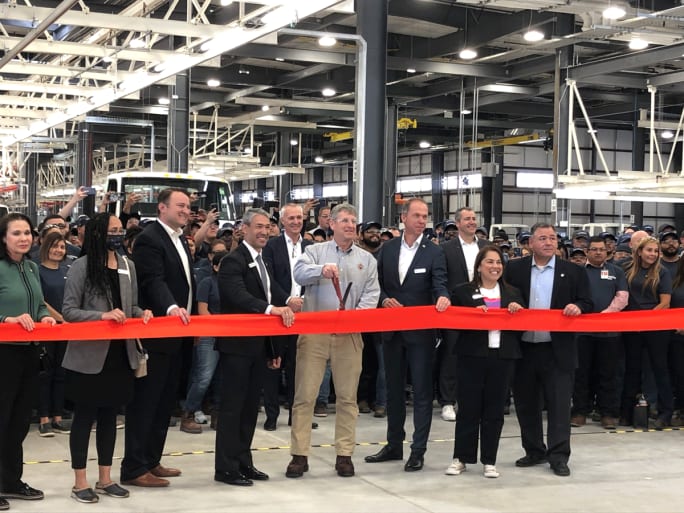
A March 23 ribbon-cutting was the formal opening of the new Navistar plant, which has been ramping up production since January.
Photo: Jim Park
“The choices we make today will take Navistar to a new level of impact in the transportation industry,” said Mark Hernandez, executive vice president, Global Manufacturing and Supply Chain. “That's why we are laying the foundation for the future in this plant, because the future begins with the decisions and investments we make today.
“The San Antonio manufacturing plant was meticulously planned and constructed to highlight our many manufacturing strengths and build toward future manufacturing goals surrounding Industry 4.0 technologies, quality and sustainability.”
“Industry 4.0” is a term being used for what many see as a new industrial revolution — where manufacturers integrate new technologies, advanced manufacturing techniques, the Internet of Things, cloud computing and analytics, and AI and machine learning into their production facilities and operations.
Examples of the concept at the San Antonio plant include automated guided vehicles that shuttle cabs and engines throughout the plant, and computer monitors that plant personnel use to get information on a truck’s build and parts during each step of the assembly process.
Fit for the Future
The San Antonio Manufacturing Plant was constructed with efficient energy use goals in mind. As part of the U.S. Department of Energy’s Better Buildings, Better Plants Program, Navistar is committed to reducing energy intensity in San Antonio and other U.S. plants by 20% by 2030. LEDs illuminate the plant, using 75% less power than conventional lighting, and translucent panels allow natural light to brighten the indoor space as a supplement to the lighting system. The building also includes energy-efficient wall paneling to better regulate indoor temperatures.
Fuel-cell forklifts will replace all-electric models, with hydrogen produced on site.
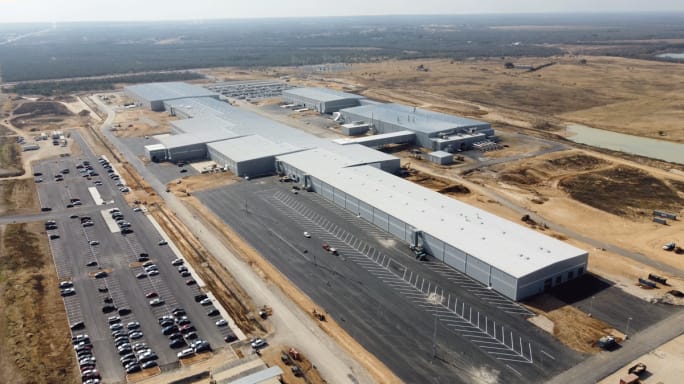
The Navistar San Antonio Manufacturing Plant is a nearly 1-million-square-foot manufacturing facility, which includes sustainable operation techniques and Industry 4.0 technologies.
Photo: Navistar
The plant also will serve as Navistar’s benchmark for lean manufacturing principles to eliminate waste, improve product quality, drive operational efficiency, and reduce cost and time. Industry 4.0 principles have been incorporated to connect digital and physical technologies, allowing the plant to be more connected and easily make data-driven decisions.
“We are incorporating the latest manufacturing principles – digital factory, connected machinery, robust lean manufacturing processes and cloud analytics – to enable predictive quality and maintenance, and allowing data-driven decisions to be made on the shop floor in real time,” said Hernandez.
The San Antonio Manufacturing Plant complements Navistar’s existing assembly manufacturing footprint, which includes truck assembly plants in Springfield, Ohio, and Escobedo, Mexico; a school bus assembly plant in Tulsa, Oklahoma; and a powertrain manufacturing plant in Huntsville, Alabama. The sustainable manufacturing processes will be integrated in all existing manufacturing plants.
In the future, Navistar plans to begin operations at the Advanced Technology Center on-site, which accelerates implementation of emerging technologies and Industry 4.0 technologies within the commercial trucking space. The ATC is focused on product development, testing and validation efforts supporting the company’s strategy, and will be a key location for future research and development footprint with a focus on zero-emission components, software and autonomous technologies.
[Editor's Note: This article was updated March 24 at 11:10 a.m. EDT to correct the model name of the first truck off the manufacturing line, and at 1:20 EDT to correct how long it's been since the opening of a new U.S. truck manufacturing plant.]
Originally posted on Heavy Duty Trucking
More Management

How to Build a Better Driver Training Program
Ready to boost up your school bus instructor training? Here’s how to pick the right talent and improve recruitment, retention, and safety.
Read More →
CALSTART and Forth Combine to Form Catalyst Mobility
The new name represents a renewed vision for the nonprofit focused on advancing clean, equitable, and affordable transportation solutions that move people and goods.
Read More →
What Makes a Great School Bus Driver Trainer?
Choosing the right school bus driver trainer takes more than experience. Learn six keys to selecting and developing trainers and evaluating program effectiveness.
Read More →

School Bus Contractors Expand Through New Deals, Acquisitions & Partnerships
STA's Canadian division acquires Ontario-based G&L Stevenson Transport while Durham School Services adds a new district contract in California, First Student adds a New Jersey contract, and Minnesota Coaches acquires Halo Transportation.
Read More →
Logan Bus Company Rolls Out AI Phone System for NYC School Bus Families
A summer pilot found that AI agents could handle most routine calls, freeing up time for customer service staff to focus on emergencies and complex family concerns.
Read More →
From Intent to Impact: What I Learned About Leadership from TAPT
A Texas transportation supervisor shares lessons on self-awareness, accountability, managing stress and building trust — and why investing in leadership development matters at every stage of your career.
Read More →
NAPT Names 2026 Award Recipients, Hall of Fame Inductee
Who earned national recognition for their work in student transportation? This year, NAPT named five recipients of its 2026 awards for service, safety, and leadership, plus its newest Hall of Famer.
Read More →
2026 State of Student Transportation Report
Driver shortages. Rising costs. Growing safety expectations. More data, but not enough time to act on it. The 2026 State of Student Transportation Report reveals what transportation leaders say is putting the most pressure on their operations—and where they’re investing next. See how your priorities compare.
Read More →
How to De-Escalate an Angry Person: 5 Steps for Handling Workplace Conflict
What makes emotions run high, and how should you handle an angry colleague or parent? Follow these steps for staying calm, listening, showing empathy, and resolving conflict.
Read More →
What Readiness Looks Like This School Year
Learn about the challenges shaping the 2026–2027 school year, from persistent driver shortages and budget pressure to technology and readiness gaps. See how school districts are responding and adapting in Zonar’s 2026 Back-to-School Readiness Report.
Read More →