




National Pupil Transportation Associations Release School Reopening Resource Report
“Guidelines, Tactics, and Templates: A Reopening Plan Resource for School Transportation Professionals” is now available.
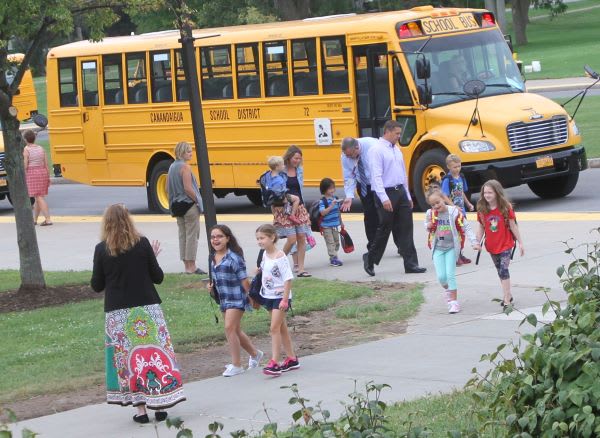
The STARTS Task Force has released its report, “Guidelines, Tactics, and Templates: A Reopening Plan Resource for School Transportation Professionals.”
File photo courtesy Scott Goble
The task force formed by three major national pupil transportation associations to offer practical information for student transportation providers during the COVID-19 pandemic as they prepare for when schools reopen released a report on Friday.
As previously reported, the National Association for Pupil Transportation (NAPT), National Association of State Directors of Pupil Transportation Services (NASDPTS), and National School Transportation Association (NSTA) formed the Student Transportation Aligned for Return To School (STARTS) Task Force in May.
The report, “Guidelines, Tactics, and Templates: A Reopening Plan Resource for School Transportation Professionals,” is a comprehensive narrative that is intended to assist school transportation professionals navigate the challenges facing them as a return to classroom learning is contemplated, according to a news release from the task force. It is also available on the task force website (www.STARTSTaskforce.com).
“The information and resources that are included with the task force report are intended to allow transportation professionals to support their local school reopening strategies by providing important content in one centralized location,” said Tim Ammon, co-founder of Decision Support Group and co-manager of the Task Force.
The STARTS Task Force was created by the school bus industry’s three leading associations to help transportation professionals across the country respond to the challenge of the return to classrooms and school buildings this fall. The task force was charged with designing a product that would be useful to both public and private school bus operations. Currently, educational community stakeholders are operating on a compressed timeline in preparing for school reopening this fall, and the task force sought to provide school bus operators with as much detailed information as possible as transportation decisions were being considered and made at the state and local levels.
“The challenge of school reopening plans from the student transportation lens is that there cannot be one single, one-size-fits-all approach,” said Jim Regan of CapitalWorks Consulting Group, also co-manager of the task force. “Therefore, we considered the pertinent issues from many different perspectives, and the report reflects that mindset.”
More than 75 volunteers contributed to the process of considering guidelines contained in reopening plans developed by state education and health officials across all 50 states. Overall, the task force efforts were targeted at minimizing the risk of students and employees contracting and transmitting the novel coronavirus (COVID-19) across all the different school transportation scenarios.
“Some of the existing solutions proposed to assist with the return-to-school process from the transportation side were well intentioned, but the task force was mindful that existing safety rules and regulations needed to be followed,” said Charlie Hood, executive director of NASDPTS.
The report outlines 27 separate guidelines integral to the return-to-school process.
“Safe, reliable, and efficient transportation is and always has been integral to education but perhaps more so now than ever,” said Curt Macysyn, executive director of NSTA. “Even considering the COVID-19 pandemic, we strongly believe that the yellow bus still provides the safest transportation option for students to return to the classroom.”
“Reopening schools in the midst of a pandemic is a massive and complex undertaking,” said NAPT executive director Mike Martin. “We hope this product will help school transportation professionals get school buses back on the road and help local communities get back to school.”
To further explain the contents of the report, the three organizations sponsored a webinar on Friday. Presenters Regan and Ammon outlined the planning tools available in the report that are designed to help pupil transporters customize a plan that will work for their operation.
Those tools include a list of guidelines and recommended tasks; various factors to consider, such as cost and impacts on special-needs student transportation; a reality test assessment; a matrix to assign tasks to staff members to complete by specific dates and to use to create a timeline and establish logic and reasoning for a rigorous decision-making process.
More Management

How to Build a Better Driver Training Program
Ready to boost up your school bus instructor training? Here’s how to pick the right talent and improve recruitment, retention, and safety.
Read More →
CALSTART and Forth Combine to Form Catalyst Mobility
The new name represents a renewed vision for the nonprofit focused on advancing clean, equitable, and affordable transportation solutions that move people and goods.
Read More →
What Makes a Great School Bus Driver Trainer?
Choosing the right school bus driver trainer takes more than experience. Learn six keys to selecting and developing trainers and evaluating program effectiveness.
Read More →


School Bus Contractors Expand Through New Deals, Acquisitions & Partnerships
STA's Canadian division acquires Ontario-based G&L Stevenson Transport while Durham School Services adds a new district contract in California, First Student adds a New Jersey contract, and Minnesota Coaches acquires Halo Transportation.
Read More →
Logan Bus Company Rolls Out AI Phone System for NYC School Bus Families
A summer pilot found that AI agents could handle most routine calls, freeing up time for customer service staff to focus on emergencies and complex family concerns.
Read More →
From Intent to Impact: What I Learned About Leadership from TAPT
A Texas transportation supervisor shares lessons on self-awareness, accountability, managing stress and building trust — and why investing in leadership development matters at every stage of your career.
Read More →
NAPT Names 2026 Award Recipients, Hall of Fame Inductee
Who earned national recognition for their work in student transportation? This year, NAPT named five recipients of its 2026 awards for service, safety, and leadership, plus its newest Hall of Famer.
Read More →
2026 State of Student Transportation Report
Driver shortages. Rising costs. Growing safety expectations. More data, but not enough time to act on it. The 2026 State of Student Transportation Report reveals what transportation leaders say is putting the most pressure on their operations—and where they’re investing next. See how your priorities compare.
Read More →
How to De-Escalate an Angry Person: 5 Steps for Handling Workplace Conflict
What makes emotions run high, and how should you handle an angry colleague or parent? Follow these steps for staying calm, listening, showing empathy, and resolving conflict.
Read More →
What Readiness Looks Like This School Year
Learn about the challenges shaping the 2026–2027 school year, from persistent driver shortages and budget pressure to technology and readiness gaps. See how school districts are responding and adapting in Zonar’s 2026 Back-to-School Readiness Report.
Read More →