




NAPT Summit's Interactive Security Training Teaches Prevention, Preparedness
Group and panel discussions as well as live enactments performed by local law enforcement using school buses at the NAPT Summit help attendees prepare for violent incidents.

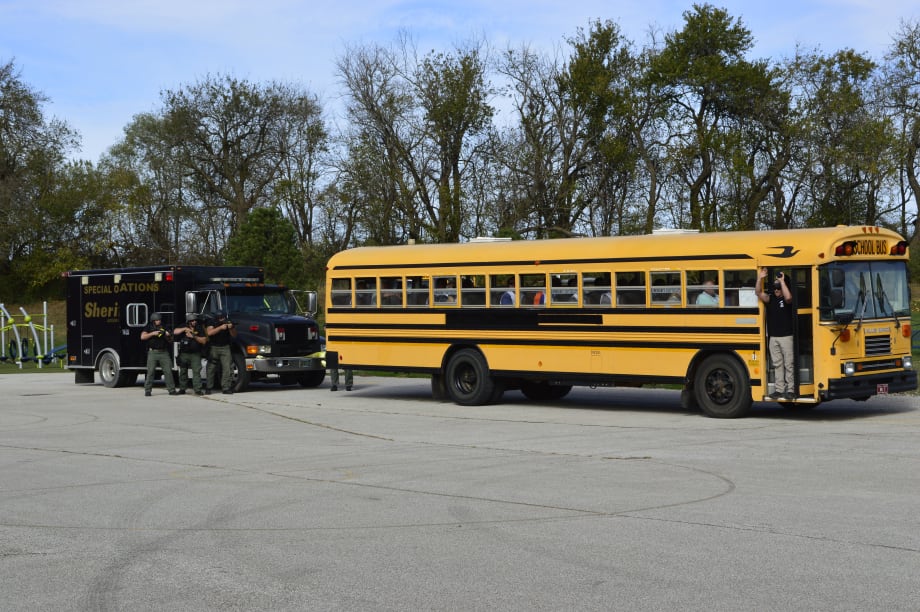
Jackson County (Mo.) Sheriff’s Department police enacted a scenario with a disgruntled father forcing his way onto a school bus with a knife. Police showed how law enforcement would surround the bus and what they would say to negotiate with the assailant.
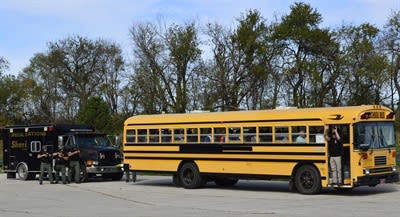
Jackson County (Mo.) Sheriff’s Department police enacted a scenario with a disgruntled father forcing his way onto a school bus with a knife. Police showed how law enforcement would surround the bus and what they would say to negotiate with the assailant.
KANSAS CITY, Mo. — Security demonstrations and related discussions left a resounding impact on Saturday, as many NAPT Summit attendees participated in interactive exercises with federal and local law enforcement.
NAPT worked with the U.S. Transportation Security Administration (TSA) for months to plan the demonstrations, with the aim of showing attendees how to prevent and mitigate threats with knowledge and preparation.
The morning kicked off with TSA officials sharing tips and tools for strengthening violence prevention, inspiring preparedness, and warning that lone offenders are a concern, particularly in potential bombing and active shooter incidents.
Officials pointed out that school buses and school bus facilities are of interest to lone offenders because they are soft targets, compared to airports which have many layers of screening, and information about who is aboard the planes, said TSA official Chris Keefover.
Keefover also reminded attendees that threats may not be immediately visible, but that doesn’t mean that they shouldn’t be prepared for them.
“Threats are like Bigfoot; just because you can’t see them, doesn’t mean they aren’t out there.”
Attendees then broke into groups to talk through a scenario in which media reports that 21 people were killed in an explosion on a school bus in Paris, and children were among the casualties. Meanwhile, a shooting occurs elsewhere in the city. The suspects are apprehended and say that the bus was targeted because children were on board. The suspects also encourage similar attacks against school bus operation facilities overseas. Meanwhile, parents air their concerns on social media.
Each group talked about their current practices, what they would do if the presented scenario became a reality, and challenges they would likely face.
Challenges mentioned included accommodating varying sizes of schools in districts and some allowing park outs, deciding when to cancel school bus service and to what extent; putting a communication plan together when schools go into lockdown; how much to say to the media; securing other methods of student transportation, such as vans and parents’ cars; and translating communication for parents that do not speak English.
Some preventive measures attendees suggested were: requiring identification or a code word from parents and guardians picking up students; training with local first responders and law enforcement using school buses; training school bus drivers on detecting improvised explosive devices (IEDs); locking school bus facility gates; making a communications manager the only point of communication to parents, media, on social media, etc.; using apps for communicating with parents and holding in-person forums for them; designating a team to answer parents’ phone calls; shutting down school bus service for a couple days; and conducting longer bus pre-trips.
TSA's Keefover suggested that NAPT could request federal security funds for school districts, as the public transportation industry did, and told the groups about the TSA’s free inspections to identify security gaps in facilities and active shooter training.
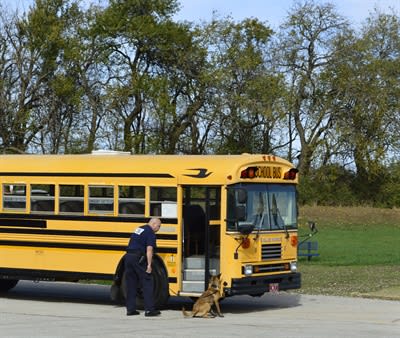
Kansas City police demonstrated how they would use a single purpose bomb dog to sniff for explosives in the event of a bomb threat.
Next, attendees heard a panel of law enforcement officials recount what they have learned from handling crisis events, such as a hostage situation with a school bus full of students in downtown Kansas City a few years ago. Also on the panel were school transportation managers who shared what they would do if faced with such an incident.
Law enforcement officials said their goal is to mitigate the threat by isolating the bus and taking their time negotiating with the suspect. To make things easier for law enforcement, Colonel Hugh Mills of Jackson County (Mo.) Sheriff’s Office said that bus drivers should try to keep the students calm, contain them in a small area, and keep the bus stable. He added that drivers should only physically engage the assailant as a last resort, and make sure during the pre-trip inspection that all video and audio equipment is working, since police will look to that for evidence.
The law enforcement officers on the panel observed from working on school bus security exercises how little space there is on school buses, that you cannot open the door from the outside, and that the high seat backs in some buses can reduce visibility.
On the school bus operations side, Jane Pilatzke of Shenendehowa (N.Y.) Central School District, said that she would pull up GPS data on the bus, and her bus drivers are trained to have their radio tuned to the 911 center. Michelle Kronk, the communications manager for North Kansas City Schools, said that communications departments need to work against the fear spurring posts on social media and counter that with accurate information to parents, the media, and the general public. Launi Harden, transportation supervisor of Washington County (Utah) School District, also noted that special-needs students should not be left out of training on these incidents.
Other transportation managers on the panel said that drivers should also have a code word to use over the radio to indicate that the line should be kept clear, and can put on 4-way lights to alert others on the road of a problem.
The afternoon held more hands-on learning in store, as local law enforcement officers presented tactical responses to violent threats in four live action scenarios in the final portion of the day, the security training exercise.
Jackson County Sheriff’s Department police enacted a scenario with a disgruntled father whose daughter is being bullied forcing his way onto a school bus with a knife. Police showed how law enforcement would surround the bus and what they would say to negotiate with the assailant, getting him to throw the knife outside the bus, open the windows, and leave the bus with them peacefully so they could take him into custody, and then safely evacuate the students.
The Kansas City Police Department then demonstrated procedures for if a bomb threat was called in to a school’s office. Officers brought a single purpose bomb dog to the bus to sniff for explosives, and explained that if the situation was determined to be life-threatening, they would bring in robots to find the bomb and send the officer and dog away from the bus. They added that they would ask some of the students or others present to stay so they could gather more information.
The third scenario involved the Kansas City, Missouri, Tactical Response Team, which showed how they would handle a situation with assailants carrying small arms on two buses threatening to “kill kids in 30 seconds” and firing shots on the bus. They surrounded the bus as a sniper looked on from a nearby building. Then, they fastened chains to the bus’ front and back emergency door, entered, deployed sound flash diversionary devices, which create explosions to distract the assailant, and got the students to safety.
The Lee’s Summit Police Department also enacted a “bump-and-run” maneuver to distract the assailant by striking the rear of the bus with their vehicle while other officers enter the bus. Meanwhile, on board, police tell bus passengers — attendees playing students — to cover their face with their hands to protect them from physical and emotional injury.
Participants noted that being aboard the bus for the exercise made them think about lessons to take home for training staff and students, such as keeping calm, and following commands from officers.
More Safety

HopSkipDrive Reports Progress on Safety Advisory Council
More than a year after forming the council, independent safety experts have helped shape new rider-safety features and policy progress, with a new goal to address rider behavior.
Read More →
What the 2026 National School Bus Safety Month Resolution Means for Student Transportation
The bipartisan resolution highlights illegal school bus passing, student safety during loading and unloading, and the need for driver training and public education.
Read More →
School Bus Stop-Arm Violations Decline 53% Across Verra Mobility Programs
Verra Mobility shares how school bus stop-arm cameras and school zone safety programs are changing driver behavior, reducing violations, and protecting students.
Read More →
Most Bus Crashes Aren’t Your Fault. Here’s How to Prove It.
A guide for what to do in between a school bus crash and a claim: what to preserve, who to notify, and how to keep the facts available when they matter.
Read More →
National School Bus Safety Week 2026: Tips, Toolkits & Resources to Keep Students Safe
School bus safety takes more than awareness. Explore expert tips, enforcement strategies, and free resources to help protect students on every ride.
Read More →
2 Killed, Dozens Injured in Florida School Bus Crash
A multi-vehicle collision caused a Polk County school bus carrying 37 students to overturn on its way to Winter Haven High School.
Read More →
Illegal School Bus Passing Drops 24% in New York Districts
With fewer than 5% of citations involving repeat offenders, Westchester County officials said enforcement, education, and community partnerships are helping change driver behavior.
Read More →
School's Back. Here's What Happened to Traffic, Speeding & Distraction
What happens to traffic when school resumes? New data analysis examines changes in distracted driving, congestion, and speeding around schools.
Read More →
Geotab Expands Fleet Safety Tools With Video Coaching, Risk Insights
New safety and video capabilities aim to help fleet managers assess risk, support drivers, and take targeted action through video coaching, red-light violation detection, and more.
Read More →
How to Build a Better School Bus Driver Training Program
Is it time to strengthen your driver training? Here’s how to pick the right talent and improve recruitment, retention, and safety. This video is brought to you by IC Bus.
Read More →