





More from NAPT: NAPT Provides Guidance to Members Regarding Immigration & Deportation Around Schools
NAPT Releases Statement on Seat Belts
NAPT’s Molly McGee-Hewitt explains the recent change in stance, as the organization is pleased with work done by the NTSB in recent years on studying the effectiveness of the safety belts.
March 18, 2025
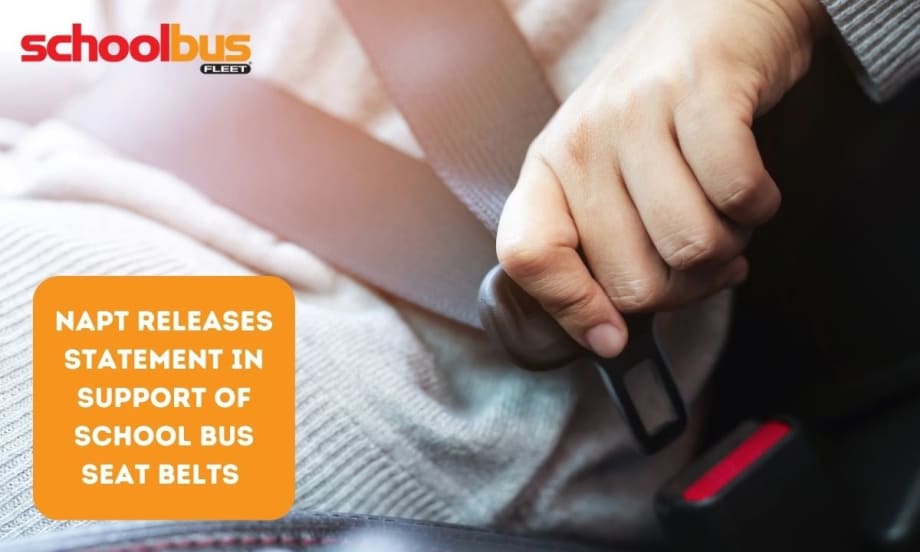
The NAPT has recently updated its stance on school bus seat belts and will begin advocating for their implementation and effectiveness. However, they are still calling out the NHTSA for its lack of testing on seat belt usage in school buses.
Photo: Canva
4 min to read
Recently, National Association for Pupil Transportation (NAPT) Executive Director and CEO Molly McGee-Hewitt commented on the current position of the NAPT in an interview in its publication, School BusRIDE.
The statement released last week from NAPT does not take an official position on seat belts' overall viability or efficacy. However, it does clarify that the NAPT recommends districts considering installing seat belts purchase only three-point lap-and-shoulder belts and that two-point lap belts are insufficient for safety purposes.
This position is shared with the National Association of State Directors and Pupil Transportations Services, the National School Transportation Association, and state association affiliates.
NAPT also aligns itself with the National Transportation Safety Board’s (NTSB) recommendation that lap-shoulder seatbelts be required on all new, large school buses and that decisions to purchase occupant restraints be made locally.
“The statement draws upon the work that the NTSB has conducted subsequent to several school bus fatality accidents,” said McGee-Hewitt in the interview. “NTSB has strongly recommended that the industry install and properly use seat belts (lap-shoulder belts) on school buses. They have demonstrated through their accident re-creations that lives were lost in the absence of seat belts, and that lives would have been saved and injuries prevented if seat belts had been in place.”
McGee-Hewitt added, “We felt that we could not ignore those findings and recommendations any longer. Our position had been that we wanted to rely on science. In all other aspects of transportation safety, NTSB’s word is the gold standard.”
A Summary of NAPT’s Recent Statement
The statement from NAPT states that it:
Accepts the findings and recommendations of the NTSB as valid and important to the efficacy of seat belts in fatality accidents they have investigated.
Recognizes the serious work that remains to be done by the National Highway Traffic Safety Administration (NHTSA) regarding testing for side impact crashes, water events, or thermal (or fire) events. NAPTA is determined that additional research and testing should not preclude a statement that accepts the safety benefits evidenced and recommended by the NTSB.
Asks members to consider their current stance on seat belts for school buses in light of the information in the NTSB reports, new technological developments, other districts' experiences, and other research and developments in the industry.
Recognizes the operational issues to consider, which should be addressed with school attorneys and insurers to bring policies and practices in line with the reality that school buses have lap-shoulder belts installed. This includes developing school policies related to mandatory use and liability for school bus drivers if seatbelts are unused or used inappropriately.
Calls on everyone at NAPT to work with partner associations and federal agencies to advance this message and support local efforts related to seat belts.
“We believe in the principle that local school leaders are capable of and ready to make sound and practical decisions for the benefit of their students and families,” said McGee-Hewitt. “In the case of seat belts for school buses, which is historically divisive, our association having a ‘pro’ or ‘con’ position doesn’t make that much of a difference to our members. Our role would be to encourage them to review their beliefs and decisions and to determine if those are still the best for their children.”
Reasoning Behind the Statement
This change in position is the result of the NAPT trying to send its members the message that it is not opposed to lap-shoulder belts on school buses.
A perception existed that the NAPT opposed seat belts. However, its argument was that the federal government failed to do its job in terms of research and testing to determine the safety of belts definitively.
With recent NTSB findings, the NAPT is encouraging members to consider whether to install seatbelts.
“We have focused for many years on fatalities caused by school buses,” said McGee-Hewitt. “In any other transportation safety arena, repeated recommendations from NTSB would have demanded action and improvements. In this case, nothing has been done by either NHTSA or the school bus industry.”
With its new position, NAPT members won’t need to explain the position to schools anymore. By accepting that lap-shoulder belts make school buses safer, members have a clear answer for school leadership.
NAPT will also be more active in providing workshops and educational opportunities for members about seat belts. It is currently exploring possibilities for sharing information on how other districts have incorporated seat belts and how effective the programs are.
While its stance on school bus seat belts is changing, the NAPT still remains firm that the NHSTA can and should be conducting more extensive testing on seat belt usage.
“For years, NAPT has called on NHTSA to conduct more extensive testing on seat belt usage,” said McGee-Hewitt. “They are, after all, the agency that all eyes turn to for regulations regarding vehicle standards and safety. The fact that they have not conducted tests related to roll-overs and events involving thermal events and water events strikes us as a seriously missed opportunity.”
NHTSA's most recent action regarding seat belts on buses mandated use on smaller buses in 2011.
More Management

How to Build a Better Driver Training Program
Ready to boost up your school bus instructor training? Here’s how to pick the right talent and improve recruitment, retention, and safety.
Read More →
CALSTART and Forth Combine to Form Catalyst Mobility
The new name represents a renewed vision for the nonprofit focused on advancing clean, equitable, and affordable transportation solutions that move people and goods.
Read More →
What Makes a Great School Bus Driver Trainer?
Choosing the right school bus driver trainer takes more than experience. Learn six keys to selecting and developing trainers and evaluating program effectiveness.
Read More →

School Bus Contractors Expand Through New Deals, Acquisitions & Partnerships
STA's Canadian division acquires Ontario-based G&L Stevenson Transport while Durham School Services adds a new district contract in California, First Student adds a New Jersey contract, and Minnesota Coaches acquires Halo Transportation.
Read More →
Logan Bus Company Rolls Out AI Phone System for NYC School Bus Families
A summer pilot found that AI agents could handle most routine calls, freeing up time for customer service staff to focus on emergencies and complex family concerns.
Read More →
From Intent to Impact: What I Learned About Leadership from TAPT
A Texas transportation supervisor shares lessons on self-awareness, accountability, managing stress and building trust — and why investing in leadership development matters at every stage of your career.
Read More →
NAPT Names 2026 Award Recipients, Hall of Fame Inductee
Who earned national recognition for their work in student transportation? This year, NAPT named five recipients of its 2026 awards for service, safety, and leadership, plus its newest Hall of Famer.
Read More →
Sponsored•September 2, 2026
2026 State of Student Transportation Report
Driver shortages. Rising costs. Growing safety expectations. More data, but not enough time to act on it. The 2026 State of Student Transportation Report reveals what transportation leaders say is putting the most pressure on their operations—and where they’re investing next. See how your priorities compare.
Read More →
How to De-Escalate an Angry Person: 5 Steps for Handling Workplace Conflict
What makes emotions run high, and how should you handle an angry colleague or parent? Follow these steps for staying calm, listening, showing empathy, and resolving conflict.
Read More →
Sponsored•September 1, 2026
What Readiness Looks Like This School Year
Learn about the challenges shaping the 2026–2027 school year, from persistent driver shortages and budget pressure to technology and readiness gaps. See how school districts are responding and adapting in Zonar’s 2026 Back-to-School Readiness Report.
Read More →