




Iowa School Bus Fire: NTSB Releases More Details, But No Cause Yet
The agency issues a preliminary report on the fatal fire, but why the school bus driver and student couldn’t escape remains unclear.

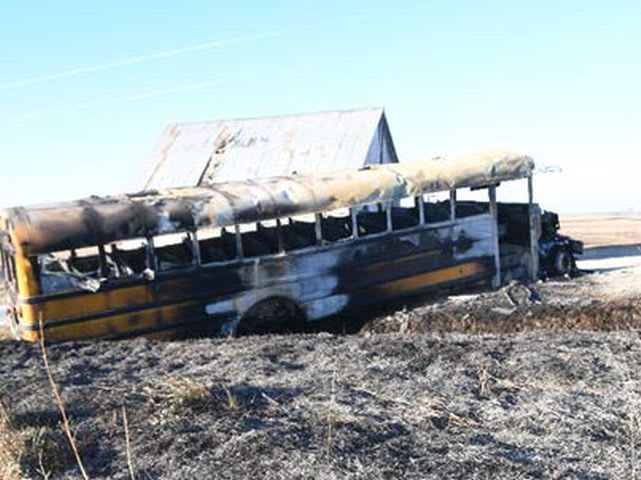
The National Transportation Safety Board has issued a preliminary report on the Dec. 12 school bus fire near Oakland, Iowa. Photos by Pottawattamie County Sheriff's Office
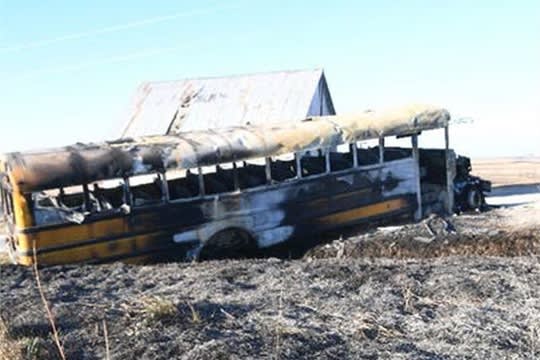
The National Transportation Safety Board has issued a preliminary report on the Dec. 12 school bus fire near Oakland, Iowa. Photos by Pottawattamie County Sheriff's Office
OAKLAND, Iowa — The cause of the recent school bus fire here — and why the driver and passenger were not able to escape — are still unclear, but an investigation update provides some new details on the incident.
School bus driver Donald Hendricks, 74, and student Megan Klindt, 16, died in the Dec. 12 school bus fire in a rural area east of the small town of Oakland.
On Friday, the National Transportation Safety Board (NTSB) released a two-page preliminary report on its ongoing investigation of the incident.
Hendricks was driving a 2004 International Type C (conventional) school bus owned and operated by Riverside Community School District. Around 6:50 a.m., he turned right from a gravel road onto a driveway to pick up Klindt, his first passenger of the day, at the farm where she lived.
According to NTSB’s report, as the bus backed out of the driveway, its right dual rear wheels crossed an earthen strip next to the road and dropped into a 3-foot-deep ditch. The wheels lost traction, and the bus became stuck, with about half of it sticking out across the gravel road.
NTSB said that as Hendricks tried to move the bus forward out of the ditch, a fire broke out in the engine compartment and spread into the passenger compartment. At some point, grass and vegetation near the back of the bus also caught fire.
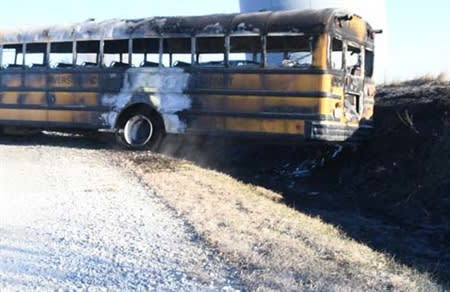
NTSB said that the bus became stuck in a ditch, and a fire broke out in the engine compartment as the driver tried to move the bus forward.
What went on inside the bus remains a mystery.
“For unknown reasons, the driver and student passenger did not exit the school bus,” NTSB said in the report.
As previously reported, the Iowa Office of the State Medical Examiner determined that Hendricks and Klindt both died from “smoke and soot inhalation and thermal injuries.”
NTSB’s preliminary report notes that there were three recalls that applied to the school bus, to correct issues with a sensor for the antilock brake system, a sensor for the stop arm, and a wiring harness for the stepwell heater blower motor. Investigators confirmed that the three recalls had been performed.
The bus was equipped with a video surveillance system, but NTSB found that it was too severely damaged by the blaze to recover data.
The agency will continue to analyze various factors as it works to identify the probable cause.
“Additional examinations of vehicle components and post-fire evidence will be performed to determine the potential origin of the fire and its propagation,” NTSB said in the report.
In a press conference two days after the fire, NTSB Senior Investigator Peter Kotowski said that while the agency has investigated crashes that involved fires in school buses and motorcoaches, the Iowa incident was unusual because of the lack of a crash.
“The circumstances in this one, without a sustained or heavy impact, is one of the reasons why it drew our attention,” Kotowski said.
NTSB’s full investigation will likely take at least a year, and then the agency will issue a final report. The preliminary report is available here.
More Safety

How to Build a Better School Bus Driver Training Program
Is it time to strengthen your driver training? Here’s how to pick the right talent and improve recruitment, retention, and safety. This video is brought to you by IC Bus.
Read More →
Recent School Bus Accidents Leave 2 Dead, 2 Injured
Four school bus crashes in Florida, Illinois, and Georgia highlight risks in transportation lots, at bus stops, and during student loading and unloading.
Read More →
When Every Second Matters, Clarity Keeps Routes Moving
From routine delays to urgent incidents, strong communication practices help drivers, dispatchers, schools, and families respond with confidence.
Read More →

What Happens When a School Bus Catches Fire — and What Can Help
School bus fires are rare but can be devastating. Learn how advances in fire suppression and asset protection help fleets detect fires earlier, reduce damage, and improve safety.
Read More →
Geotab Launches Tool to Help Fleets Investigate Road Incidents
Geotab Investigations combines telematics data, video, documents, and other evidence to help fleets reconstruct incidents, resolve claims, and determine what happened.
Read More →
Texas Sixth Grader Wins 2026 National School Bus Safety Poster Contest
Sai Darshana Yekolu of Moseley Middle School in Prosper, Texas, was named the newest winner for her artwork, bringing the theme of “Safe Rides, Everyday Heroes” to life.
Read More →
Doing More With Less: How Transportation Directors Can Prioritize Safety Amid Budget Uncertainty
With diesel prices soaring and nearly one-third of transportation directors expecting budget cuts, maintaining student safety has never been more challenging. Download this guide to learn how leading districts are prioritizing risk, funding critical safety technology, and building stronger budget cases with data.
Read More →
Walton County Schools Adds Gatekeeper Stop-Arm Enforcement System
The Florida district will deploy Gatekeeper’s updated Student Protector technology, which now incorporates AI to improve video evidence.
Read More →
How To Build a More Secure School Bus Yard During and After Hours
As thefts and overnight security threats continue, school transportation leaders are combining stronger operational practices with AI-enabled surveillance to better protect buses, facilities, and staff.
Read More →
FMCSA Names New Chief Safety Officer: What School Bus Operators Should Know
Steve Dowling is set to lead the federal agency's efforts to advance commercial motor vehicle safety and reduce crashes, fatalities, and injuries on the nation's roadways.
Read More →