




IC Bus Innovation Summit Envisions Future of the School Bus
Thought leaders and industry experts discuss the impacts of connected and automated vehicles, ridesharing, onboard Wi-Fi, and big data at the bus manufacturer’s first-ever event of its kind.

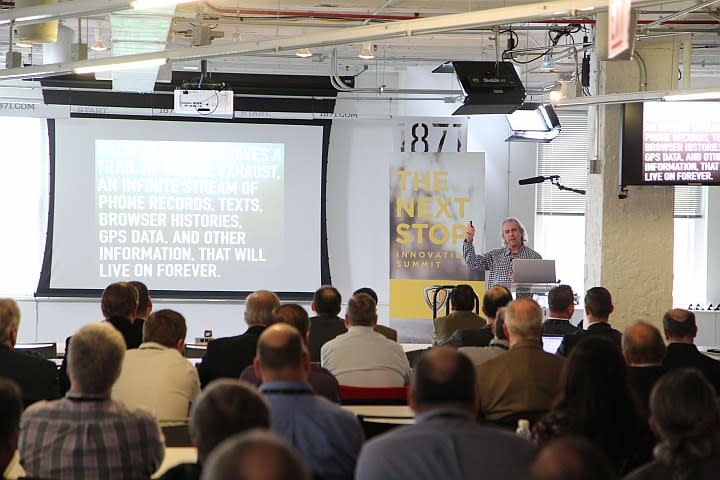
Participants at The Next Stop Innovation Summit included innovators from outside the industry who talked about trends that could affect the school bus industry. Shown here is Howard Tullman, CEO of 1871, a hub that supports more than 400 digital startups.
Participants at The Next Stop Innovation Summit included innovators from outside the industry who talked about trends that could affect the school bus industry. Shown here is Howard Tullman, CEO of 1871, a hub that supports more than 400 digital startups.
CHICAGO — School bus manufacturer IC Bus gathered thought leaders and transportation industry experts here last week to discuss the upcoming impacts of technology on the yellow bus.
The Next Stop Innovation Summit, the first event of its kind that IC Bus has hosted, was created to examine current market trends and challenges and to begin mapping out the future of the school bus industry.
Bus leaders from various backgrounds in education, technology, innovation, safety, and sustainability convened at 1871, a hub that supports more than 400 digital startups, for a conversation about the industry today and where technology and macro trends are leading it. With a diverse mix of speakers, panels, and sessions, the summit aimed to lay the groundwork for the school bus transportation industry ahead.
"Our industry touches so many people, and although the yellow school bus is an icon of safety and reliability in transporting millions of children to and from school each day, here at IC Bus, we recognize that the evolution of the school bus is always in progress," said Trish Reed, vice president and general manager of IC Bus. “Quickly, it will be 2027. Will we shape the future or have it shaped for us? We need to think about how to take advantage of trends instead of having them work to our detriment.”
"We created the Innovation Summit with an attitude toward modernizing and innovating the school bus industry in order to meet the ever-changing demands of tomorrow," she added.
Participants at the summit included innovators from outside the industry who shared their perspectives on trends that could affect the school bus industry.
Howard Tullman, CEO of 1871, discussed the increasing speed at which technological developments are progressing, and how businesses need to accommodate the new consumer, who, he said, no longer wants to “commit, spend, or own,” by ensuring their services are “easy, fast, and flexible.”
“It’s not the big that eat the small; it’s the fast that eat the slow,” Tullman said.
Consumers in what he called this “right-now economy” are also significantly more distracted, he pointed out.
“80% of us look at our phones 163 times a day,” Tullman said. This happens to dovetail with the fact that 43% of all cars sold are now connected vehicles.
In three morning breakout sessions, panelists covered transportation topics, macro trends, and environmental issues.
Transportation topics tackled by three panelists included the benefits of dynamic routing, blending with other transportation methods such as Uber and app-driven carpool services, and training older drivers on new technology.
Donald Brooks, the vice president of vehicle maintenance (rail and bus) at Chicago Transit Authority (CTA), talked about how bus operators can now reroute based on what they see on the road with the aid of CleverCAD, computer-aided dispatch technology, and can communicate updates to dispatch in real time.
Dr. Joe Schwieterman, the director of DePaul University’s Chaddick Institute for Metropolitan Development, said that all areas of transportation are feeling pressure to be more efficient from disruptive technologies such as Uber, carpool service apps, and bicycle sharing. Like public transit, school transportation will need dynamic routing to be more efficient, such as by eliminating stops where no students are showing up.
He added that blending of transportation types, such as using Uber and informal carpool services in addition to the school bus, are coming to school transportation, driven by the growing complexity of students’ schedules, which now include more extracurricular activities, stops at daycare, etc.
One audience member mentioned the challenge of training school bus drivers on new technology when their average driver’s age is between 60 and 70 years old, and they aren’t accustomed to using a tablet. Brooks responded that there is a learning curve with some CTA drivers who transitioned to touch screens from paper and pen, and wouldn’t log in or use the system to contact dispatch.
Debbie Halvorson, president of trucking transportation company American Eagle Logistics, and a former Illinois congresswoman, said that her drivers are being trained on using electronic logging devices, but the challenge is they have long days and then have to learn something that many are resistant to.

Macro trends panelists and moderator Jessica Dixon of IC Bus, share the benefits of Wi-Fi equipped school buses.
Macro trends panelists Adam Alonso, executive director of BUILD Inc., and Michael Flood, vice president of strategy at Kajeet, a wireless provider of a mobile broadband solution that connects disadvantaged students to the internet outside of school, discussed with attendees how the school bus of the future can become an extension of the classroom, helping all students learn more effectively.
Flood said that some districts Kajeet works with have seen homework completion rates go up for students with onboard Wi-Fi. Since the company can put more robust antennae on the buses, it can pull stronger signals than students can get on their phones, getting the benefit to students in more remote areas.
The service, which works best when linked to the classroom curriculum, eliminates access to content that is not child-appropriate, as well as to entertainment such as Netflix and Spotify.
Alonso, whose organization helps at-risk students, said that keeping them occupied on the bus can improve behavior by reducing anxiety, particularly on the morning route, because they can spend time preparing for the day.
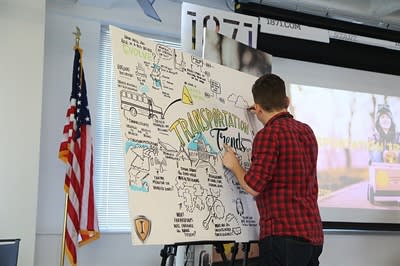
IC Bus had an artist on hand to provide illustrations of each panel discussion.
In the environmental topics breakout session, panelists weighed in on the future of alternative-fuel vehicles.
School bus contractor Cook-Illinois Corp. has used biodiesel and found that it emits 30% less emissions and requires no modification on the buses, said John Benish Jr., president and chief operating officer. Additionally, because of increasing restrictions on diesel emissions, last year for the first time, the company didn’t buy more diesel buses; instead, it added propane and gasoline buses to its fleet.
Economic drivers such as emissions and noise regulations worldwide are also making alternative-fuel buses more attractive, and more sectors will adopt electric powertrains, added Julie Furber, executive director of electrification at Cummins.
In the afternoon, attendees gathered for mixed panels and discussions on big data and transportation trends.
Moderator Mark Johnson, the vice president of marketing for Navistar, said that by 2020, the Internet of Things (IOT) will connect 50 billion objects. IOT is important for school buses because a significant amount of data can be collected from them to enhance safety. For example, a connected vehicle could register black ice on the road and report that to dispatch, added Terry Kline, senior vice president and chief information officer at Navistar.
Conversely, Greg Lindsay, senior fellow at the New Cities Foundation, who leads the Connected Mobility Initiative, warned that it’s important not to deploy technology before knowing what to do with it. Moreover, many IOT devices may not have security built into them, as was evidenced by a hacker attack in October 2016.
“How do we ensure security of these devices?” he asked. “Who has access? Who owns the data?”

Panelists weigh in on big data issues such as Internet of Things and securing student data tracking.
Jason Corbally, president of Education Logistics (Edulog), said that Google has revolutionized mapping, which makes creating routing schedules easier; the hard part is obtaining student data due to privacy concerns, and he proposed that technology vendors such as Edulog work with the school transportation industry to establish standards on what to collect.
Ted Thien, senior vice president and general manager, Versatrans at Tyler Technologies, agreed, adding that parents want bus information on their devices, and with so many students moving around districts, there should be a student identifier in every state, though data must also be confirmed as accurate.
Transportation trends panelists considered questions such as how the role of bus driver will evolve as technology advances over the next 10 years.
Fred Andersky, director of customer solutions at Bendix, noted that technology ends up on commercial vehicles about five to 10 years before school buses. For example, commercial vehicles are equipped with collision mitigation, and school buses just now have air disc brakes. He identified the next technologies for school buses as connectivity, vehicle-to-vehicle, vehicle-to-infrastructure, vehicle-to-pedestrian, and collision mitigation.
Keith Henry, president of the National Association for Pupil Transportation, said that an unintended but positive consequence of connected vehicles is that safety in the danger zone could be improved.
A driver can get distracted now because of the 60 students behind the driver, he said, but a “driver” will still be needed on automated vehicles to help special-needs students and respond to medical emergencies, he added.
Howard Putnam, former CEO of Southwest Airlines, closed the summit with a unique understanding of disruptive ideas that affected his organizations and how this might affect the school bus transportation market.
"This is one of the more unique speaking experiences in my professional career, and I enjoyed sharing my lessons learned as an airline industry executive who looked to shake things up and try new things," Putnam said. "As I attended sessions and spoke with participants, it is clear to me that the school bus transportation leadership are prepared to change the way the game is played, rather than just simply play the game."
More Management
Samsara Launches Free Driver Rewards Program
The new Driver Perks program gives eligible professional drivers access to discounts and offers without adding a cost for participating fleets.
Read More →
How Tax-Exempt Municipal Leases Can Help Finance School Buses
Let’s explore school bus financing options, including municipal leases, vendor payable accounts, and balloon payments, and how they can help stretch fleet budgets.
Read More →
Nominate Rising School Transportation Pros Under 40!
We’re searching for the next generation of leaders making an impact across the K-12 student transportation industry to recognize as SBF’s 2027 Trailblazers. Nominations are open now!
Read More →

Changing Lanes: BusWhere, EverDriven, InterMotive, Summit School Services, Switzer-Carty & Thomas Built Buses
Check out who's been hired, promoted, and appointed to leadership positions at various school transportation suppliers, contractors, and manufacturers.
Read More →
The Most Expensive Thing You Do Before Selling a School Bus: Wait
When should you sell an aging school bus? Learn how maintenance, mileage, corrosion, specifications, and timing can affect resale value long before the auction.
Read More →
American Student Transportation Partners Acquires AJ Myers and Sons
A new deal brings a 75-year Pennsylvania student transportation provider into one of the nation’s largest private school bus contracting groups.
Read More →
What I Brought Home From SBFX: Relationships, Leadership, and Preparing What's Next
Who could lead your transportation operation tomorrow if you couldn't? Bernando Brown explores succession planning, mentorship, and preparing emerging leaders to step up.
Read More →
Inside School Bus Fleet ConneX 2026: Industry Leaders Connect in Scottsdale [Photos]
See highlights from SBFX 2026 in Arizona, where school bus operators and suppliers gathered for meetings, education, networking, awards, and more.
Read More →
School Transportation’s Biggest Pressures and Opportunities: SBFX Attendees Weigh In
School bus operators point to rising costs, staffing, and vehicle prices as immediate pressures while identifying technology, training, and routing as opportunities for growth.
Read More →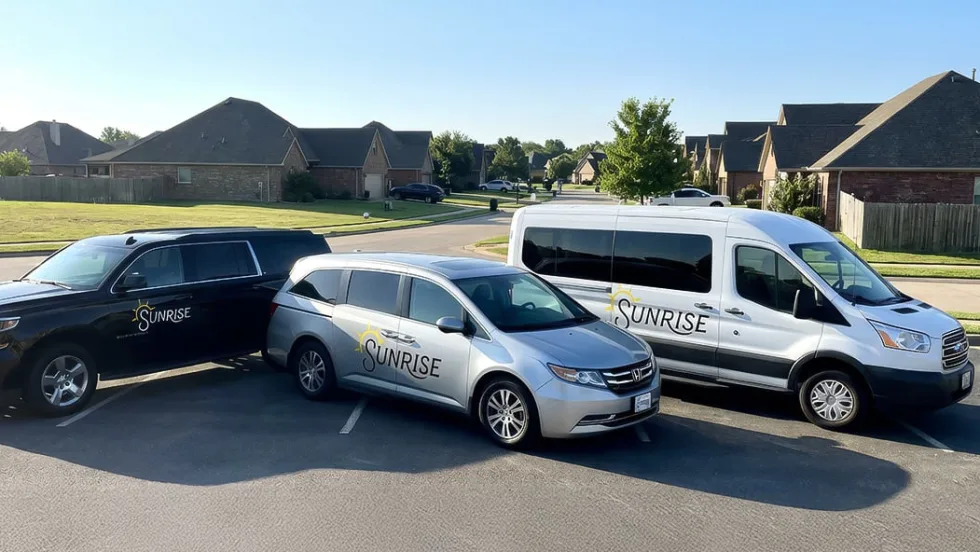
STA Acquires Sunrise Transportation
Student Transportation of America expands in Illinois and Connecticut through Sunrise's fleet of nearly 1,000 vehicles.
Read More →