





[From 2017] School Buses Rescue Residents in Hurricane
Hurricane Update: Info and Resources for School Transportation
Get the latest on hurricanes Helene and Milton here, where we update on the current state of schools affected with resources and tips.
October 11, 2024
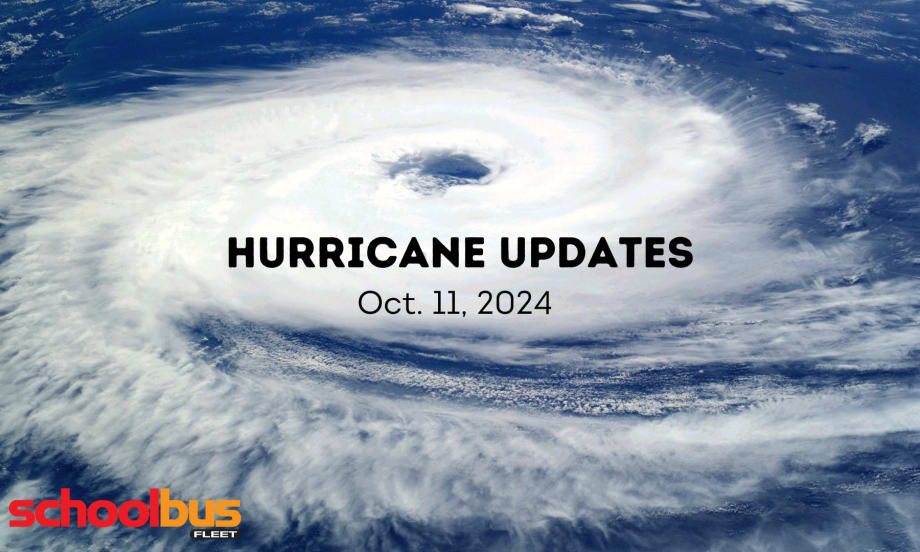
With two hurricanes in less than two weeks in the U.S., school districts across the country reacted to the crises.
Photo: SBF/Canva
5 min to read
Late last month, the strongest hurricane since 2017 and the deadliest since 2005, hit the southeastern U.S. Hurricane Helene made landfall in Florida late Sept. 26, rolling north to Georgia, Tennessee, the Carolinas, and other nearby areas, and finally dissipating by Sept. 29. The devastation was massive, with a death toll upward of 200. Millions were without power, water, or gas, and everyday life became a fight for survival for those in the worst of her path.
As those affected by Helene began to recover, a week later, another hurricane was on its way.
Category 3 Hurricane Milton made landfall in Sarasota County, Fla., Wednesday, Oct. 9, moving over central Florida and passing over the ocean by about 5 p.m. Thursday. Winds were reported up to 120 mph. Winds and flooding are now gradually diminishing. News reports say that 16 people have died in the storm.
Florida Gov. Ron DeSantis’ provided an update on the morning of Friday, Nov. 11, where 51 counties are still in a state of emergency. Approximately 2.4 million residents across the state are still without power. The State Assistance Information Line is open at 1-800-342-3557.
Governor DeSantis Holds a Media Availability in Bradenton Beach Following Hurricane Milton https://t.co/cVgnZRilMp
— Ron DeSantis (@GovRonDeSantis) October 11, 2024
More updated information on Milton can be found online here.
Effect on Schools
The Florida Department of Education (DOE) said it is in contact with all school districts and the is working with Florida Division of Emergency Management (FDEM) to address critical needs. Of the 50 school districts that closed for Hurricane Milton, 17 of them welcomed students back today.
Sixteen of Hillsborough County (Fla.) Public Schools in the Tampa area served as emergency storm shelters for the community, and the transportation team stepped up to help people evacuate.
For more information on school district, state college and university reopenings in the Sunshine State, visit https://www.fldoe.org/storminfo.
In South Carolina, Greenville County Schools staff drove to assess damage to routes along student’s homes, noting over 1,500 issues unsafe for transportation. Once the worst of it had been cleared, team members teamed up with the community to assist with clean-up efforts and distribute meals. The district reopened Wednesday, Oct. 9, with modified bus routes and were happy to be back in action.
State of Schools Now
As of this morning, seven of Hillsborough County (Fla.) Public Schools remain active shelters, serving 1,500 residents. About 60% of their schools have power restored, some are still surrounded by flooded waters, and debris impacts most campuses.
Orange County (Fla.) Public Schools reported that damage to their schools was minimal, and they plan to reopen Tuesday, Oct. 15.
In August, Ga., Richmond County School System will reopen Wednesday, Oct. 16. Power has now been restored to all locations, with access to clean water and food.
To get an idea of what schools in the areas hit are coping, School Bus Fleet reached out for updates from those in the path of Milton and Helene. Here is what those we heard back from were able to share. We will add more responses here as they come in.
“We are happy to report all of our transportation crew are accounted for and all our students. One driver lost everything between the raging waters and the mud slides, but she has not stopped working any opportunity she gets. Our challenges are the massive amounts of debris, road closures and ongoing infrastructure reconstruction of water lines being washed out and electricity being restored. Even 14 days out, even the tiniest improvements are huge victories. We just have so far to go to resemble some form of familiarity or normal. Our department has been on the ground since day 7 delivering supplies to our legacy neighborhoods and public housing, checking on students door to door.” — Amanda Rigsby, Director of Transportation, Asheville (N.C.) City Schools
“I am pleased to share that we experienced no damage to our buses or bus facilities as a result of Hurricane Helene. While some of our schools sustained minor damage, it did not affect their long-term operations. The primary challenges we faced in reopening schools were related to power outages, internet disruptions, loss of food supplies due to extended electrical outages, and road conditions that posed safety concerns.” — Adam James, Director of Transportation and Fleet Services, Greenville (S.C.) County Schools
While Marlon Watson, executive director of transportation for Johnston County Public Schools, is located in the eastern part of Tennessee and did not experience any first-hand devastation, he did help transport hurricane relief supplies to some of the impacted areas on behalf of the North Carolina Pupil Transportation Association (NCPTA), stopping in Brunswick and McDowell counties. “The NCPTA raised $11,000 in donations and provided much needed help for those that were impacted,” he shared.
Resources for Those Affected by the Hurricanes
U.S. DOE List of Resources for K-12 Communications After Natural Disasters
Red Cross Hotline: 1-800-Red Cross
Heart of Florida United Way’s 211 Information & Referral Line: Dial 211 or text your ZIP code to 898211
Disaster Updates from the Florida Division of Emergency Management
Disaster Legal Hotline: 833-514-2940
North Carolina Dept. of Public Safety Hurricane Helene Resources
Florida Crisis Cleanup number: 844-965-1386
How to Help and What You Can Do
If you live in Florida and want to volunteer, opportunities are promoted through Volunteer Connect.
The Asheville City Schools Foundation Hurricane Relief and Emergency Assistance Fund is now active, providing direct support to Asheville City Schools' students and families impacted by Hurricane Helene.
To follow future storms and you’re in an area that has the potential to experience hurricanes, stay tuned to the National Hurricane Center for updates and forecasts.
According to the U.S. Department of Education, there have been more than 500 major natural disasters (from presidential declarations) since 2017 across all 50 states.
Stay tuned for another article soon on disaster preparedness tips to help your team be ready in the event the unexpected comes to your area.
If your school district has been affected and needs help or has updates to share, please comment below or email info@schoolbusfleet.com.
More Management

How to Build a Better Driver Training Program
Ready to boost up your school bus instructor training? Here’s how to pick the right talent and improve recruitment, retention, and safety.
Read More →
CALSTART and Forth Combine to Form Catalyst Mobility
The new name represents a renewed vision for the nonprofit focused on advancing clean, equitable, and affordable transportation solutions that move people and goods.
Read More →
What Makes a Great School Bus Driver Trainer?
Choosing the right school bus driver trainer takes more than experience. Learn six keys to selecting and developing trainers and evaluating program effectiveness.
Read More →


School Bus Contractors Expand Through New Deals, Acquisitions & Partnerships
STA's Canadian division acquires Ontario-based G&L Stevenson Transport while Durham School Services adds a new district contract in California, First Student adds a New Jersey contract, and Minnesota Coaches acquires Halo Transportation.
Read More →
Logan Bus Company Rolls Out AI Phone System for NYC School Bus Families
A summer pilot found that AI agents could handle most routine calls, freeing up time for customer service staff to focus on emergencies and complex family concerns.
Read More →
From Intent to Impact: What I Learned About Leadership from TAPT
A Texas transportation supervisor shares lessons on self-awareness, accountability, managing stress and building trust — and why investing in leadership development matters at every stage of your career.
Read More →
NAPT Names 2026 Award Recipients, Hall of Fame Inductee
Who earned national recognition for their work in student transportation? This year, NAPT named five recipients of its 2026 awards for service, safety, and leadership, plus its newest Hall of Famer.
Read More →
Sponsored•September 2, 2026
2026 State of Student Transportation Report
Driver shortages. Rising costs. Growing safety expectations. More data, but not enough time to act on it. The 2026 State of Student Transportation Report reveals what transportation leaders say is putting the most pressure on their operations—and where they’re investing next. See how your priorities compare.
Read More →
How to De-Escalate an Angry Person: 5 Steps for Handling Workplace Conflict
What makes emotions run high, and how should you handle an angry colleague or parent? Follow these steps for staying calm, listening, showing empathy, and resolving conflict.
Read More →
Sponsored•September 1, 2026
What Readiness Looks Like This School Year
Learn about the challenges shaping the 2026–2027 school year, from persistent driver shortages and budget pressure to technology and readiness gaps. See how school districts are responding and adapting in Zonar’s 2026 Back-to-School Readiness Report.
Read More →