





From the Archives (2008): Fuel Crisis Survival
Get Ready for $5-$6 Diesel Fuel
Oil and diesel prices, already spiking, may get worse with President Biden's move to cut off crude oil imports from Russian in the wake of the invasion of Ukraine.
March 8, 2022

The U.S. Department of Energy already committed to releasing 30 million barrels of crude oil from the U.S. Strategic Petroleum Reserve to ensure an adequate supply of petroleum in response to Russia’s further invasion of Ukraine.
Photo: File, Strategic Petroleum Preserve
3 min to read
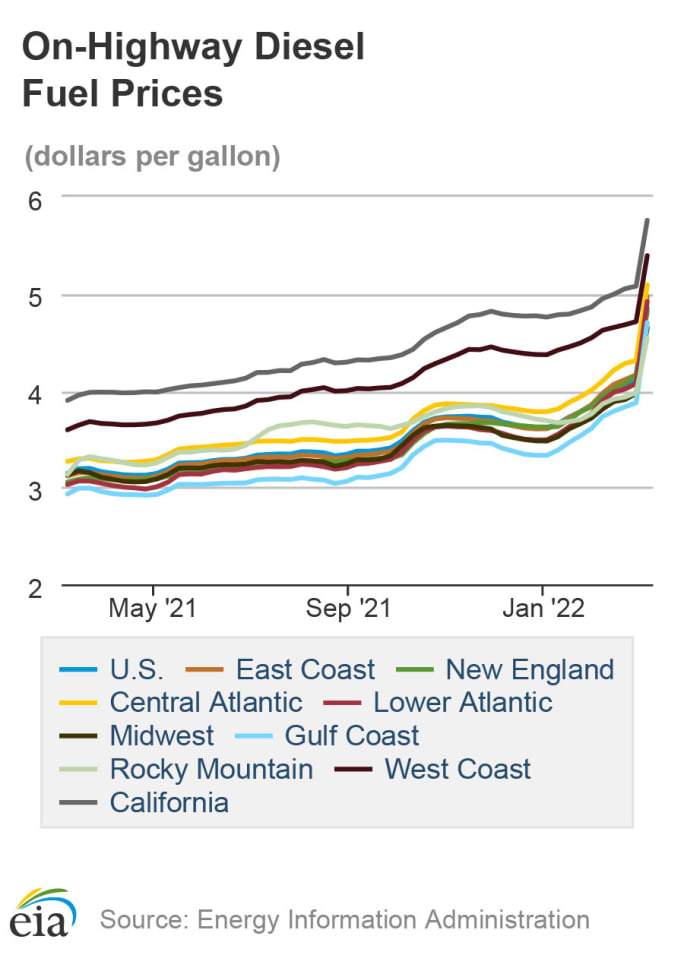
The average retail price of ultra-low-sulfur diesel has risen nearly a dollar per gallon in the past month, and prices are likely to go higher as crude oil prices spike and President Biden announced a ban on Russian oil imports.
Figures from the Department of Energy show the national weekly average as of March 7 of $4.85, up from $3.95 a month earlier. The 90-cent jump is the biggest in the Department of Energy’s records going back to February 2007 and also the highest average price. The last time it was this close was $4.771 in July 2008.
Unless something drastic happens, we are headed to pump prices of more than $5 a gallon for diesel, said Tom Kloza, head of global energy analysis at Oil Price Information Services.
Diesel is once again the power mover in US markets. All-time high record pump price of $4.8448 gal (7/17/08) gets breached tomorrow and $5 gal national average is in sight. California is targeting $6 gal by the weekend.
— Tom Kloza (@TomKloza) March 8, 2022
Russian Oil Ban
On March 8, President Biden announced that as part of the West’s economic sanctions it has been taking against Russia in response to the attack on Ukraine, that the federal government is banning all imports of Russian oil and gas and energy.
Oil futures rose in response, with West Texas Intermediate crude rising as much as 7% to trade above $128 per barrel, according to CNBC; It ended the day 3.6% higher at $123.70. Brent crude oil, the international benchmark, jumped 7.7% to $132.75; at the end of the session the contract stood 4.3% higher at $123.21.
“The market has already been self-sanctioning the Russian energy complex, with buyers avoiding the nation’s oil,” CNBC pointed out.
The U.K. also announced it would phase out Russian oil imports by the end of the year. However, so far other European countries have not announced bans.
A senior administration official explained in a call why the U.S. is able to take this action even though our allies in Europe are not doing the same. The official pointed out that in 2021, Russian oil was just under 10% of U.S. overall imports of oil but a third of Europe’s imports.
In addition, this official said, “the U.S. produces far more oil domestically than any of our allies. In fact, we’re a net exporter, the leading oil and gas producer in the world.”
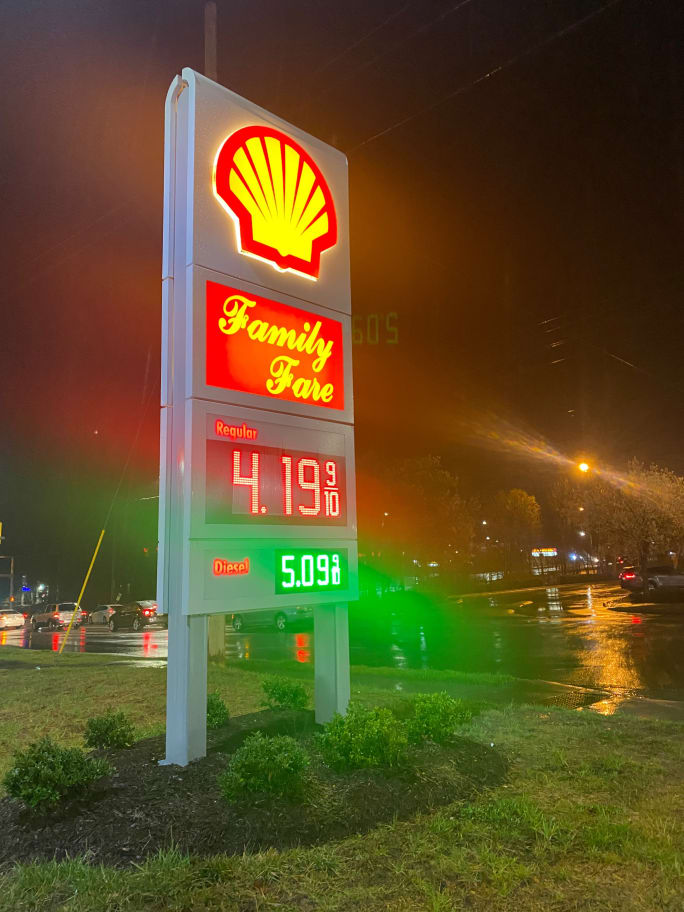
Gas prices were already above $4 and diesel prices over $5 per gallon on March 8 in Durham, North Carolina.
Photo: Wes Platt
“The United States is able to take this step because of our strong domestic energy production and infrastructure. And we recognize that not all of our Allies and partners are currently in a position to join us.”
Some critics have said Biden administration policies limiting oil drilling are hampering U.S. oil production, but the official said that “U.S. oil and gas production is approaching record highs while thousands of drilling permits on federal lands go unused. So federal policies are not limiting the production of oil and gas.”
The administration also used the situation to push the transition away from fossil fuels.
“In the long run, the way to avoid high gas prices is to speed up, not slow down, our transition to a clean energy future. The reality is we can’t drill our way out of dependence on a global commodity that’s controlled, in part, by foreign nations and their leaders, including Putin. The only way to eliminate Putin’s and every other producing country’s ability to use oil as an economic weapon is to reduce our dependency on oil.”
Originally posted on Heavy Duty Trucking
More Maintenance

The Evolution of DEF Header Technology: What School Bus Operations Should Know at Replacement Time
See what school bus fleets should consider when replacing DEF headers to improve reliability, reduce repeat repairs, and control maintenance costs.
Read More →
Sponsored•September 8, 2026
The Essential Guide to School Bus Maintenance and Student Safety
Your district's buses carry students to school every day. This guide shows how predictive maintenance powered by fleet data helps keep buses reliable, drivers accountable and students safer from the first bell to the last stop.
Read More →
Kerry Brothers Grows Michigan School Bus Repair Network
The acquisition of Downriver Truck and Bus expands Kerry Brothers’ school bus maintenance footprint across southeast Michigan, adding repair capacity, diagnostic resources, and state inspection support.
Read More →
Noregon Introduces CAN Bus Diagnostic Tool, Expands JPRO Features
CAN Mentor and the latest JPRO update aim to simplify vehicle network diagnostics and improve repair efficiency for technicians of all experience levels.
Read More →
Cummins on Smarter, Simpler Engine Innovation
Cummins discusses its first-ever gasoline engine for school buses, EPA 2027, and why bus fleets still want durable, simpler internal combustion options.
Read More →
Report: 72% of Diesel School Buses Now Use Advanced Low-Emission Engines
New data shows advanced low-emission diesel technology continues expanding across school bus fleets, even as electric bus adoption gains momentum.
Read More →
Vampire Tools' CAIMAN 7.5-Inch Multi-Purpose Screw Extractor Long-Nose Pliers with Crimper
Vampire Tools introduced the VAMPLIERS Caiman 7.5-inch multi-purpose pliers, combining screw extraction, cutting, crimping, and gripping functions into a single tool designed for fleet maintenance professionals.
Read More →
How Advanced Diagnostics Helps Bus Fleets Stay Ahead of Repairs
Chat with Noregon’s Kevin Smallhorn at ACT Expo about bus diagnostic tools, telematics integration, CNG maintenance support, and strategies to help reduce downtime and improve uptime.
Read More →
How School Bus Fleets are Getting Ahead of Breakdowns
Don’t let bus downtime wear you down. Here’s how bus operators are shifting from manual processes to AI-powered, data-driven maintenance systems for improved reliability and safety.
Read More →
Pennsylvania School Bus Maintenance Team Praised for Dedication to Safety
Matthews Bus Company’s West Jefferson received a letter of commendation from the Pennsylvania State Police for their fleet inspections.
Read More →