




Georgia Names Winners in 2nd Annual Pupil Transportation Safety Awards
The state Department of Education recognizes 16 school districts for their commitment to ensuring safe and efficient student transportation.

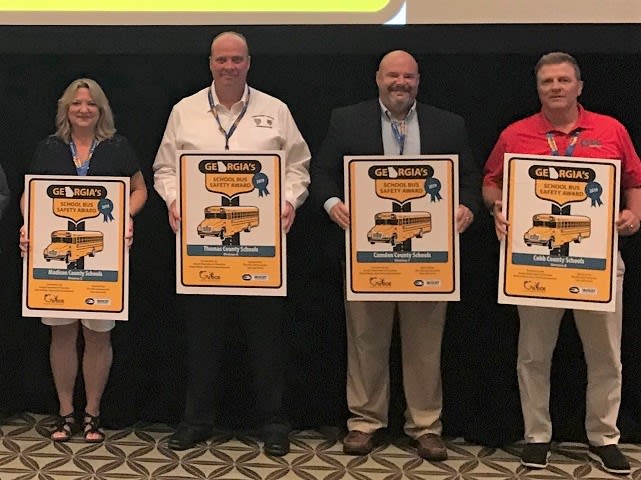
Georgia's Department of Education honored 16 of the state’s school districts at its second annual Pupil Transportation Safety Awards during the Georgia Association for Pupil Transportation conference on June 17. Shown here are the Division 5-8 Blue Award winners. Photo by John Osborne, Georgia DOE
Georgia's Department of Education honored 16 of the state’s school districts at its second annual Pupil Transportation Safety Awards during the Georgia Association for Pupil Transportation conference on June 17. Shown here are the Division 5-8 Blue Award winners. Photo by John Osborne, Georgia DOE
ATLANTA — Georgia’s Department of Education (DOE) recently honored 16 of the state’s school districts at its second annual Pupil Transportation Safety Awards.
The winners were recognized at the Georgia Association for Pupil Transportation conference on June 17 in Jekyll Island. The awards, sponsored by Blue Bird and Yancey Bus Sales and Service, recognizes school districts that are committed to providing safe and efficient student transportation, according to a news release from the agency.
During last year's inaugural awards, the association highlighted the safety efforts of eight school districts.
“Our pupil transportation professionals are entrusted with precious cargo and work incredibly hard each day to make sure Georgia’s students arrive at school safe and ready to learn,” said Richard Woods, the state’s school superintendent. “These 16 districts are going above and beyond to ensure student safety and recognize the school bus as an extension of the overall climate and culture of a school. I thank them for their efforts and commend them for their work.”
The winning districts were split into a total of eight divisions based on enrollment size, and then selected by a panel of judges, based on an application that evaluated a number of factors that impact school bus safety, according to the state DOE. Those factors included but were not limited to: completing safety training, evacuation drills, and other safety initiatives with students; evaluation of accidents and internal practices to prevent accidents; and innovative initiatives used to inspire safe practices, hire and retain drivers, and enhance student safety.
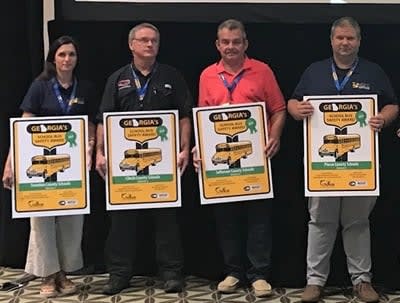
The winning districts were split into a total of eight divisions based on enrollment size, and then were evaluated on a number of factors that impact school bus safety. Shown here are the Division 1-4 Green Award winners. Photo by John Osborne, Georgia DOE
Here is a full list of this year's winners:
Division 1
(districts with a full-time student enrollment between zero and 1,260)
Blue Award Winner – Towns County School District
Green Award Winner – Treutlen County Schools
Division 2
(districts with a full-time student enrollment between 1,260 and 1,799)
Blue Award Winner – Atkinson County School District
Green Award Winner – Clinch County School System
Division 3
(districts with a full-time student enrollment between 1,800 and 2,869)
Blue Award Winner – Mitchell County Schools
Green Award Winner – Jefferson County Schools
Division 4
(districts with a full-time student enrollment between 2,870 and 3,649)
Blue Award Winner – Morgan County School District
Green Award Winner – Pierce County Schools
Division 5
(districts with a full-time student enrollment between 3,650 and 5,149)
Blue Award Winner – Madison County School District
Green Award Winner – Cartersville City Schools
Division 6
(districts with a full-time student enrollment between 5,150 and 8,799)
Blue Award Winner – Thomas County Schools
Green Award Winner – Ware County School District
Division 7
(districts with a full-time student enrollment between 8,800 and 19,999)
Blue Award Winner – Camden County Schools
Green Award Winner – Marietta City Schools
Division 8
(districts with a full-time student enrollment above 20,000)
Blue Award Winner – Cobb County School District
Green Award Winner – Gwinnett County Public Schools
To read more about the school bus safety efforts at each of the winning districts, go here.
More Safety

How to Build a Better School Bus Driver Training Program
Is it time to strengthen your driver training? Here’s how to pick the right talent and improve recruitment, retention, and safety. This video is brought to you by IC Bus.
Read More →
Recent School Bus Accidents Leave 2 Dead, 2 Injured
Four school bus crashes in Florida, Illinois, and Georgia highlight risks in transportation lots, at bus stops, and during student loading and unloading.
Read More →
When Every Second Matters, Clarity Keeps Routes Moving
From routine delays to urgent incidents, strong communication practices help drivers, dispatchers, schools, and families respond with confidence.
Read More →

What Happens When a School Bus Catches Fire — and What Can Help
School bus fires are rare but can be devastating. Learn how advances in fire suppression and asset protection help fleets detect fires earlier, reduce damage, and improve safety.
Read More →
Geotab Launches Tool to Help Fleets Investigate Road Incidents
Geotab Investigations combines telematics data, video, documents, and other evidence to help fleets reconstruct incidents, resolve claims, and determine what happened.
Read More →
Texas Sixth Grader Wins 2026 National School Bus Safety Poster Contest
Sai Darshana Yekolu of Moseley Middle School in Prosper, Texas, was named the newest winner for her artwork, bringing the theme of “Safe Rides, Everyday Heroes” to life.
Read More →
Doing More With Less: How Transportation Directors Can Prioritize Safety Amid Budget Uncertainty
With diesel prices soaring and nearly one-third of transportation directors expecting budget cuts, maintaining student safety has never been more challenging. Download this guide to learn how leading districts are prioritizing risk, funding critical safety technology, and building stronger budget cases with data.
Read More →
Walton County Schools Adds Gatekeeper Stop-Arm Enforcement System
The Florida district will deploy Gatekeeper’s updated Student Protector technology, which now incorporates AI to improve video evidence.
Read More →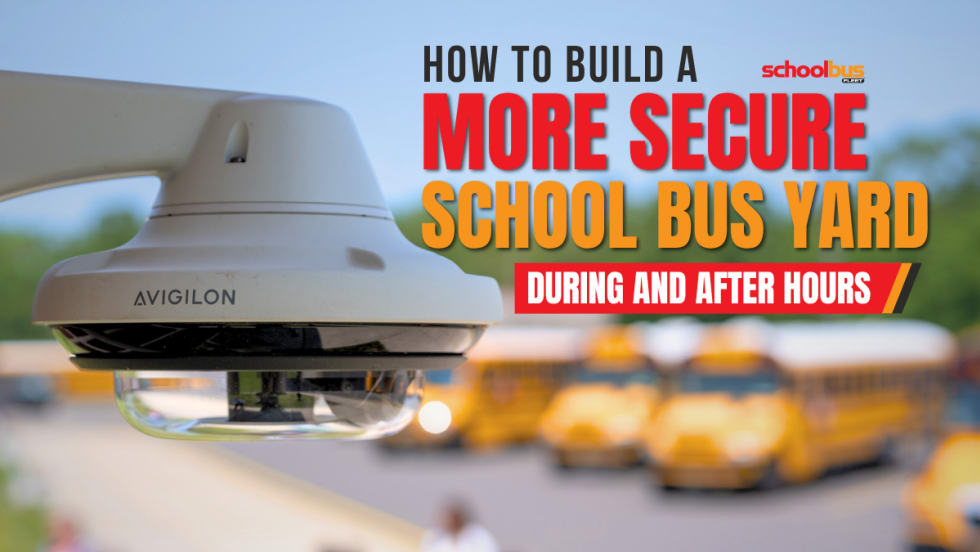
How To Build a More Secure School Bus Yard During and After Hours
As thefts and overnight security threats continue, school transportation leaders are combining stronger operational practices with AI-enabled surveillance to better protect buses, facilities, and staff.
Read More →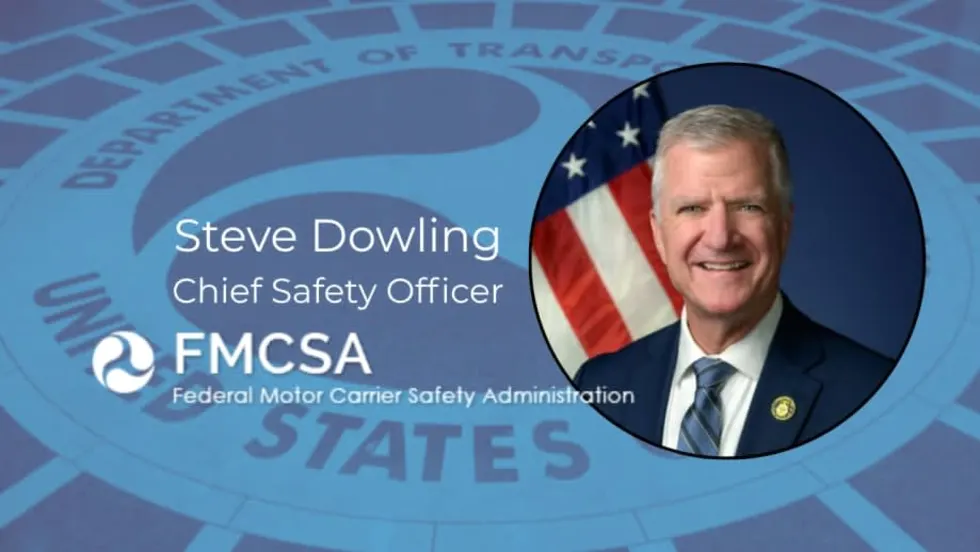
FMCSA Names New Chief Safety Officer: What School Bus Operators Should Know
Steve Dowling is set to lead the federal agency's efforts to advance commercial motor vehicle safety and reduce crashes, fatalities, and injuries on the nation's roadways.
Read More →