





Related: Study Shows Propane School Buses Reduce Harmful Emissions
Georgia District Adds 23 Propane School Buses
Henry County Schools' Blue Bird Vision propane buses are expected to emit 500 fewer pounds of particulate matter per year and about 19,000 fewer pounds of nitrogen oxide than the diesel buses they replaced.
November 14, 2019
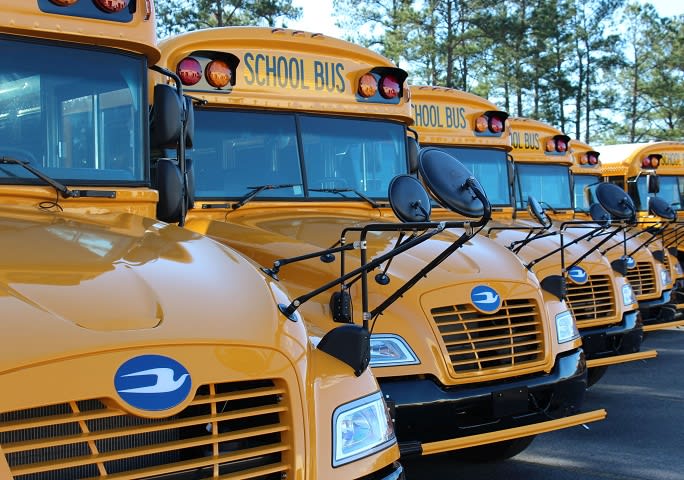
Henry County (Ga.) Schools' 23 Blue Bird Vision propane school buses are expected to emit 500 fewer pounds of particulate matter per year than the diesel buses they replaced. File photo
2 min to read
Henry County (Ga.) Schools' 23 Blue Bird Vision propane school buses are expected to emit 500 fewer pounds of particulate matter per year than the diesel buses they replaced. File photo
HENRY COUNTY, Ga. — A school district here recently added a total of 23 Blue Bird Vision propane school buses to its fleet.
Henry County Schools rolled out its new propane buses — purchased with $104,000 in grant funding — at the start of the 2019-20 school year, according to a news release from Roush CleanTech, the propane system supplier for Blue Bird. The district made the switch from diesel to propane this year after receiving several positive reports from other Georgia districts that added propane buses to their fleets. Henry County later solidified its decision when Roush CleanTech hosted a group of the district’s staff members at its facility in Livonia, Mich., according to the propane system supplier.
“After seeing their technology and how it works, the maintenance on the buses, and what goes into the fuel itself, it was obvious to us that propane was a great fuel choice,” said Cliff Shearhouse, the transportation director for Henry County Schools.
Located in the heavy traffic area of the Atlanta suburbs, the district currently transports 24,000 students on about 300 routes daily.
Henry County’s new propane buses are expected to emit 500 fewer pounds of particulate matter per year and about 19,000 fewer pounds of nitrogen oxide (NOx) annually compared to the 23 diesel buses they replaced (which were 1995 to 2006 model years), according to Roush CleanTech.
With a limited number of public fueling stations in the area, Henry County Schools enlisted the help of Superior Energy Systems to create an onsite propane fueling station, which included two propane dispensers and an 18,000-gallon tank.
Additionally, Shearhouse reported that after signing a fuel contract with Blossman Gas, the district pays on average about $1.60 per gallon for propane compared to $2.80 per gallon for diesel fuel. He also noted the positive feedback from bus drivers about how quiet the buses are and the financial and time-saving advantages of propane for quick bus starts during the colder, winter months.
Shearhouse advised other school districts looking to add propane buses to their fleets to ensure their request for proposals for infrastructure and fuel are accurate, and that they can cater to their district’s future operational plans.
Currently, about 7.5% of Henry County Schools' fleet is propane, but the district anticipates operating an all-propane fleet within the next 10 years, according to Roush CleanTech.
In related news, Blue Bird recently celebrated the delivery of its 15,000th propane-powered school bus after school districts in Virginia and Pennsylvania added more than a dozen propane-fueled buses to their fleets.
More Alternative Fuels

CALSTART and Forth Combine to Form Catalyst Mobility
The new name represents a renewed vision for the nonprofit focused on advancing clean, equitable, and affordable transportation solutions that move people and goods.
Read More →
Alt-Fuel Moves: New Buses, Charging Hubs & Real-World EV Testing
Propane and electric school bus deployments continue to grow as districts add new vehicles, expand charging infrastructure, and gather more real-world operating data.
Read More →
Fewer Electric School Bus Models Reshape the U.S. Market
WRI’s latest buyer’s guide points to a consolidating electric school bus market, but fewer options may reflect a maturing industry rather than fewer meaningful choices for school bus operators.
Read More →
The Fuel Budget You Can Actually Predict: How Propane Autogas Keeps Money in the Classroom
Learn how propane autogas helps school districts manage fuel costs with predictable pricing, lower maintenance, and reduced emissions from former transportation director Joel Stutheit.
Read More →
Hendrickson, Driventic Introduce New Electric Powertrain for School Buses
ELECTRAAX, the electrified, lightweight drive axle offers integrated ePowertrain efficiency and modular flexibility for Class 6–7 school bus use.
Read More →
The Mobility House Joins PowerFlex in Fleet Electrification Deal
The acquisition combines intelligent charging software, bidirectional charging expertise, and fleet electrification services to support the growing adoption of electric school buses across North America.
Read More →
Alt-Fuel Moves: Electric School Bus Investments Hit the Road
See which districts across the U.S. are putting electric school buses into service, expanding charging infrastructure, and planning the next phase of fleet electrification.
Read More →
With Fuel Volatility Ahead, School Districts Turn to Propane
While diesel prices peaked above $5 this spring, districts with propane autogas-powered fleets paid under $2 per gallon, according to PERC.
Read More →
EPA Unveils Proposed Changes to 2027 Heavy-Duty Engine Rules
The federal agency has proposed changes to next year’s targets that would eliminate DEF derates, ease warranty requirements, and retain current NOx emissions standards.
Read More →
Alt-Fuel Moves: EV Charging & Infrastructure Projects Gain Momentum
The latest developments include new funding, charging infrastructure, utility investments, and fleet technologies designed to support the transition to electric school buses nationwide.
Read More →