




Fuel-Price Dip Likely Only Temporary Reprieve
Retail fuel prices have never increased so quickly on a percentage basis over a three-week period, according to the Department of Energy.

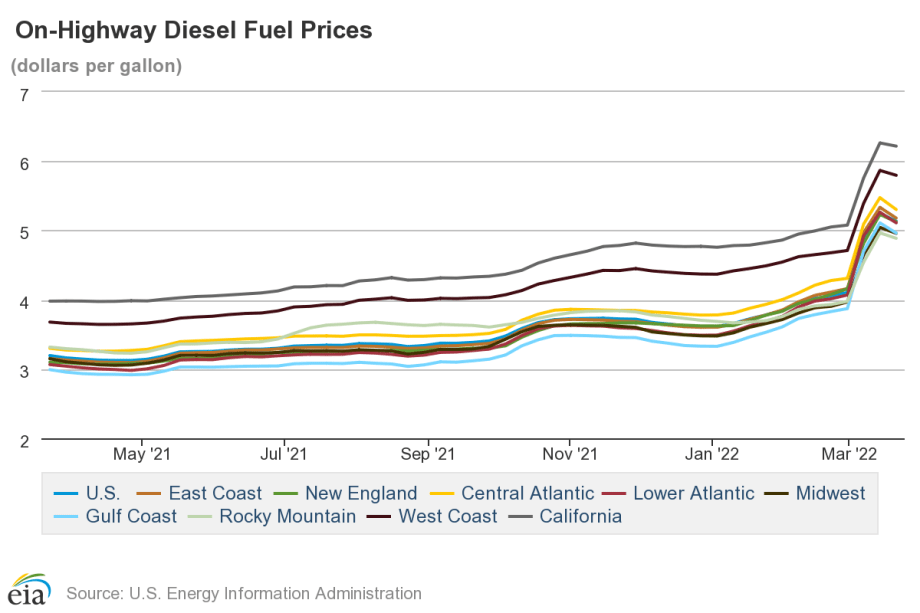
Fuel-industry experts don't expect last week's dip in diesel prices to continue.
Source: DOE's Energy Information Administration
Although retail diesel fuel prices took a slight dip last week after skyrocketing to record highs the past few weeks, that’s not likely a trend that will continue, as traders warn of global diesel shortages.
In just three weeks, the national average price of ultra-low-sulfur No. 2 diesel rose 29%, by $1.19 per gallon, from $4.06 per gallon on Feb. 14 to a record $5.25 on March 14, according to numbers from the Department of Energy. As usual, prices are even higher in California, where they hit $6.26.
Retail gasoline prices peaked on March 14 at $4.32 per gallon, a 22% increase from $3.53 on Feb. 21.
The DOE points out that when adjusted for inflation, prices are still lower than all-time highs in 2008. However, retail fuel prices have never increased so quickly on a percentage basis over a three-week period in the agency’s data, which for gasoline dates back to August 1990 and for diesel dates back to March 1994.
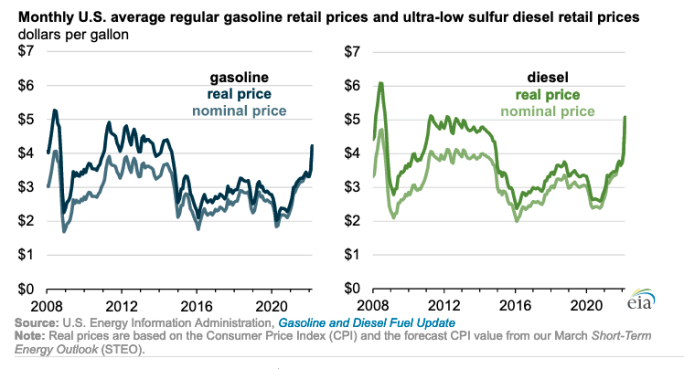
Adjusted for inflation, fuel prices are not quite at record highs.
Source: DOE's Energy Information Administration
The national average dropped slightly the following week to $5.13, but don’t expect that to last.
How High Will Fuel Prices Go?
Tom Kloza, global head of energy analysis at Oil Price Information Service, said in a tweet that Monday morning brought soaring wholesale prices for diesel, gasoline, and crude oil. Futures and wholesale numbers tend to be passed on to retail within 48 hours.
“No end in sight to diesel price inflation,” he said in another tweet. “Futures surpass $3.84 gal and nationwide average is $5.04 gal. CA average is $6.264 gal. I would not be surprised to see $5-$6.50 gal diesel prevail through 2nd, 3rd and 4th quarters.” California diesel could top $7.
Leaders from three of the largest commodity traders, speaking at a Financial Times Commodities Global Summit in Switzerland, warned that sanctions on Russia following its invasion of Ukraine mean global markets face a squeeze on diesel. A shortage that could lead to fuel rationing in Europe also could mean higher prices in the U.S. because of the way oil and diesel prices are tied to the global market.
“Diesel is not just a European problem, this is a global problem. It really is,” said Torbjorn Tornqvist, co-founder and chair of Geneva-headquartered Gunvor Group, according to a report in the Financial Times.
Another executive predicted that 2 million to 2.5 million barrels of Russian oil production would go missing from the global market, split between crude and refined products, according to that same report.
The situation led to the International Energy Agency on March 18 calling for emergency measures to cut global oil demand.
If fully carried out in advanced economies, it said, the measures recommended by the IEA’s new 10-Point Plan to Cut Oil Use would lower oil demand by 2.7 million barrels a day within four months — equivalent to the oil demand of all the cars in China.
Since the majority of oil demand comes from transport, the IEA’s plan focuses on how to use less oil getting people and goods from A to B. The short-term actions it proposes include lower speed limits, working from home, occasional limits on car access to city centers, cheaper public transport, more carpooling and other initiatives — and greater use of high-speed rail and virtual meetings instead of air travel.
“As a result of Russia’s appalling aggression against Ukraine, the world may well be facing its biggest oil supply shock in decades, with huge implications for our economies and societies,” said IEA Executive Director Fatih Birol.
Originally posted on Heavy Duty Trucking
More Management

How to Build a Better Driver Training Program
Ready to boost up your school bus instructor training? Here’s how to pick the right talent and improve recruitment, retention, and safety.
Read More →
CALSTART and Forth Combine to Form Catalyst Mobility
The new name represents a renewed vision for the nonprofit focused on advancing clean, equitable, and affordable transportation solutions that move people and goods.
Read More →
What Makes a Great School Bus Driver Trainer?
Choosing the right school bus driver trainer takes more than experience. Learn six keys to selecting and developing trainers and evaluating program effectiveness.
Read More →

School Bus Contractors Expand Through New Deals, Acquisitions & Partnerships
STA's Canadian division acquires Ontario-based G&L Stevenson Transport; Durham School Services adds a new district in California; First Student expands in New Jersey; and Minnesota Coaches rebrands and acquires Halo Transportation.
Read More →
Logan Bus Company Rolls Out AI Phone System for NYC School Bus Families
A summer pilot found that AI agents could handle most routine calls, freeing up time for customer service staff to focus on emergencies and complex family concerns.
Read More →
From Intent to Impact: What I Learned About Leadership from TAPT
A Texas transportation supervisor shares lessons on self-awareness, accountability, managing stress and building trust — and why investing in leadership development matters at every stage of your career.
Read More →
NAPT Names 2026 Award Recipients, Hall of Fame Inductee
Who earned national recognition for their work in student transportation? This year, NAPT named five recipients of its 2026 awards for service, safety, and leadership, plus its newest Hall of Famer.
Read More →
2026 State of Student Transportation Report
Driver shortages. Rising costs. Growing safety expectations. More data, but not enough time to act on it. The 2026 State of Student Transportation Report reveals what transportation leaders say is putting the most pressure on their operations—and where they’re investing next. See how your priorities compare.
Read More →
How to De-Escalate an Angry Person: 5 Steps for Handling Workplace Conflict
What makes emotions run high, and how should you handle an angry colleague or parent? Follow these steps for staying calm, listening, showing empathy, and resolving conflict.
Read More →
What Readiness Looks Like This School Year
Learn about the challenges shaping the 2026–2027 school year, from persistent driver shortages and budget pressure to technology and readiness gaps. See how school districts are responding and adapting in Zonar’s 2026 Back-to-School Readiness Report.
Read More →