




Freightliner unveils autonomous truck
The Freightliner Inspiration Truck is designed to maintain legal speed, stay in the selected lane, keep a safe braking distance from other vehicles, and slow or stop based on traffic and road conditions.

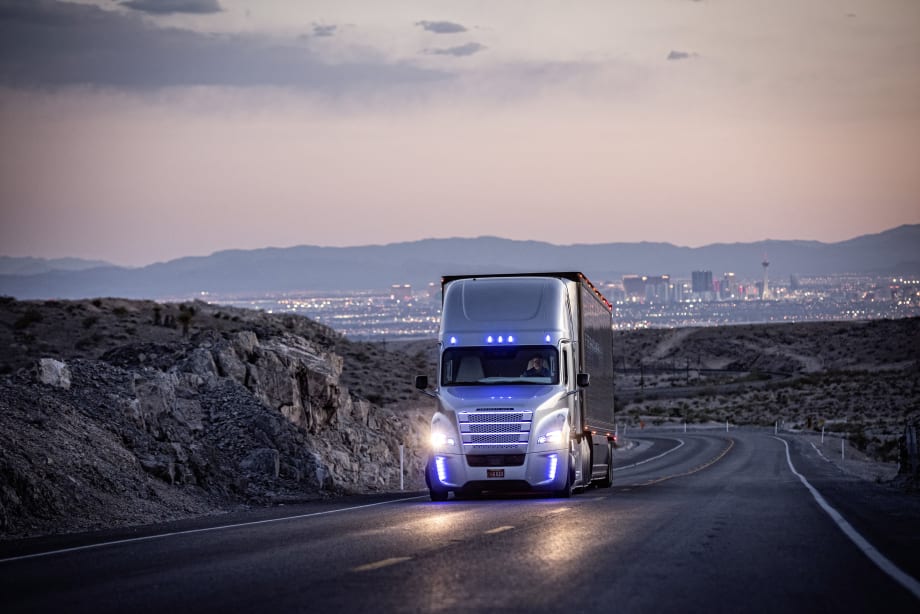
The Freightliner Inspiration Truck was unveiled in Las Vegas on Wednesday. It is designed to maintain legal speed, stay in the selected lane and keep a safe braking distance from other vehicles.
LAS VEGAS — In a ceremony at Hoover Dam on Wednesday, Daimler Trucks North America (DTNA) unveiled the Freightliner Inspiration Truck to international news media, trucking industry analysts and officials.
The vehicle is the first licensed autonomous commercial truck to operate on an open public highway in the U.S., company officials said. Developed by engineers at DTNA, it is designed to unlock autonomous vehicle advancements that reduce accidents, improve fuel consumption, cut highway congestion and safeguard the environment.
DTNA is also the parent company of Thomas Built Buses.
Some of the core autonomous vehicle systems in the concept vehicle are already successfully deployed in the current Freightliner Cascadia Evolution truck, company officials said.
The autonomous truck underwent extensive testing before the Nevada Department of Motor Vehicles granted a license to operate it on public roads in the state, according to the company. On Tuesday, Nevada Gov. Brian Sandoval formally granted the license to operate the vehicle in the state, affixing a license plate to the truck and taking part in the ceremonial first drive of the truck in autonomous mode.
The truck is equipped with Highway Pilot sensors, and computer hardware is based upon a series production Freightliner Cascadia Evolution, fully certified to meet all U.S. Federal Motor Vehicle Safety Standards, company officials said. The Highway Pilot links a set of camera technology and radar systems with lane stability, collision avoidance, speed control, braking, steering and other monitoring systems. This combination creates what the National Highway Traffic Safety Administration defines as a Level 3 autonomous vehicle operating system that can perform safely under a range of highway driving conditions.
The operating system enables the driver to cede full control of all safety-critical functions under certain traffic or environmental conditions. The autonomous vehicle system is responsible for maintaining legal speed, staying in the selected lane, keeping a safe braking distance from other vehicles, and slowing or stopping the vehicle based on traffic and road conditions. The vehicle monitors changes in conditions that require transition back to driver control when necessary in highway settings. The driver is in control of the vehicle for exiting the highway, on local roads and in docking for making deliveries.
In total, two trucks with this equipment exist. Trucking industry analysts and international media were given the chance to ride in the two trucks on public roads near the Las Vegas Motor Speedway on Wednesday as the vehicle operated in autonomous mode.
“With the Freightliner Inspiration Truck, drivers can optimize their time on the road while also handling other important logistical tasks, from scheduling to routing,” said Richard Howard, DTNA's senior vice president, sales and marketing. “The autonomous vehicle technology not only contributes to improved safety and efficiency, but allows for improved communication through connectivity and integration.”
For more information, visit www.freightlinerinspiration.com.
More Safety

How to Build a Better School Bus Driver Training Program
Is it time to strengthen your driver training? Here’s how to pick the right talent and improve recruitment, retention, and safety. This video is brought to you by IC Bus.
Read More →
Recent School Bus Accidents Leave 2 Dead, 2 Injured
Four school bus crashes in Florida, Illinois, and Georgia highlight risks in transportation lots, at bus stops, and during student loading and unloading.
Read More →
When Every Second Matters, Clarity Keeps Routes Moving
From routine delays to urgent incidents, strong communication practices help drivers, dispatchers, schools, and families respond with confidence.
Read More →

What Happens When a School Bus Catches Fire — and What Can Help
School bus fires are rare but can be devastating. Learn how advances in fire suppression and asset protection help fleets detect fires earlier, reduce damage, and improve safety.
Read More →
Geotab Launches Tool to Help Fleets Investigate Road Incidents
Geotab Investigations combines telematics data, video, documents, and other evidence to help fleets reconstruct incidents, resolve claims, and determine what happened.
Read More →
Texas Sixth Grader Wins 2026 National School Bus Safety Poster Contest
Sai Darshana Yekolu of Moseley Middle School in Prosper, Texas, was named the newest winner for her artwork, bringing the theme of “Safe Rides, Everyday Heroes” to life.
Read More →
Doing More With Less: How Transportation Directors Can Prioritize Safety Amid Budget Uncertainty
With diesel prices soaring and nearly one-third of transportation directors expecting budget cuts, maintaining student safety has never been more challenging. Download this guide to learn how leading districts are prioritizing risk, funding critical safety technology, and building stronger budget cases with data.
Read More →
Walton County Schools Adds Gatekeeper Stop-Arm Enforcement System
The Florida district will deploy Gatekeeper’s updated Student Protector technology, which now incorporates AI to improve video evidence.
Read More →
How To Build a More Secure School Bus Yard During and After Hours
As thefts and overnight security threats continue, school transportation leaders are combining stronger operational practices with AI-enabled surveillance to better protect buses, facilities, and staff.
Read More →
FMCSA Names New Chief Safety Officer: What School Bus Operators Should Know
Steve Dowling is set to lead the federal agency's efforts to advance commercial motor vehicle safety and reduce crashes, fatalities, and injuries on the nation's roadways.
Read More →