




Did You Miss: Closer Look: Southern States Among Largest Round 1 Clean School Bus Beneficiaries
Four Key Lessons Learned for School Bus Electrification
The Center for Transportation and the Environment partnered with the World Resource Institute’s Electric School Bus Initiative to prepare technical plans for three school districts. Although needs varied, they found some common lessons.
by SBF Staff
February 2, 2023
Three districts in Washington state, Oklahoma, and Pennsylvania were assisted with electric school bus feasibility plans.
Image: Canva/CTE
3 min to read
Two organizations with a focus on green transportation teamed with three United States school districts to evaluate operational needs and provide detailed plans outlining resources and decisions necessary to transition to an all-electric school bus fleet.
The Center for Transportation and the Environment (CTE) and World Resource Institute’s (WRI) Electric School Bus Initiative prioritized partnerships with school districts in historically underserved communities, based on air quality, income and racial demographics, or tribal status. The fleets considered varied operationally, geographically, and in fleet size.
“The diversity of fleets allowed CTE and WRI to identify challenges and offer findings and solutions as guidance to other school districts interested in electrifying their fleets,” a news release stated.
The chosen districts included:
Yakima School District No. 7 (Yakima, Wash.)
Reading School District (Reading, Penn.)
The Chickasaw Nation (Ada, Okla.)
Despite each district facing different needs, CTE and WRI reported four lessons learned that proved common:
Most Districts Don’t Need Shared 50kW Chargers
The organizations found that a 50kW DC fast charger shared across two buses isn’t much faster than two separate 19kW Level 2 AC chargers, but it’s more expensive to purchase, install, and manage. Relying on fewer chargers also may require manually moving charger cables or vehicles to ensure adequate charging is provided.
“Unless a 50kW DC fast charger answers a specific need, the extra benefit may be overshadowed by the additional costs,” the CTE reported.
Level 2 AC Chargers Work for Much of a District’s Needs
Most bus routes analyzed for this project were well covered by charged with a single 80A 19kW Level 2 AC charger. Some exceptions exist, and some fleets have routes that need larger batteries or high-power midday charging. Rural fleets and fleets consisting mostly of Type A school buses can expect greater challenges with longer routes and smaller batteries, increasing the need for higher-power charging.
“Finding the right balance between infrastructure cost and operating constraints is critical, but most school bus fleets can work with mostly Level 2 charging,” the CTE stated, “and this is likely a good place for many fleets to start.”
Field Trip Routes Might Require Additional Charging Upgrades
Extracurricular field trip routes may be too long for a single Level 2 charge given range limitations of current electric school bus technology. This may require mid-day charging or DC fast-charging, which would call for additional infrastructure, utility investments, and skilled technicians.
“This may be especially challenging for rural districts (that) are more geographically isolated and require longer travel to and from extracurricular events,” according to the CTE.
Consider Discrepancies Between Projected Costs and Construction Estimates
Charging infrastructure costs vary greatly depending on many factors.
“CTE provided a high-level cost estimate for each fleet based on assumptions from WRI research and other CTE projects,” the organization reported. “In CTE’s experience, a cost estimate from a design-build firm can be much higher than this early estimate. A school district considering ESBs should engage a design-build firm early in the process to gather more concrete cost information that will help in determining necessary funding.”
Detailed cost estimates also help a district plan a phased approach over time to work with its overall operation and procurement schedule.
More Alternative Fuels

CALSTART and Forth Combine to Form Catalyst Mobility
The new name represents a renewed vision for the nonprofit focused on advancing clean, equitable, and affordable transportation solutions that move people and goods.
Read More →
Alt-Fuel Moves: New Buses, Charging Hubs & Real-World EV Testing
Propane and electric school bus deployments continue to grow as districts add new vehicles, expand charging infrastructure, and gather more real-world operating data.
Read More →
Fewer Electric School Bus Models Reshape the U.S. Market
WRI’s latest buyer’s guide points to a consolidating electric school bus market, but fewer options may reflect a maturing industry rather than fewer meaningful choices for school bus operators.
Read More →
The Fuel Budget You Can Actually Predict: How Propane Autogas Keeps Money in the Classroom
Learn how propane autogas helps school districts manage fuel costs with predictable pricing, lower maintenance, and reduced emissions from former transportation director Joel Stutheit.
Read More →
Hendrickson, Driventic Introduce New Electric Powertrain for School Buses
ELECTRAAX, the electrified, lightweight drive axle offers integrated ePowertrain efficiency and modular flexibility for Class 6–7 school bus use.
Read More →
The Mobility House Joins PowerFlex in Fleet Electrification Deal
The acquisition combines intelligent charging software, bidirectional charging expertise, and fleet electrification services to support the growing adoption of electric school buses across North America.
Read More →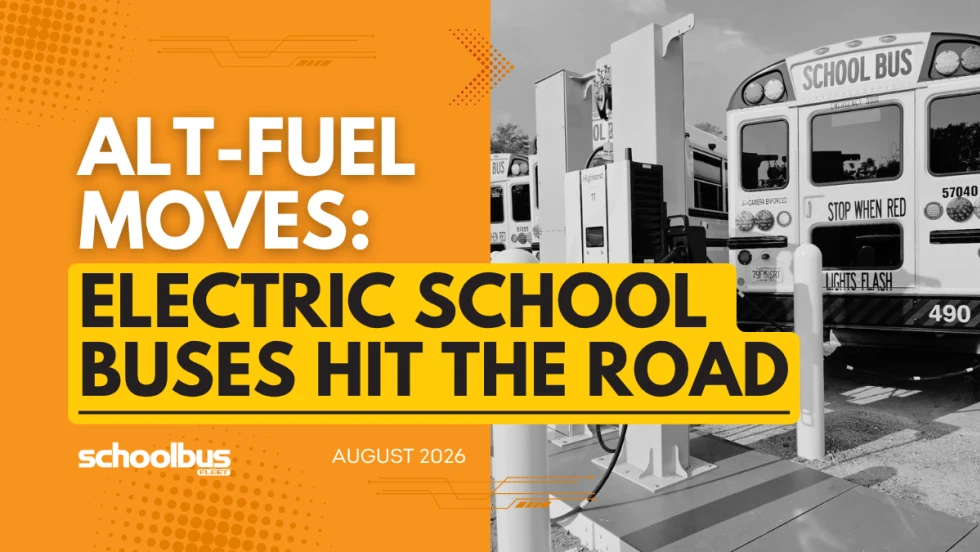
Alt-Fuel Moves: Electric School Bus Investments Hit the Road
See which districts across the U.S. are putting electric school buses into service, expanding charging infrastructure, and planning the next phase of fleet electrification.
Read More →
With Fuel Volatility Ahead, School Districts Turn to Propane
While diesel prices peaked above $5 this spring, districts with propane autogas-powered fleets paid under $2 per gallon, according to PERC.
Read More →
EPA Unveils Proposed Changes to 2027 Heavy-Duty Engine Rules
The federal agency has proposed changes to next year’s targets that would eliminate DEF derates, ease warranty requirements, and retain current NOx emissions standards.
Read More →
Alt-Fuel Moves: EV Charging & Infrastructure Projects Gain Momentum
The latest developments include new funding, charging infrastructure, utility investments, and fleet technologies designed to support the transition to electric school buses nationwide.
Read More →