




California Conference Highlights Student Safety, Celebrates 50 Years
Members of the California Association of School Transportation Officials gather in San Diego for refreshers on student safety issues and to mark a big anniversary.


Sandy Dillman, CASTO's state secretary (left), and Mike Sawyer, a CASTO program chair, celebrate the association's 50-year anniversary. Photo by DG Photo LA, courtesy of CASTO

Sandy Dillman, CASTO's state secretary (left), and Mike Sawyer, a CASTO program chair, celebrate the association's 50-year anniversary. Photo by DG Photo LA, courtesy of CASTO
SAN DIEGO — Pupil transporters converged here on Saturday for refreshers on their impact on students, student safety issues, and to celebrate the California Association of School Transportation Officials’ (CASTO’s) 50th anniversary.
The conference kicked off with Management Consultant Dr. Cal LeMon telling the audience that during his 20-plus years working with clients in pupil transportation, CASTO is among those he has valued the most because of its members’ dedication to the organization and the students they serve.
He reminded attendees of the impact they have, especially on the children they transport.
“You leave an imprint that stays for a long time,” LeMon said.
He then shared a memory of how his second-grade school bus driver left an imprint on him, despite the fact that he couldn’t remember the man’s name.
What he did remember was that when he accidentally dropped and ruined an art project that was very important to him while walking down the bus steps and got very upset, the driver had put the bus in neutral and given him a hug.
Having worked with clients all over the world, LeMon said he learned that a person’s affect (what they feel) matters much more than their cognition (what they know) when it comes to imprinting others positively or negatively.
He reminded the audience that negativity goes through the bus very quickly. However, when transportation professionals, especially drivers, are positive, they have a substantial impact on students, causing them to think, ‘You have not only given me a safe trip today, but you care about me.’
When experiencing a workplace conflict, he recommended embracing the discomfort and taking the coworker or employee aside.
“Tell them, ‘I need to tell you what I am thinking or feeling. I want to resolve this,’” he advised. “We have to find amicable ways to be honest with each other without ripping each others’s heads off in the process."
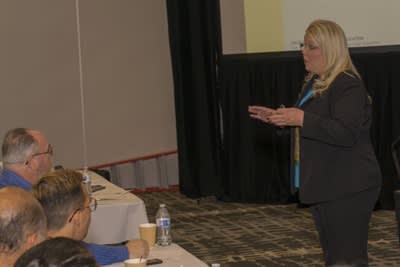
Stephanie Oliver, a transportation programs consultant at the California Department of Education (DOE), updated attendees on the status of a law requiring child-check reminder alert systems in the state. Photo by DG Photo LA, courtesy of CASTO
In one of the first sessions, Stephanie Oliver, a transportation programs consultant at the California Department of Education (DOE), updated attendees on the status of a law requiring child-check reminder alert systems in the state.
Special-needs student Paul Lee died in September 2015 in Whittier, California, after being left unsupervised on a school bus for several hours on a hot day. His death spurred a bill, introduced by Sen. Tony Mendoza, that would require all school buses in the state to be equipped with child-check reminder alarm systems and for bus drivers to be trained on those systems. That bill was signed into law in September 2016.
The law required a plan be put in place with procedures to ensure that a student is not left unattended on a school bus or vehicle used to transport students by Jan. 1, 2017. It added information to California Education Code 39831.3 (5) to require “procedures and standards for designating an adult chaperone, other than the driver, to accompany pupils on a school pupil activity bus.”
Another update is the addition of the Notice of Disciplinary Action or Finding of Gross Negligence, Oliver said. That requires school transportation operators to notify the California Department of Motor Vehicles within five calendar days of disciplinary action taken against a driver who left the vicinity of a vehicle with an unsupervised student on board. (In this section of the code, “gross negligence” means “the want of even scant care or an extreme departure from the ordinary standard of conduct,” she pointed out.)
“There is a process we have to comply with,” Oliver told attendees. “We don’t get to say, 'They have been a driver for 30 years,’ or ‘They have been a driver for two weeks.' We have to report [the incident and disciplinary action].”
The school district or transportation company identifies how, when, and where the procedure for checking for unattended students will be done, and determines due process and disciplinary procedures for a driver who left an unsupervised pupil onboard. These procedures must be updated in the transportation safety plan, per Education Code 39831.3, Oliver said. She recommended that pupil transporters add these procedures to their policies and procedures and driver handbook, per California Education Code 39843, which went into effect Jan. 1, 2017.
School districts that contract out school bus service must also ensure that the contractor is aware of the policy to ensure students are not left behind on the bus, and that the contractor has a child-check system in place.
Regarding child check alert systems and the law, Oliver told attendees that the California Highway Patrol had the job of writing the specifications for installation and the use of the system. Those specifications are available and went into effect on Jan. 1, 2018.
The deadline to have the systems in place on all school buses and vehicles is still on or before the start of the 2018-19 school year. (A proposed bill to extend the deadline to 2019-2020 died because Sen. Mendoza had resigned his state Senate seat in February.) Pupil transporters are being proactive and scheduling to have the systems added, Oliver said. The many transporters that currently have a system need to ensure that it meets the specifications.
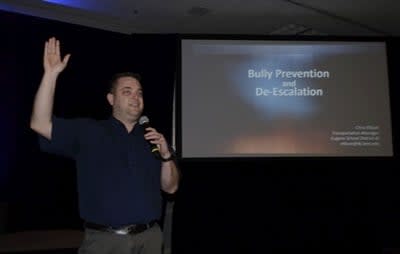
Chris Ellison, the transportation manager at Eugene (Ore.) School District 4J, discussed types of bullying and how to prevent and de-escalate them.
On Saturday afternoon, Chris Ellison, the transportation manager at Eugene (Ore.) School District 4J, discussed types of bullying and how to prevent and de-escalate them.
To emphasize what a serious problem bullying presents, Ellison showed a news clip from 2011 with footage of a student on a Virginia bus being verbally and physically bullied by two other students. The victim suffered post-traumatic stress disorder and the boys who were charged with assaulting the special-needs student pled guilty. The bus driver was charged with felony neglect, but was acquitted, Ellison said.
There are three categories of bullying: physical, verbal, and social. In particular, social bullying, which includes leaving someone out on purpose, telling others not to be friends with someone, spreading rumors about someone, embarrassing someone in public, and harassing people via social media, text, etc., has severe effects, Ellison said.
The school bus is an ideal location for bullying, he pointed out, because supervision is minimal with only one adult, who is primarily concentrating on driving, on board. There is also a hectic rush of activity during boarding that makes small bullying tactics hard to spot, high-back seats can make it difficult to see students, and the bus is a small, closed space. Moreover, for many bullying victims, the school bus is their only way to and from school.
However, Ellison noted, pupil transporters are in a position to stop bullying.
Effective behavior management can lay the groundwork for preventing bullying on the bus. Since the bus driver is likely to be the first person to see the students in the morning and the last person to see them in the evening, they are in a unique position to observe any evidence of bullying.
Drivers can greet students and address them by name, which goes a long way toward building a relationship and trust, Ellison said.
Ellison shared additional components to a successful behavior management program employed by his district’s transportation department. Those include being respectful of and showing interest in students; clearly communicating the expected behavior on the bus and that harassment of any kind is unacceptable; drawing attention to good behavior; and being consistent and fair in addressing all problem behaviors.
To demonstrate an effective response to bullying, Ellison also showed a video titled “What Are You Going to Do?”, which covers an eight-step system. Steps include stopping the bullying and taking control of the situation, addressing the bully or bullies, providing emotional support and protection for the victim, and making the incident a teachable moment for bystanders.
Ellison’s district provides continuing education for all transportation employees on recognizing the signs of bullying, he added, such as a fear of boarding the bus, trying to miss the bus, ripped clothes or missing possessions, or signs of physical abuse.
Meanwhile, the trade show floor offered glimpses of alternative-fuel vehicles, including IC Bus’s new concept electric school bus, the ChargE, and Blue Bird’s Propane Vision. Other show floor vendors included Transfinder, which, like CASTO, is also celebrating an anniversary (30 years), Fogmaker, Q’Straint, Safe Fleet, and Zonar.
CASTO members also celebrated their association’s half-century milestone with a black-tie dinner and dancing event on Saturday evening.
More Management
How to Build a Better Driver Training Program
Ready to boost up your school bus instructor training? Here’s how to pick the right talent and improve recruitment, retention, and safety.
Read More →
CALSTART and Forth Combine to Form Catalyst Mobility
The new name represents a renewed vision for the nonprofit focused on advancing clean, equitable, and affordable transportation solutions that move people and goods.
Read More →
What Makes a Great School Bus Driver Trainer?
Choosing the right school bus driver trainer takes more than experience. Learn six keys to selecting and developing trainers and evaluating program effectiveness.
Read More →


School Bus Contractors Expand Through New Deals, Acquisitions & Partnerships
STA's Canadian division acquires Ontario-based G&L Stevenson Transport while Durham School Services adds a new district contract in California, First Student adds a New Jersey contract, and Minnesota Coaches acquires Halo Transportation.
Read More →
Logan Bus Company Rolls Out AI Phone System for NYC School Bus Families
A summer pilot found that AI agents could handle most routine calls, freeing up time for customer service staff to focus on emergencies and complex family concerns.
Read More →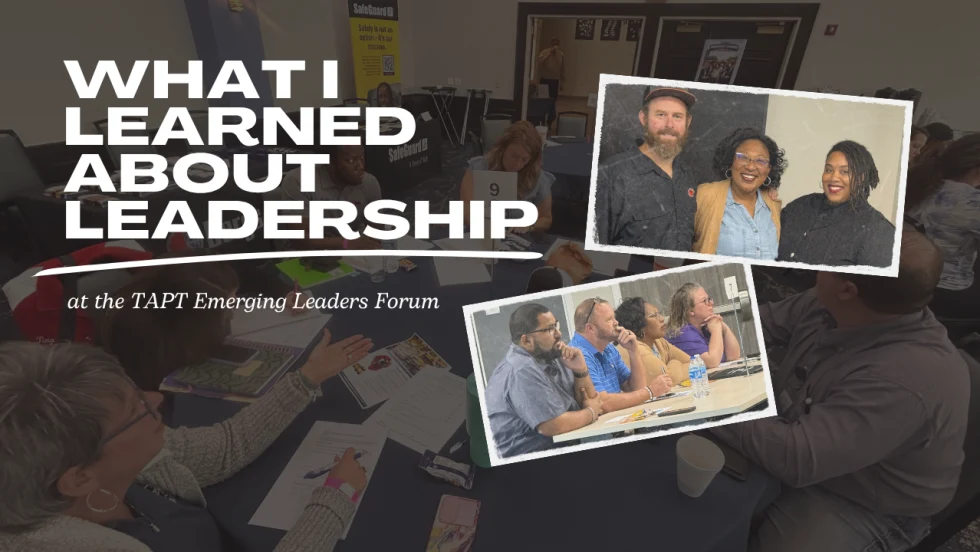
From Intent to Impact: What I Learned About Leadership from TAPT
A Texas transportation supervisor shares lessons on self-awareness, accountability, managing stress and building trust — and why investing in leadership development matters at every stage of your career.
Read More →
NAPT Names 2026 Award Recipients, Hall of Fame Inductee
Who earned national recognition for their work in student transportation? This year, NAPT named five recipients of its 2026 awards for service, safety, and leadership, plus its newest Hall of Famer.
Read More →
2026 State of Student Transportation Report
Driver shortages. Rising costs. Growing safety expectations. More data, but not enough time to act on it. The 2026 State of Student Transportation Report reveals what transportation leaders say is putting the most pressure on their operations—and where they’re investing next. See how your priorities compare.
Read More →
How to De-Escalate an Angry Person: 5 Steps for Handling Workplace Conflict
What makes emotions run high, and how should you handle an angry colleague or parent? Follow these steps for staying calm, listening, showing empathy, and resolving conflict.
Read More →
What Readiness Looks Like This School Year
Learn about the challenges shaping the 2026–2027 school year, from persistent driver shortages and budget pressure to technology and readiness gaps. See how school districts are responding and adapting in Zonar’s 2026 Back-to-School Readiness Report.
Read More →