




California Conference Explores School Bus Driver’s Crucial Role in Safety
Loading and unloading procedures and communication were some of the topics covered at the California Association of School Transportation Officials' annual conference in Anaheim.

Pam McDonald, CASTO president (center), recognized attendees who have driven a school bus for the longest and shortest periods of time. Shown with her are Christie Anthony of Kern County Superintendent of Schools and Jason Cannon of Apple Valley Unified School District.

Pam McDonald, CASTO president (center), recognized attendees who have driven a school bus for the longest and shortest periods of time. Shown with her are Christie Anthony of Kern County Superintendent of Schools and Jason Cannon of Apple Valley Unified School District.
ANAHEIM, Calif. — Communication styles, loading and unloading procedures, and giving constructive feedback were some of the key issues covered during the California Association of School Transportation Officials’ (CASTO’s) annual conference.
Pam McDonald, president of CASTO, kicked off the event on Saturday by recognizing attendees who have driven a school bus for the longest and shortest periods of time: two who have driven for 47 years each and two who have transported students for two months. The drivers with the longest-running careers were anointed “king and queen,” and those who are new to the profession were named “prince and princess” of the conference.
“School buses are the safest mode of transportation, thanks to you guys,” McDonald told the audience. “Students look to us to protect them. Let’s remember that that’s our mission.”
Keynote speaker Vicki Sanderson energized the audience with humorous insights on the variety of personality types, their communication styles, and how those mix in the workplace, as well as dealing with difficult people.
She asked attendees to envision various shapes and select the one that they felt suited their personality. She then shared traits and style for each of the “types” — circle, square, triangle, and squiggly line — and how they work together. Sanderson then detailed the communication pattern types: passive, aggressive, passive-aggressive, and assertive.
Difficult people, she noted, choose to act that way because it gets them the results they want.
“Be careful with your difficult people,” Sanderson warned. “There’s a temptation to give in to them so you don’t have to deal with them.”
The importance of following crucial steps in the loading and unloading process was covered by Sabine Konrad, a driver instructor for Visalia Unified School District. She began the session by pointing to a rash of incidents over the course of three days in late 2018, in which five students were killed by motorists who ran a school bus’s stop arm or struck a student at their bus stop.
She then asked attendees to stand and observe a moment of silence for the victims in those crashes.
Konrad emphasized that bus drivers cannot be even slightly distracted during the loading and unloading process, which can be the most dangerous step in transporting students.
“One split second of not paying attention can have a devastating outcome,” she warned.
Konrad outlined the steps a driver should take and when, such as turning on the amber and red lights, deploying the stop arm, getting out of the bus to help students cross (which is only done in California, she noted), checking mirrors, and counting students as they unload. She stressed that these steps should be carried out consistently so as not to confuse the motoring public.
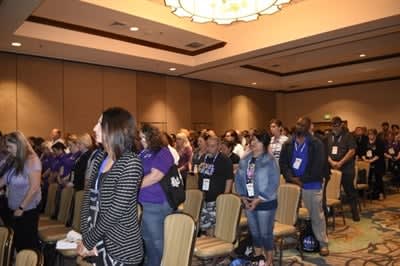
Presenter Sabine Konrad requested a moment of silence for the five students who were killed by motorists in illegal passing incidents or at their bus stop in late 2018.
Alex Robinson, executive director of the New York City Department of Education Office of Pupil Transportation, shared with attendees some of her experiences of the ups and downs of managing the largest pupil transportation fleet in the U.S. As the agency’s longest-standing executive director, having served for seven years in the role, she oversees the transportation of approximately 170,000 students to about 4,000 public and private schools.
One challenge that Robinson recounted was dealing with about 27,000 calls related to school transportation that came in on the first day of this school year, she said. Her staff of 80 customer service representatives was able to handle about 14,000 of those calls immediately.
Robinson also discussed how she has contended with Mayor Bill de Blasio’s request that the department not say there is a bus driver shortage, but instead that “some companies are short of drivers,” the issues of school choice and transporting special-needs students, and pushing against an “it is what it is” mindset.
“I didn’t want to hear, ‘That’s the way it’s always been done,’” she said of when she first came aboard and wanted to make changes.
Rick Weaver, who had been an officer with the California Highway Patrol (CHP) for 27 years before retiring, talked to attendees about crucial steps to take in case of an accident.
Although the CHP investigates school bus crashes with $1,000 or more in damage, he urged attendees to call them even if they are involved in an accident that they don’t think resulted in that level of damage.
“If it’s nothing, they’ll tell you,” Weaver said. “Your certificate [depends on it.]”
He pointed out that many school bus collisions happen when the bus is being driven 10 mph or less, while backing, and due to unsafe starts and turning movements.
Drivers should take the time to become familiar with their vehicle, in particular, with its length, height, and their depth perception behind the wheel, before driving it in an effort to reduce the likelihood of an accident, he added.
If drivers do get into an accident, they should move the bus to the side of the road, take down names and numbers, get an accurate count of students, and follow the officer’s orders.
Also, don’t freely offer up statements to the other driver, Weaver added.
“Don’t admit fault,” he said. “Save your statements for the officer.”
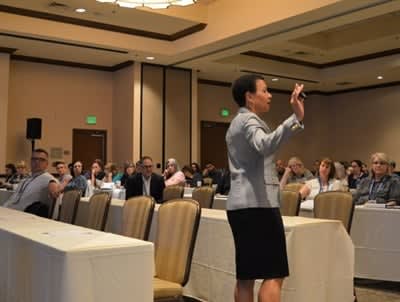
Dr. LaFaye Platter, the former deputy superintendent for Hemet Unified School District (now retired), shared strategies on giving and receiving constructive feedback to transportation personnel.
On Monday, Nico Chavez, the legislative advocate for the School Transportation Coalition, highlighted the state’s accomplishments in allocating $55 million in school bus replacement funding as well as the push for legislation that would require internal and external video camera systems on school buses.
As SBF previously reported, lawmakers introduced two bills — Assembly Bill 934 and Senate Bill 371 — which would require school districts to install internal and external cameras on school buses. Chavez urged attendees to show their support for both pieces of legislation, and the state’s school bus replacement program to ensure students have the “cleanest and safest school buses possible.”
He also noted that the state plans to distribute at least 50% of its Volkswagen settlement funds to replace existing school, transit, and shuttle buses with electric models in the third or fourth quarter of this year.
Later that morning, Dr. LaFaye Platter, retired deputy superintendent for Hemet Unified School District, discussed ways to build positive supervisor-employee relationships in a session titled “The Neuroscience of Giving Constructive Feedback.”
Platter spoke about how the thought of giving and receiving feedback in the workplace causes a neurological fight or flight response, in which employees may feel anxious about the feedback they receive.
To help employees overcome those feelings, Platter said supervisors should increase their visibility in the workplace, focus on and highlight the strengths of employees when asking for or giving feedback, and evaluate how employees perceive feedback over time.
“The biggest part of leadership is building successful work relationships with your employees,” she explained. “It’s one thing to have an open door policy, but employees may not always be ready to go through that door themselves, so you have to take the door to them and solicit feedback.”
Ron Kinney, longtime CASTO member and president of QET Management Services, concluded the conference by presenting recent data on the state’s school bus collisions before and after implementing lap-shoulder belts. The data, collected from the State Highway Patrol between 2006 and 2013-14, showed that injuries from school bus collisions decreased by 57% after installing lap-shoulder belts, and that overall school bus collisions were reduced by 14%.
While California is one of several states that require seat belts on school buses, Kinney said, it’s still important for school districts to create a policy for enforcing lap-shoulder belts on buses.
“If drivers aren’t supported by the district to encourage students to wear lap-shoulder belts, then it will only be harder to enforce a lot of the rules and regulations surrounding them,” he added.
More Management

How to Build a Better Driver Training Program
Ready to boost up your school bus instructor training? Here’s how to pick the right talent and improve recruitment, retention, and safety.
Read More →
CALSTART and Forth Combine to Form Catalyst Mobility
The new name represents a renewed vision for the nonprofit focused on advancing clean, equitable, and affordable transportation solutions that move people and goods.
Read More →
What Makes a Great School Bus Driver Trainer?
Choosing the right school bus driver trainer takes more than experience. Learn six keys to selecting and developing trainers and evaluating program effectiveness.
Read More →


School Bus Contractors Expand Through New Deals, Acquisitions & Partnerships
STA's Canadian division acquires Ontario-based G&L Stevenson Transport while Durham School Services adds a new district contract in California, First Student adds a New Jersey contract, and Minnesota Coaches acquires Halo Transportation.
Read More →
Logan Bus Company Rolls Out AI Phone System for NYC School Bus Families
A summer pilot found that AI agents could handle most routine calls, freeing up time for customer service staff to focus on emergencies and complex family concerns.
Read More →
From Intent to Impact: What I Learned About Leadership from TAPT
A Texas transportation supervisor shares lessons on self-awareness, accountability, managing stress and building trust — and why investing in leadership development matters at every stage of your career.
Read More →
NAPT Names 2026 Award Recipients, Hall of Fame Inductee
Who earned national recognition for their work in student transportation? This year, NAPT named five recipients of its 2026 awards for service, safety, and leadership, plus its newest Hall of Famer.
Read More →
2026 State of Student Transportation Report
Driver shortages. Rising costs. Growing safety expectations. More data, but not enough time to act on it. The 2026 State of Student Transportation Report reveals what transportation leaders say is putting the most pressure on their operations—and where they’re investing next. See how your priorities compare.
Read More →
How to De-Escalate an Angry Person: 5 Steps for Handling Workplace Conflict
What makes emotions run high, and how should you handle an angry colleague or parent? Follow these steps for staying calm, listening, showing empathy, and resolving conflict.
Read More →
What Readiness Looks Like This School Year
Learn about the challenges shaping the 2026–2027 school year, from persistent driver shortages and budget pressure to technology and readiness gaps. See how school districts are responding and adapting in Zonar’s 2026 Back-to-School Readiness Report.
Read More →