




Baron Launches Weather Monitoring Tools for Safety
The Baron Threat Net is a suite of products that allows users to monitor weather and safety for situational awareness by location.

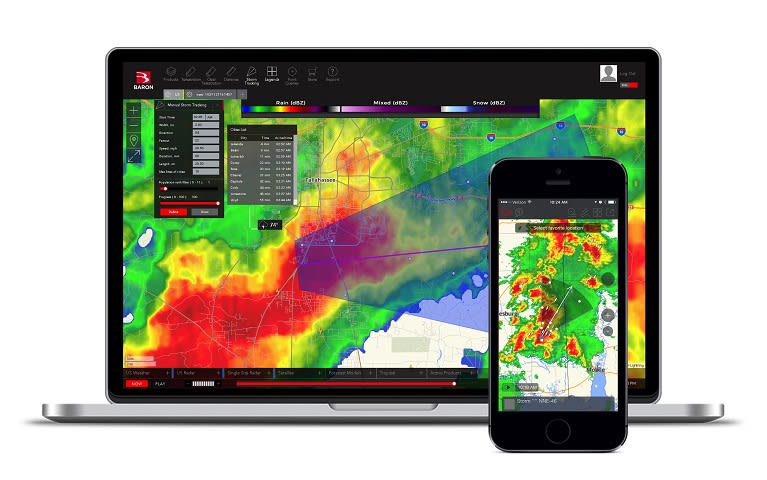
Baron's Threat Net allows users to monitor weather and safety for situational awareness by location.
Baron's Threat Net allows users to monitor weather and safety for situational awareness by location.
HUNTSVILLE, Ala. — Baron, a provider of critical weather solutions, has introduced a new suite of products for active weather monitoring and forecasting tools for public safety.
Baron's Threat Net features operations center, mobile and web-based accessibility. The suite of products allows users to monitor weather and safety for situational awareness by location, and includes custom alerts, such as Baron’s location-based pinpoint alerting and standard alerts from the National Weather Service that can be delivered via in-app notifications, push or text notifications, and email.
Baron’s technology is designed to be user friendly and accessible to customers who might not have any meteorological background, and can be used in a variety of public safety settings such as schools, according to the company.
Baron’s Threat Net features high-resolution, customizable mapping down to street level, a full-screen interactive mode, storm vectors enabling storm tracking up to an hour in advance, and a critical weather indicator that warns users in real time of dangerous storm situations.
In addition, Baron’s Threat Net has a tropical weather package that provides data on hurricanes and their unique features, as well as hurricane tracking and forecasting tools. The Threat Net also can provide public safety information on non-weather environmental threats such as HAZMAT disasters by determining rain or wind conditions that may spread chemical spills, and toxic smoke and gasses.
More Safety

Geotab Expands Fleet Safety Tools With Video Coaching, Risk Insights
New safety and video capabilities aim to help fleet managers assess risk, support drivers, and take targeted action through video coaching, red-light violation detection, and more.
Read More →
How to Build a Better School Bus Driver Training Program
Is it time to strengthen your driver training? Here’s how to pick the right talent and improve recruitment, retention, and safety. This video is brought to you by IC Bus.
Read More →
Recent School Bus Accidents Leave 2 Dead, 2 Injured
Four school bus crashes in Florida, Illinois, and Georgia highlight risks in transportation lots, at bus stops, and during student loading and unloading.
Read More →

When Every Second Matters, Clarity Keeps Routes Moving
From routine delays to urgent incidents, strong communication practices help drivers, dispatchers, schools, and families respond with confidence.
Read More →
What Happens When a School Bus Catches Fire — and What Can Help
School bus fires are rare but can be devastating. Learn how advances in fire suppression and asset protection help fleets detect fires earlier, reduce damage, and improve safety.
Read More →
Geotab Launches Tool to Help Fleets Investigate Road Incidents
Geotab Investigations combines telematics data, video, documents, and other evidence to help fleets reconstruct incidents, resolve claims, and determine what happened.
Read More →
Texas Sixth Grader Wins 2026 National School Bus Safety Poster Contest
Sai Darshana Yekolu of Moseley Middle School in Prosper, Texas, was named the newest winner for her artwork, bringing the theme of “Safe Rides, Everyday Heroes” to life.
Read More →
Doing More With Less: How Transportation Directors Can Prioritize Safety Amid Budget Uncertainty
With diesel prices soaring and nearly one-third of transportation directors expecting budget cuts, maintaining student safety has never been more challenging. Download this guide to learn how leading districts are prioritizing risk, funding critical safety technology, and building stronger budget cases with data.
Read More →
Walton County Schools Adds Gatekeeper Stop-Arm Enforcement System
The Florida district will deploy Gatekeeper’s updated Student Protector technology, which now incorporates AI to improve video evidence.
Read More →
How To Build a More Secure School Bus Yard During and After Hours
As thefts and overnight security threats continue, school transportation leaders are combining stronger operational practices with AI-enabled surveillance to better protect buses, facilities, and staff.
Read More →