




After 1 Walkout Ends, Quebec Braces for Broader School Bus Strike
Nearly 2,200 school bus drivers from 44 federated unions in Quebec plan to go on strike on May 15. The news comes on the heels of a local walkout in April.

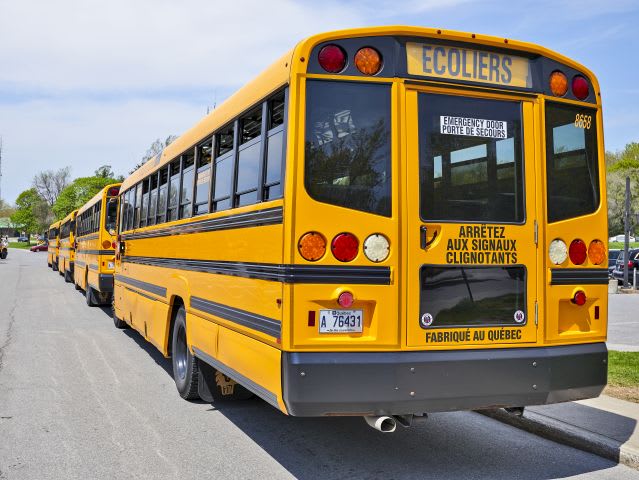
Nearly 2,200 school bus drivers from 44 federated unions in Quebec plan to go on strike on May 15. Buses are seen here in Montreal. Bombaert / iStock image
Nearly 2,200 school bus drivers from 44 federated unions in Quebec plan to go on strike on May 15. Buses are seen here in Montreal. Bombaert / iStock image
MONTREAL — A school bus driver strike slated for mid-May threatens to impact service for nearly 110,000 students across Quebec.
The School Transportation Sector (STS) of the Federation of Public Service Employees announced on May 1 that 2,170 school bus drivers from 44 unions in the federation will go on strike on May 15. The action is expected to affect routes for 32 school boards throughout Quebec.
Stephen Gauley, president of the STS, said in a statement that the unions voted to approve a six-day strike. Their goal, he said, is to get the Quebec government to pass a supplementary budget allocation dedicated to improving their working conditions.
Gauley noted that a walkout is also anticipated to take place during the week of May 28 “if nothing is settled by then.”
The province-wide strike plans come on the heels of a local walkout in April that disrupted transportation service for the Lester B. Pearson School Board in Dorval and the Trois-Lacs School Board in Vaudreuil-Dorion.
CBC News reported that some 4,000 students who live west of Montreal and in the West Island had to find another way to get to school during that strike, which began on April 23. The school bus drivers were calling for their employer, Lucien Bissonnette Inc., to increase their pay, according to the news source.
On April 25, the Lester B. Pearson School Board announced on Facebook that an agreement had been reached, ending the local bus strike. Routes resumed their normal schedules the following morning.
According to the Federation of Public Service Employees, school bus workers in Quebec earn an average rate of CA$17.86 (US$13.86) per hour, for an average annual income of CA$19,288 (US$14,973). The federation added that some pupil transporters make CA$12.07 (US$9.37) per hour, which is close to the minimum wage, with no other benefits.
On April 17, union federation officials met with Quebec’s minister of education, Sébastien Proulx, to discuss funding for higher school bus driver pay, but the issue remained unresolved as of press time. In announcing plans for the strike to start May 15, union leaders pointed out that a labor shortage in pupil transportation has led to problems like school bus delays and cancellations.
“The poor working conditions that have prevailed for too long in this sector are currently causing serious problems in attracting and retaining drivers of school vehicles,” said Jacques Létourneau, president of the Confederation of National Trade Unions. “We therefore very much hope that the government will solve this problem once and for all in order to guarantee funding that will ensure the continuity of this important public service on which hundreds of thousands of parents count every day of school.”
More Management

How to Build a Better Driver Training Program
Ready to boost up your school bus instructor training? Here’s how to pick the right talent and improve recruitment, retention, and safety.
Read More →
CALSTART and Forth Combine to Form Catalyst Mobility
The new name represents a renewed vision for the nonprofit focused on advancing clean, equitable, and affordable transportation solutions that move people and goods.
Read More →
What Makes a Great School Bus Driver Trainer?
Choosing the right school bus driver trainer takes more than experience. Learn six keys to selecting and developing trainers and evaluating program effectiveness.
Read More →


School Bus Contractors Expand Through New Deals, Acquisitions & Partnerships
STA's Canadian division acquires Ontario-based G&L Stevenson Transport while Durham School Services adds a new district contract in California, First Student adds a New Jersey contract, and Minnesota Coaches acquires Halo Transportation.
Read More →
Logan Bus Company Rolls Out AI Phone System for NYC School Bus Families
A summer pilot found that AI agents could handle most routine calls, freeing up time for customer service staff to focus on emergencies and complex family concerns.
Read More →
From Intent to Impact: What I Learned About Leadership from TAPT
A Texas transportation supervisor shares lessons on self-awareness, accountability, managing stress and building trust — and why investing in leadership development matters at every stage of your career.
Read More →
NAPT Names 2026 Award Recipients, Hall of Fame Inductee
Who earned national recognition for their work in student transportation? This year, NAPT named five recipients of its 2026 awards for service, safety, and leadership, plus its newest Hall of Famer.
Read More →
2026 State of Student Transportation Report
Driver shortages. Rising costs. Growing safety expectations. More data, but not enough time to act on it. The 2026 State of Student Transportation Report reveals what transportation leaders say is putting the most pressure on their operations—and where they’re investing next. See how your priorities compare.
Read More →
How to De-Escalate an Angry Person: 5 Steps for Handling Workplace Conflict
What makes emotions run high, and how should you handle an angry colleague or parent? Follow these steps for staying calm, listening, showing empathy, and resolving conflict.
Read More →
What Readiness Looks Like This School Year
Learn about the challenges shaping the 2026–2027 school year, from persistent driver shortages and budget pressure to technology and readiness gaps. See how school districts are responding and adapting in Zonar’s 2026 Back-to-School Readiness Report.
Read More →