




New Arkansas Law Allows Local Control for School Bus Seat Belts
A young 4-H member’s project turns into legislation that gives Arkansas residents the legal framework to ask their school districts to require seat belts on school buses.
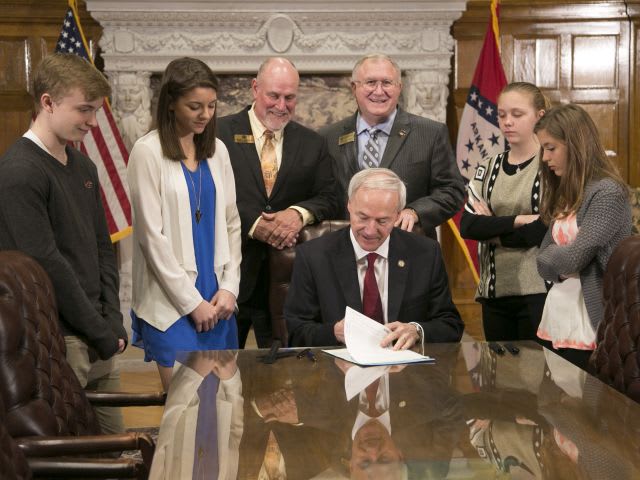
Hannah Alder (far right) watched on March 6 as Arkansas Gov. Asa Hutchinson signed a school bus seat belt bill that stemmed from Alder’s 4-H project. Photo by Ryan McGeeney/U of A System Division of Agriculture
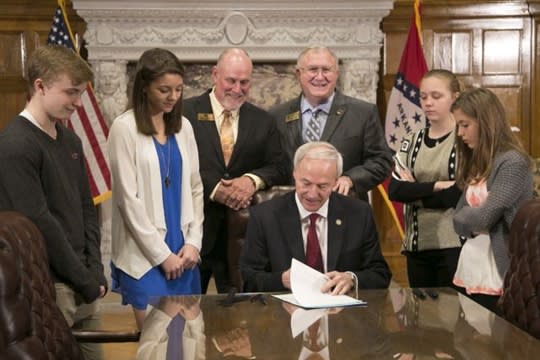
Hannah Alder (far right) watched on March 6 as Arkansas Gov. Asa Hutchinson signed a school bus seat belt bill that stemmed from Alder’s 4-H project. Photo by Ryan McGeeney/U of A System Division of Agriculture
LITTLE ROCK, Ark. — What started as a young 4-H member’s scare from a family car accident has turned into a law that gives Arkansas residents the legal framework to ask their local school districts to require seat belts on new school buses starting in 2018.
Hannah Alder, a 13-year-old Star City Middle School student and 4-H member, watched on March 6 as Arkansas Gov. Asa Hutchinson signed House Bill 1002 into law at the state Capitol.
The bill, sponsored by state Rep. Mark McElroy of Tillar and co-sponsored by state Sen. Dave Wallace of Leachville, began in 2014 as Alder’s 4-H project.
“I was talking with our 4-H leader about a car wreck my mom and I had been in,” Alder said. “When I had my wreck, it scared me, and I want other kids to be safe and not get hurt as bad as I did.”
Alder, who was in fifth grade at the time, prepared a report examining the number of fatalities associated with crashes involving school buses, many of which do not have seat belts for passengers.
Jane Newton, a Lincoln County extension agent for the University of Arkansas System Division of Agriculture (which facilitates the state’s 4-H program), said she encouraged Alder to present the report to Rep. McElroy.
“I thought, ‘How cute,’ until she got really serious, and I found out she had done her homework,” McElroy said. “That started about two and a half years ago. In that time period, there have been several deadly bus crashes in this region alone. One in Houston, involving a rollover, and one in Chattanooga that was devastating.”
Under the new law, residents can petition their local school board to determine how much of a millage increase would be required to afford the addition of passenger seat belts to newly purchased school buses, and to put that millage increase to a vote in the next regularly scheduled election.
“Local control was really the only way to fund this,” McElroy said. “This lets the people decide — the people who put their kids on the bus every day can decide if that’s something they want to pay for.”
McElroy said the addition of seat belts to a school bus can increase the cost of the bus by about $7,000 to $10,000. Although federal law requires smaller school buses, those with a gross vehicle weight rating of 10,000 pounds or less, to be equipped with lap-shoulder belts, any requirements for belts on larger school buses are left up to state and local legislation.
Ryan McGeeney is a communication specialist for the University of Arkansas System Division of Agriculture.
More Safety

How to Build a Better School Bus Driver Training Program
Is it time to strengthen your driver training? Here’s how to pick the right talent and improve recruitment, retention, and safety. This video is brought to you by IC Bus.
Read More →
Recent School Bus Accidents Leave 2 Dead, 2 Injured
Four school bus crashes in Florida, Illinois, and Georgia highlight risks in transportation lots, at bus stops, and during student loading and unloading.
Read More →
When Every Second Matters, Clarity Keeps Routes Moving
From routine delays to urgent incidents, strong communication practices help drivers, dispatchers, schools, and families respond with confidence.
Read More →

What Happens When a School Bus Catches Fire — and What Can Help
School bus fires are rare but can be devastating. Learn how advances in fire suppression and asset protection help fleets detect fires earlier, reduce damage, and improve safety.
Read More →
Geotab Launches Tool to Help Fleets Investigate Road Incidents
Geotab Investigations combines telematics data, video, documents, and other evidence to help fleets reconstruct incidents, resolve claims, and determine what happened.
Read More →
Texas Sixth Grader Wins 2026 National School Bus Safety Poster Contest
Sai Darshana Yekolu of Moseley Middle School in Prosper, Texas, was named the newest winner for her artwork, bringing the theme of “Safe Rides, Everyday Heroes” to life.
Read More →
Doing More With Less: How Transportation Directors Can Prioritize Safety Amid Budget Uncertainty
With diesel prices soaring and nearly one-third of transportation directors expecting budget cuts, maintaining student safety has never been more challenging. Download this guide to learn how leading districts are prioritizing risk, funding critical safety technology, and building stronger budget cases with data.
Read More →
Walton County Schools Adds Gatekeeper Stop-Arm Enforcement System
The Florida district will deploy Gatekeeper’s updated Student Protector technology, which now incorporates AI to improve video evidence.
Read More →
How To Build a More Secure School Bus Yard During and After Hours
As thefts and overnight security threats continue, school transportation leaders are combining stronger operational practices with AI-enabled surveillance to better protect buses, facilities, and staff.
Read More →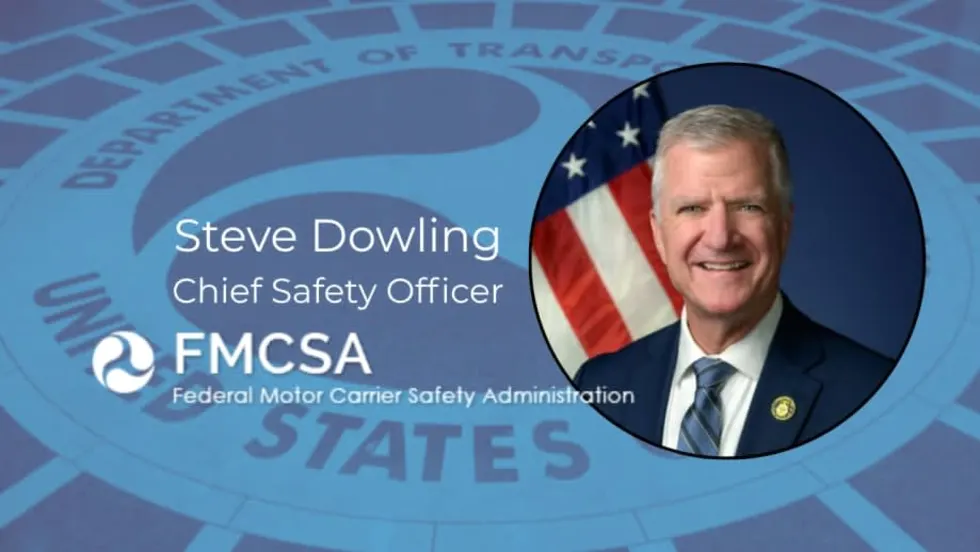
FMCSA Names New Chief Safety Officer: What School Bus Operators Should Know
Steve Dowling is set to lead the federal agency's efforts to advance commercial motor vehicle safety and reduce crashes, fatalities, and injuries on the nation's roadways.
Read More →