




Roger's Last Ride: Putting Our Compassion Into Action
A transportation director's humbling and dramatic story about one of her employees exemplifies the practice of turning compassion into an action verb.

A transportation director's humbling and dramatic story about one of her employees exemplifies the practice of exercising compassion. Photo by Christopher Smith

A transportation director's humbling and dramatic story about one of her employees exemplifies the practice of exercising compassion. Photo by Christopher Smith
If you spend any time reading the news, you might agree that our world could use a little more compassion. A Latin phrase coined nearly 700 years ago, “com pati,” was formed by the French into a verb to imply empathy, to suffer with someone. By the latter 1500s, the verb degenerated into a weak noun that implied nothing more than “sympathy.”
Four hundred-fifty years later, not much has changed. Or has it? As dark as things may sometimes seem, there are inspirational moments that offer hope and encouragement.
This past summer, I attended a Michigan Association for Pupil Transportation conference titled “Making It Matter – Leadership, Learning, and Compassion” that included student transportation directors from around the state. The goal of the event was to ensure that attendees were treating the title like a verb, rather than a noun — to model compassion in action.
During the course of the conference, one transportation supervisor, Jacquie, shared a humbling and dramatic story about one of her employees named Roger that exemplified our theme.
Her employee was a crusty 68-year-old retired engineer turned school bus driver with a curmudgeon-like personality and long white hair. Roger was leaving the school bus garage for the day when he stopped by Jacquie’s office and yelled, “Hey! Boss-lady!” (a curmudgeon’s way of conveying kindness). “I just want you to know … I love you.” (Translated: “Thanks for being a great boss; I respect and appreciate all you do for me.”)
Jacquie rushed to Roger’s side as he lay motionless on the road. She gently laid her hands on his bleeding head. … She told him to breathe. Told him to hang on. Told him she cared about him.
While students on his bus loved him, previous supervisors in his other career looked down on him for his bluntness and coarse exterior. But not Jacquie. She treated Roger (and all her drivers) with respect, responding with an equally enthusiastic “I love you, too, Roger! I hope you have a wonderful night.” Roger beamed as he left her office to mount his Harley-Davidson motorcycle, and rode away.
Mere moments later, another bus driver frantically called Jacquie. She was screaming into the phone for Jacquie to hurry; Roger had just been hit by a motorist who had turned in front of him. Jacquie flew out of the office to her car and down the road; emergency personnel hadn’t even arrived yet.

Phillip Haldaman is a school administrator for the Charlevoix-Emmet (Mich.) Intermediate School District and is the president-elect of the Michigan Association for Pupil Transportation.
Jacquie rushed to Roger’s side as he lay motionless on the road. She gently laid her hands on his bleeding head; he was in obvious pain. She told him to breathe. Told him to hang on. Told him she cared about him. Roger mumbled something, she couldn’t tell what, before emergency crews arrived to begin their work.
Sadly, Roger did not survive the crash; he died a short time later. Jacquie’s compassion and encouraging words were the last gifts Roger received this side of eternity. She had turned compassion into an action verb.
Motivational speaker Zig Ziglar once said that there are over 4 billion people on the earth who go to bed hungry every night … for an honest word of appreciation; they need kindness and compassion. If we focused on extending as much to others each day, who knows of the suffering we may help erase. Better to write our own epitaph onto the hearts and lives of others as we put compassion into action on a daily basis.
More Blog Posts
The Sound of Summer Starting [Guest Editorial]
That unmistakable school bus rumble? It carries childhood memories, community routines, and a whole lot of unseen work behind the scenes.
Read More →
The Technology Power Combo That Enables EV Charging on Difficult Sites
As the pace of fleet electrification increases and charging infrastructure continues to pose challenges, many fleets find themselves puzzling over the question: how do I install charging infrastructure faster and more cost-efficiently?
Read More →
Trip Sheet: Farewell, Faithful Readers – Keep on Rolling
Executive Editor Wes Platt offers parting thoughts as he parks the School Bus Fleet bus to focus on ultra-local community journalism, making way for someone else to take the wheel as the pupil transportation industry continues to evolve.
Read More →
Trip Sheet: School Transportation Pros Can Champion Children's Mental Health
Children's Mental Health Awareness Day underscores the significance of school bus drivers in fostering supportive environments during students' journeys. SAMHSA's initiatives, including stigma reduction and access to resources, complement the Biden-Harris administration's funding efforts to enhance youth mental health services and workforce development.
Read More →
Trip Sheet: Is It Time for Daylight Saving Time to Clock Out?
How do you think the potential shift to permanent Daylight Saving Time or standard time would impact our daily lives and routines, especially considering the divided approach across various states?
Read More →
Trip Sheet: Meeting a Hero in My Own Back Yard
I remain impressed by the matter-of-fact heroism that’s often demonstrated by school bus drivers like Deona Washington who are caught in these situations where the best of us might lose our cool and panic. But, then again, bus drivers are a unique breed.
Read More →
Trip Sheet: 3 Takeaways from the EPA Clean School Bus Grant Program
Most applicants sought grant funding to acquire electric school buses, with propane coming in a distant second. No one indicated plans to purchase compressed natural gas (CNG) buses in this round. That’s not terribly surprising, I suppose, given how few school districts listed the inclusion of CNG buses in their fleets for our 2023 top district fleets survey.
Read More →
Trip Sheet: Let's Get Rolling: What's Coming in 2024?
Calendar pages keep flipping toward the mandates set in states like New York and California to transition their school bus fleets from diesel to zero-emission, but there’s plenty of reluctance and pushback.
Read More →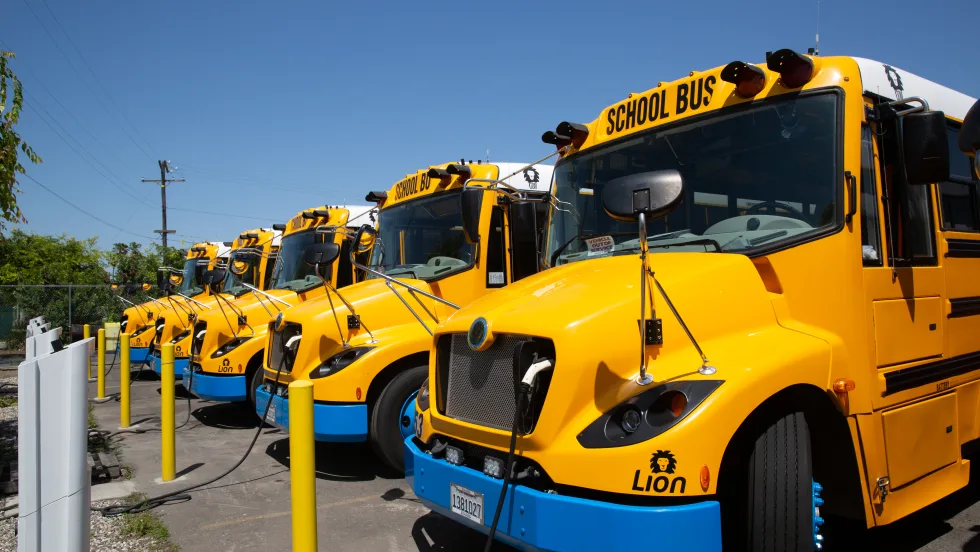
California School Children Ride in Green School Buses
Today, California prides itself on utilizing the most zero-emission (ZE) school buses in the country with over 1,689 being used by California school districts; and while the state is on a positive health trajectory thanks to a decree to eliminate gas and diesel vehicles, more work needs to be done to improve children’s well-being.
Read More →
Behind The Wheel of Childrens’ Safety Aboard the School Bus
Bus drivers are the primary caretakers of children during their commute and thus bear responsibility for their safety. By prioritizing proper operating procedures, maintenance checks, and additional precautions, drivers can help avoid the loss of precious young lives under their care.
Read More →