




Workshop Training
North Dakota's Department of Public Instruction formulated a comprehensive workshop program to teach school bus drivers the obligations they have to the children and the school district, and in maintaining the equipment for efficient service.

The responsibilities bus drivers have in transporting children to and from school each day must be made clear and important for each and every driver who accepts such an obligation to insure the safety of the children, the driver himself and the other motorists traveling on the same roads with the school buses.
North Dakota school bus drivers learn the rules and regulations of their jobs through formal workshop meetings. There they meet with transportation authorities who inspire them with the importance of safe driving and the frequent inspection of equipment. Guest speakers give them helpful ideas on handling the children. During discussion sessions they have a chance to ask questions and get some useful suggestions solving their own problems.
Materials used for the workshops in North Dakota was developed with the aid of the county superintendents, according to Harold Wakefield, consultant, School Bus Transportation, Department of Public Instruction.
The individual programs vary somewhat as the county superintendent in charge of school bus transportation has complete charge in her county and programs the workshop to meet the needs of the school district. Some counties held the workshops in the morning, others in the evening kicking them off with a dinner meeting. In some instances two or more counties cooperate to hold one workshop while other counties schedule two workshop meetings a year.
Workshop Features
Basic features of the workshops are: 1) A written test on Regulations and Safe Driving Practices, followed up with a discussion of the test. 2) Small discussion groups monitored by local superintendents. 3) Inspection of buses and the behind-the-wheels tests conducted by the State Highway Patrol.
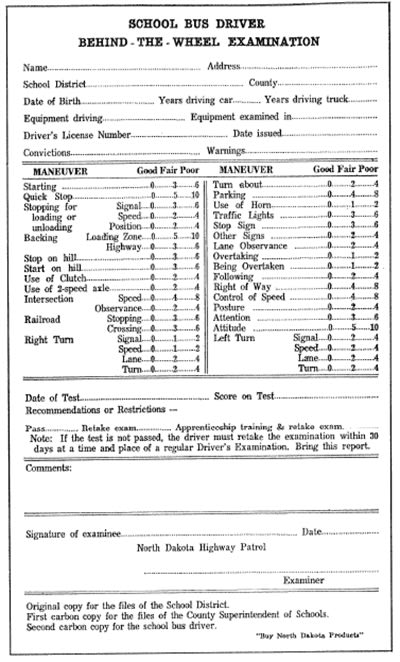
Last year, 48 workshops were conducted between the last week in August and the first week in November, according to Wakefield, who participates in many workshops as a guest speaker to discuss problems relating to bus transportation. At each workshop, it is stressed that THE GOAL IS TO HAVE A SCHOOL YEAR WITHOUT AN ACCIDENT IN WHICH A SCHOOL BUS WAS INVOLVED.
A general plan for a school bus drivers’ workshop provided by the North Dakota Department of Instruction lists an outline for the program, the personnel needed to conduct the meetings, and a brief description on the rooms and equipment necessary. These are given in the accompanying chart.
An important aspect of this entire meeting is the opportunity for drivers to discuss their individual problems. The best results are obtained by dividing them into small groups and providing each driver with a chance to ask questions. Sometimes “leader” questions have to be asked in order to get a discussion started. Topics that trigger good reactions and comments include: Conduct on a School Bus; Relations between the Driver and the Administration; Relations between Parents and the Bus Drivers; Maintenance of a Bus. A list of questions offered to the county supervisors is given here.
Test on Driving Regulations
The general test on regulations and safe driving practices covers road signs and driving signals; situations involving behavior problems with children and the drivers handling of them; emergency situations which reflects driver knowledge in handling the bus. Typical questions include: What should you do when your bus starts to skid sideways? In case the bus breakdowns what should be done with the children? What is a safe maximum speed for a school bus traveling on a black top road? Multiple choice answers to these questions can provide a stimulus for discussions.
A typical safe driving clinic for bus drivers and other equipment operators can take up the better part of a day. Where the clinic involves only a handful of drivers, the sessions can be more personalized and will require less time. Where a large number of drivers attend a clinic, more time must be allowed for correcting the tests and for the discussions. Also, the behind-the-wheels test will require more time. The program for a full day given here exemplifies a good schedule of sessions.
Printed materials are distributed to the drivers attending the workshops. It is important for them to have something to refer to after they’ve left the workshop sessions. North Dakota Department of Public Instruction distributes a school bus drivers handbook which was compiled in conjunction with the State Highway Patrol. The 28-page booklet defines the qualifications of drivers; responsibility of drivers; rider relation; responsibilities of the school administrator; responsibility of parents; discipline on a bus; regulations for drivers; skills required; regulations governing pupils riding school buses; practices governing the safe operation of a school bus; equipment on a school bus; storm conditions; accidents; liability; insurance coverage; what to do in case of an accident; and ends with a series of test questions.
Thus the North Dakota school bus driver by means of a formal workshop session is made to feel a part of a vital group and inspired to keep the standards established by that group in maintaining safe transportation for the school children.
SUGGESTIONS FOR A WORKSHOP
More and more states are setting up yearly programs dealing with the safe operation of school buses. These programs vary in different states but generally include a behind-the-wheel test, a written test on rules and regulations, and a period for the discussion of the problems of individual drivers. This has been the program generally followed in North Dakota. THE GOAL IS TO HAVE A SCHOOL YEAR WITHOUT AN ACCIDENT IN WHICH A SCHOOL BUS WAS INVOLVED.
PROGRAM
Hold a general assembly for an introduction and an outline of the program for the workshop.
Start the written test.
Start the machine test, if machines are available, as soon as the drivers arrive. Allow the drivers to go to the written test but continue after the written test has been started.
When eight or more drivers have completed the tests, have them meet with a moderator for a discussion period.
Have a general assembly when all drivers have completed the tests. Any special speaker should present his talk at the general assembly. Go over the corrected tests with the drivers and answer any questions the drivers may raise.
PERSONNEL NEEDED
Provide two moderators for the written test. One should be available to read the test should any of the drivers so desire.
Provide two operators for the machine test. The consultant will carry two othoraters.
Provide moderators for the discussion groups.
Provide two or more to correct the written test.
Provide someone to conduct the review of the written test.
Provide the special speaker if one is desired.
ROOMS AND EQUIPMENT
Provide a room for the written test with tables or tablet arm chairs.
Provide room for the machine tests with a long table or two small tables. There must be an electrical outlet available.
Provide rooms for the discussion groups.
Provide room for the general assemblies.
DISCUSSION GROUPS
The opportunity for drivers to discuss their problems is the most important part of any workshop. The best results will be obtained by dividing into small groups thus offering a chance for each driver to ask questions. The following is a list of questions which may be used by the moderator to start a discussion.
CONDUCT ON A SCHOOL BUS
What should be considered good conduct on a school bus?
Who is primarily responsible for maintaining good conduct on a school bus?
How can the administrator help?
If a child violates a rule or regulation what should be done?
Is knowledge of rules and regulations by parents and children important? How can this be achieved?
RELATIONS BETWEEN THE DRIVER AND THE ADMINISTRATION
Who is legally responsible for the operation of a transportation program?
Should the school board set up rules and regulations for drivers?
What rules and regulations should be established?
In what state publications are general rules and regulations given? Should they be more specific? Should they be more general?
RELATIONS BETWEEN PARENTS AND THE BUS DRIVERS
Is the cooperation of parents important for the safe operation of a school bus?
Are rules and regulations of value in obtaining the cooperation of the parents?
What should be included in a set of rules for bus riders?
What are the attitudes of a driver that will bring about good relations with the parents?
MAINTENANCE OF A BUS
How often should a bus be greased?
How often should the driver check his bus? What should be included in this check?
When do brakes become unsafe?
How can a driver reduce the operating costs of a school bus?
More Management
How to Build a Better Driver Training Program
Ready to boost up your school bus instructor training? Here’s how to pick the right talent and improve recruitment, retention, and safety.
Read More →
CALSTART and Forth Combine to Form Catalyst Mobility
The new name represents a renewed vision for the nonprofit focused on advancing clean, equitable, and affordable transportation solutions that move people and goods.
Read More →
What Makes a Great School Bus Driver Trainer?
Choosing the right school bus driver trainer takes more than experience. Learn six keys to selecting and developing trainers and evaluating program effectiveness.
Read More →

School Bus Contractors Expand Through New Deals, Acquisitions & Partnerships
STA's Canadian division acquires Ontario-based G&L Stevenson Transport; Durham School Services adds a new district in California; First Student expands in New Jersey; and Minnesota Coaches rebrands and acquires Halo Transportation.
Read More →
Logan Bus Company Rolls Out AI Phone System for NYC School Bus Families
A summer pilot found that AI agents could handle most routine calls, freeing up time for customer service staff to focus on emergencies and complex family concerns.
Read More →
From Intent to Impact: What I Learned About Leadership from TAPT
A Texas transportation supervisor shares lessons on self-awareness, accountability, managing stress and building trust — and why investing in leadership development matters at every stage of your career.
Read More →
NAPT Names 2026 Award Recipients, Hall of Fame Inductee
Who earned national recognition for their work in student transportation? This year, NAPT named five recipients of its 2026 awards for service, safety, and leadership, plus its newest Hall of Famer.
Read More →
2026 State of Student Transportation Report
Driver shortages. Rising costs. Growing safety expectations. More data, but not enough time to act on it. The 2026 State of Student Transportation Report reveals what transportation leaders say is putting the most pressure on their operations—and where they’re investing next. See how your priorities compare.
Read More →
How to De-Escalate an Angry Person: 5 Steps for Handling Workplace Conflict
What makes emotions run high, and how should you handle an angry colleague or parent? Follow these steps for staying calm, listening, showing empathy, and resolving conflict.
Read More →
What Readiness Looks Like This School Year
Learn about the challenges shaping the 2026–2027 school year, from persistent driver shortages and budget pressure to technology and readiness gaps. See how school districts are responding and adapting in Zonar’s 2026 Back-to-School Readiness Report.
Read More →