




Lessons from the Past: A Ride Through School Bus History
What to Expect Out of the NCST This May
For the first time in 10 years, the National Congress on School Transportation convenes to determine best practice recommendations for school buses. Here’s what you need to know.
by Ronna Weber, NASDPTS
December 27, 2024
Decisions made at the NCST direct the industry how and influence major standards such as the yellow color that is on buses today thanks to the first-ever NCST!
Logo: NASDPTS/Photo: Canva
4 min to read
The 17th National Congress on School Transportation (NCST) will be held May 4-7, 2025, in Des Moines, Iowa. This is the first time the Congress will be held since 2015 due to COVID.
What is the NCST, and how does it work?
The National Congress on School Transportation (NCST) was formed in 1939 and brings together
representatives of state departments of education, public safety, motor vehicles, and police or other state agencies with state-wide responsibilities for the administration of student transportation.
The Congress operates like a legislature, rather than a conference. There are no speakers and there are no sponsored events. At the Congress, the state delegations work through proposals and vote on them, just like a legislature does.
In the end, the final document is the National School Transportation Specifications and Procedures (NSTSP) Manual, which is considered a compilation of the best practices of the school transportation industry. Some states adopt the NSTSP as their state specifications in whole and some adopt it in part. Many others refer to the document when looking for best practices.
The proposals are created through the work of 11 writing committees. The committees include
General Operations;
School Bus Specifications;
Specially Equipped School Buses;
School Bus Inspections;
Activity Bus Operations;
Alternative Transportation;
School Transportation Security & Emergency Preparedness;
Students with Disabilities and Special Health Care Needs;
Infants, Toddlers & Pre-School Children;
Emerging Technologies; and
Alternative Fuels.
Committees
Each committee has a chair, and its members are selected from within the school transportation industry with the goal of balancing the expertise of the committee to include rural, urban, district-operated, and contracted to name a few of the specialties. Vendors can be members of writing committees, but they are to be non-voting members consulted for their expertise. Proposed changes were submitted for committee consideration, but the committees may also consider proposals of their own.
Once final, those proposals are then made available to the state delegations for review and comment. Concurrently to state delegation review, the proposals are reviewed by the Editing, Technical Assistance, and Appendices Committees to ensure a thorough review. The feedback from the state delegations, and the reviewing committees will be considered by the writing committees, and their final proposals will be available for review by mid-April.
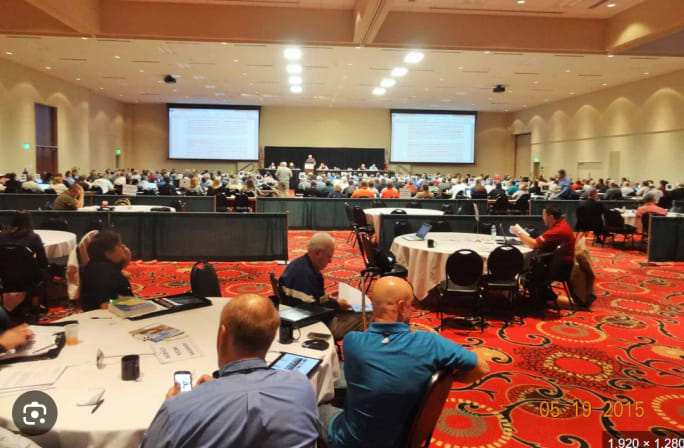
The 2015 NCST
Photo: Max Christensen
Congress Makeup & Order
The state delegations take the reins during the actual Congress as they are the ones to consider the proposals put forth. Each state was asked to form a delegation of no more than seven delegates and up to two alternates. State delegations are often comprised of those overseeing pupil transportation in the state, along with those covering areas such as inspections, contractors, and special needs transportation, to name a few of the areas of expertise needed at the Congress.
The room is divided by group at the Congress. State delegations lead the effort during the Congress, and only state delegation members and the related NCST committee members may speak during the deliberations. Only state delegation members are allowed in the deliberation area, and all others must sit in their appropriate section. All those observing the proceedings are asked not to interrupt or influence the deliberations of the Congress.
The NCST is led by its Steering Committee, which is comprised of individuals from the National Association of Pupil Transportation (NAPT), National School Transportation Association (NSTA), National Association of State Directors of Pupil Transportation Services (NASDPTS), National Safety Council, and the School Bus Manufacturers Technical Council.
The Role of NCST
“The National Congress on School Transportation is an amazing process,” said NCST Chair Mike LaRocco. “I know of no other industry that gathers and works through its best practices as our does. We work to ensure that our nation’s children are as safe as they can possibly be, and the work of the Congress is a testament to that dedication.”
How to Attend
If you want in at this influential gathering and want to attend the Congress, please learn more and register online as there is limited space. Registration is $400 per person.
One crucial thing to note if you are planning to attend the Congress: the REAL ID deadline is May 7, 2025, which means that to travel by airplane, the Transportation Security Administration (TSA) will require that you either have a REAL ID issued by your state’s Department of Motor Vehicles or a valid passport in order to travel. As our Congress ends on May 7, we ask that all attendees traveling by airplane ensure they are prepared to meet this requirement.
If you have questions or need more information, please contact NCST Chair Mike LaRocco or Ronna Weber at ncstconference@gmail.com.
Stay tuned for outcomes of this year’s NCST!
Subscribe to Our Newsletter
More Management

How to Build a Better Driver Training Program
Ready to boost up your school bus instructor training? Here’s how to pick the right talent and improve recruitment, retention, and safety.
Read More →
CALSTART and Forth Combine to Form Catalyst Mobility
The new name represents a renewed vision for the nonprofit focused on advancing clean, equitable, and affordable transportation solutions that move people and goods.
Read More →
What Makes a Great School Bus Driver Trainer?
Choosing the right school bus driver trainer takes more than experience. Learn six keys to selecting and developing trainers and evaluating program effectiveness.
Read More →


School Bus Contractors Expand Through New Deals, Acquisitions & Partnerships
STA's Canadian division acquires Ontario-based G&L Stevenson Transport while Durham School Services adds a new district contract in California, First Student adds a New Jersey contract, and Minnesota Coaches acquires Halo Transportation.
Read More →
Logan Bus Company Rolls Out AI Phone System for NYC School Bus Families
A summer pilot found that AI agents could handle most routine calls, freeing up time for customer service staff to focus on emergencies and complex family concerns.
Read More →
From Intent to Impact: What I Learned About Leadership from TAPT
A Texas transportation supervisor shares lessons on self-awareness, accountability, managing stress and building trust — and why investing in leadership development matters at every stage of your career.
Read More →
NAPT Names 2026 Award Recipients, Hall of Fame Inductee
Who earned national recognition for their work in student transportation? This year, NAPT named five recipients of its 2026 awards for service, safety, and leadership, plus its newest Hall of Famer.
Read More →
Sponsored•September 2, 2026
2026 State of Student Transportation Report
Driver shortages. Rising costs. Growing safety expectations. More data, but not enough time to act on it. The 2026 State of Student Transportation Report reveals what transportation leaders say is putting the most pressure on their operations—and where they’re investing next. See how your priorities compare.
Read More →
How to De-Escalate an Angry Person: 5 Steps for Handling Workplace Conflict
What makes emotions run high, and how should you handle an angry colleague or parent? Follow these steps for staying calm, listening, showing empathy, and resolving conflict.
Read More →
Sponsored•September 1, 2026
What Readiness Looks Like This School Year
Learn about the challenges shaping the 2026–2027 school year, from persistent driver shortages and budget pressure to technology and readiness gaps. See how school districts are responding and adapting in Zonar’s 2026 Back-to-School Readiness Report.
Read More →