




Understanding, Managing Difficult Special-Needs Student Behavior
Building relationships through good communication and receiving ongoing training are key to a school bus driver’s success in resolving challenging behavior.
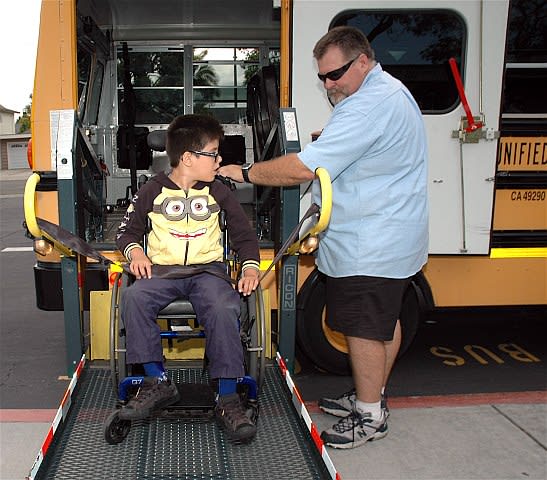
Former Newport-Mesa (Calif.) Unified School District bus driver Steve Black operates a wheelchair lift to help a student board the bus. (Black is now a dispatcher for the district.)
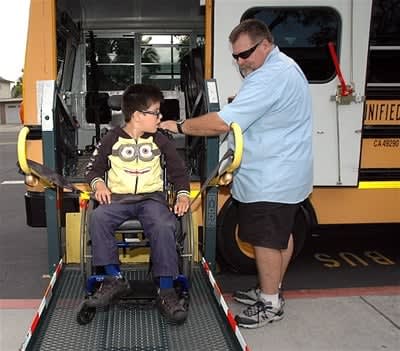
Former Newport-Mesa (Calif.) Unified School District bus driver Steve Black operates a wheelchair lift to help a student board the bus. (Black is now a dispatcher for the district.)
A tragic incident occurred in San Bernardino, California, in early December when two special-education aides and a driver, trained in de-escalation techniques, restrained a teenage boy with autism following an outburst. The boy lost consciousness at the scene, was taken to a hospital, and pronounced dead.
While many details of this case have yet to be released, one thing is certain: No school bus attendant or driver wants to find themselves at the center of such a tragic situation.
While not every crisis can be avoided, having a network of good communication with school officials and ongoing training can help drivers reduce their chance of experiencing escalated behavior and can make a positive difference in the lives of students.
Constant communication
One way drivers can address challenging behavior before it escalates is through communication with supervisors, teachers, aides, and parents. The student’s previous bus driver may also prove a valuable resource.
Pete Meslin, director of transportation at Newport-Mesa (Calif.) Unified School District, encourages drivers dealing with a behavior problem to speak to their supervisor after the first or second occurrence.
“We have to build relationships, and not just with special educators, but with parents and anybody else that provides service for that student,” he says.
Building solid relationships includes getting to know students.
“It doesn’t cost any time and money to get to know their names, their interests, a little bit about that kid, what they enjoy, and don’t enjoy doing,” says Dr. Randy Boardman, who spent 27 years as a teacher and administrator in Wisconsin and Nebraska, and is now a senior training advisor for Crisis Prevention Institute (CPI) in Milwaukee.
“If you have no relationship with this child before the crisis, you’ve set yourself up to face the risk when something goes bad.”
When a child enters the school bus, a simple “Good morning” helps them feel valued. Asking about their day, such as “How’d you do on your big test today?” lets them know you care.
A driver who knows their students and what each child looks forward to can refocus their attention from their disability to a fun activity.
Cheryl Wolf, a special-needs transportation consultant, suggests ways to engage kids, such as playing music they can sing along with, or playing a game. “[For example,] ‘Are we going to count red Volkswagens or yellow Volkswagens?’ ‘What kinds of cars are we going to see as we travel?’ ‘Oh, gosh, we’re out in the country. How many cows do we see?’”
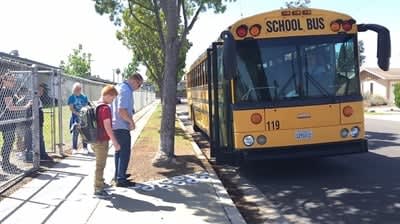
Special-needs students at Newport-Mesa USD wait to climb aboard the bus for the ride home.
Educating on disabilities
Part of knowing the students riding your bus, Wolf points out, is understanding the 13 identifiable disabilities. In particular, drivers have to know about autism and be aware of triggers that are going to cause an outburst.
In addition to knowing their students, their disabilities, and what their behaviors are, it is also important for bus drivers to understand that each student is different, says Therese Pelicano, transportation manager of special needs for Frederick County (Md.) Public Schools. Transportation managers should work with the school, counselors, and psychologists to develop a behavior plan for students with emotional disabilities that can be put into place on the bus, she adds.
Once drivers better understand these disabilities, they can learn ways to modify the challenging behavior associated with them.
“In this environment, there are no problem students, just problem behaviors,” Meslin says.
To modify the aggressive behavior of a student, Pelicano’s staff looked for ways to de-escalate the situation. Talking with teachers, they discovered he loved to draw.
“We decided to try an Etch a Sketch and see if that would help,” Pelicano explains. “We also reinforce positive behavior. If he’s acting appropriately, even if it’s for 15 minutes, we give him Tiger Tickets. Students can use Tiger Tickets to purchase items from the school store, or to access computer time. We do all kinds of modifications for students.”
Meslin points out that maintaining good behavior on the bus always includes drivers paying attention to their students and keeping the atmosphere positive.
“Don’t just communicate with students when they’re misbehaving,” Meslin says. “Positively reinforce good behavior. It may be as simple as saying, ‘Jimmy you did a great job today,’ or, ‘Give me a high-five. I noticed that you used your quiet hands today.’”
Often students affected by autism use stimming, a behavior such as flapping their hands, that calms them down, Pelicano explains.
“That’s a behavior we typically tell our bus staff to ignore. They’re trying to calm themselves down, and it’s not a safety issue.”
Lacking words to communicate their feelings, needs, and wants, children with cognitive delays or learning disabilities use their behavior as their special way of communicating, Boardman says.
Meslin also tells drivers to keep control of their bus.
“Behaviors occur far more frequently on buses that are noisy and out of control. If the bus has a calm atmosphere, there’s far less screaming, yelling, hitting, punching, and destruction of property.”
Training is essential
That’s where training comes in. Based on research, Boardman says that if training isn’t comprehensive and ongoing, drivers will react based on the emotions of the moment, and that’s when bad things can happen.
At Newport-Mesa, Meslin invites autism experts, psychologists, occupational therapists, and administrators to speak at mandatory transportation meetings. He brings in school nurses to talk about topics ranging from food allergies to seizures, and behavioral specialists to discuss escalating behaviors and how to intervene.
At Frederick County, “In addition to having experts speak to staff, we have parents come in and talk about what it’s like to have a child with a disability, and what their day is like,” Pelicano says.
If a district with a school bus contract determines that more training is needed, Boardman recommends that the district specify training on behavior of children with special needs and appropriate responses the next time the contract is out for bid.
In Boardman’s experience, most emergency operation drills are conducted in school parking lots. However, since emergencies typically take place on the road, he tells drivers attending his CPI training classes to look for a few safe places along their routes to exit the road. With prior approval, drivers can then practice drills in a more realistic setting, such as a church parking lot.
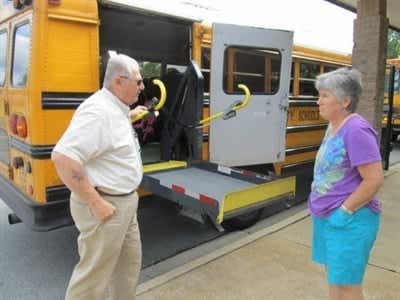
Frederick County (Md.) Public Schools bus driver Frank Abrecht inspects a wheelchair lift with instructional assistant Lois Cowles.
Observations are invaluable
Meslin recalls a student who was extremely agitated every time he got on the bus, to the point of hitting his head against the window and screaming for nearly the whole ride to school.
The driver noted that when the boy entered the bus, he kept his eyes on his father, who had brought him to the bus stop. He shared this observation with Meslin, his supervisor, who attended an emergency IEP (individualized education program) meeting with school staff. As the team talked, they realized the boy’s father was a single dad, and his son had a severe case of autism. They determined the father and son had not learned how to separate properly. Also, the father did not have a morning routine in place.
“For many students, whether or not they have autism, routines are helpful,” Meslin points out. “You get up at this time, you brush your teeth at that time, you grab your backpack at that time, and it’s a schedule. Routines make people feel more comfortable.”
The school psychologist spoke with the student’s father, gave him some tips on how to develop a routine, and even purchased an inexpensive clock to help him and his son with this new practice.
“That solved the problem to the point the dad went before the school board, got up before the microphone and talked about the difference we made in his and his child’s life,” Meslin adds.
“And that’s all because that driver paid attention and shared his thoughtful observations. The fact that he did made that student far more effective at school, because when you’re agitated [when] going to school, you’re not ready to learn.”
More Special Needs Transportation
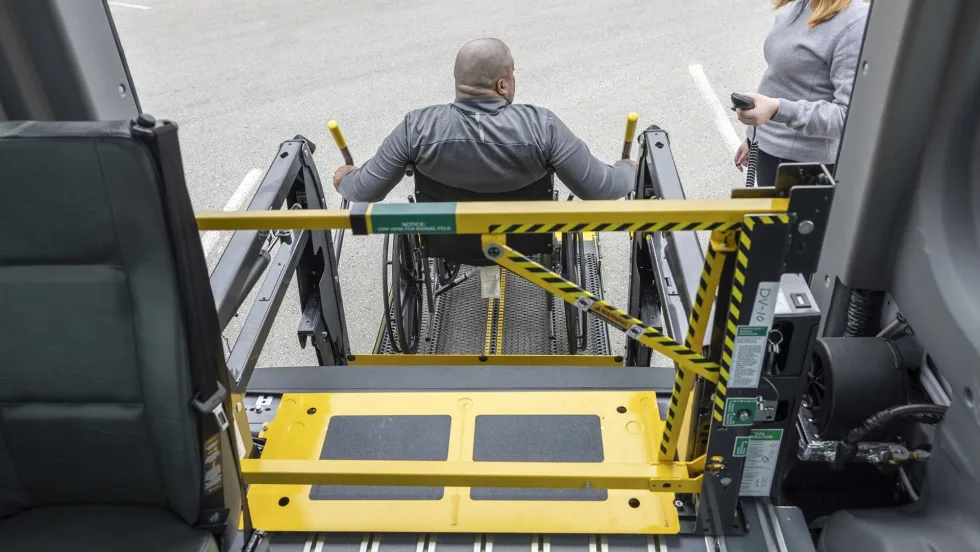
BraunAbility Introduces New Safety Barrier for Wheelchair Lifts
LiftSentinel is designed to add another layer of protection during wheelchair loading and unloading and can be retrofitted to many existing commercial lift installations.
Read More →
HopSkipDrive Launches New Safety, Driver Consistency Features for 2026-27 School Year
The company’s free ride recording, live ride tracking, and consistent driver assignments aim to improve safety and continuity for diverse student transportation needs.
Read More →
The Most Common Wheelchair Securement Mistakes on School Buses (and How to Fix Them)
Small missteps in wheelchair securement can have serious consequences. Here are 32 tips from experts to reduce risk and increase student safety on the bus.
Read More →
Inside AMF Bruns’ New Showroom: School Bus Securement Solutions Explained
Go inside AMF Bruns America’s new Ohio showroom with Maritza Valentin to see its FutureSafe technology, driver training tools, securement systems, and seating innovations.
Read More →
What AMF Bruns’ New Facility Means for Customers [Video]
Inside AMF Bruns’ new Stow, Ohio, operations: See how expanded space and innovation will enhance customer support and operations.
Read More →
AMF Bruns Expands in Ohio, Investing in Growth and Community
With expanded production space, local investment, and a growing workforce, AMF Bruns is scaling its U.S. presence. Here’s an exclusive first look inside the new Stow, Ohio, HQ.
Read More →
Inside AMF Bruns of America’s New Ohio Manufacturing Facility [Photos]
Take a behind-the-scenes look at AMF Bruns of America’s new 41,000-square-foot Stow, Ohio, headquarters, featuring advanced manufacturing, expanded space, and future-ready mobility solutions.
Read More →
First Student Boosts Student Support in Wichita & Texas
First Student and Wichita Public Schools are using behavioral support strategies to improve student ride experiences, while a separate initiative expands access to after-school programs through a bus donation.
Read More →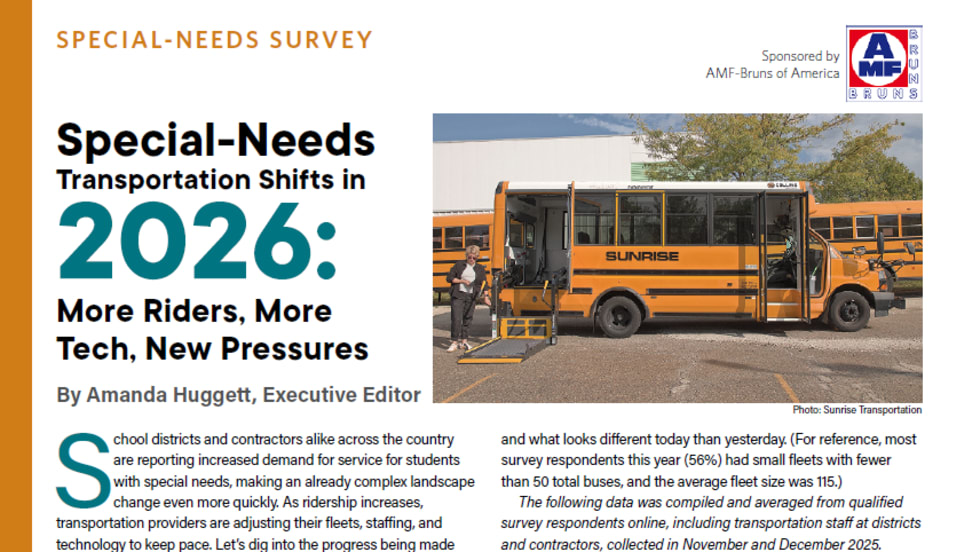
2026 Special-Needs Transportation Survey
What’s changing in special-needs transportation? This year, student transportation operators report a rising need, easing driver shortages, growing tech adoption, and evolving challenges. Sponsored by AMF Bruns of America.
Read More →
The Lived-Experience Gap in Mobility Tech: An Expert Take on Safe Student Transportation
Brianna Pauwee, a product application specialist at AMF Bruns of America and a wheelchair user, drops in to The Route to share practical securement and training insights, plus the story behind the new “Beyond Mobility” podcast. The Route is sponsored by IC Bus.
Read More →