




Transportation Software Boosts Efficiency for Maine District
From maintenance reports to routing to student records, Maine School Administrative District No. 75’s transportation department has digitally migrated its work into Tyler Technologies’ Traversa.
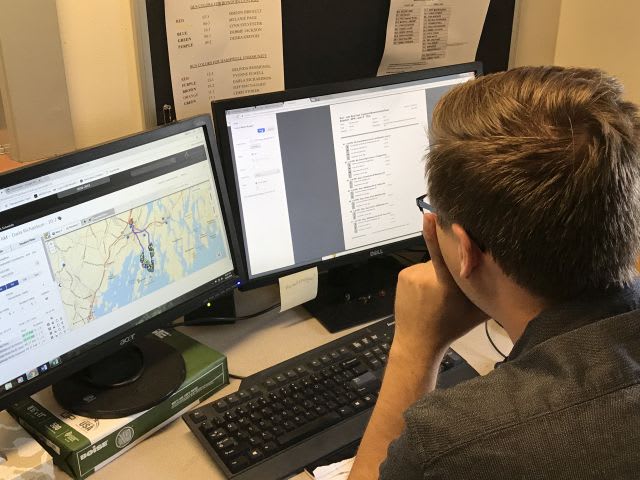
Tyler Technologies’ Traversa enabled Maine School Administrative District No. 75 to be more efficient by creating routes faster and digitizing maintenance records.
Tyler Technologies’ Traversa enabled Maine School Administrative District No. 75 to be more efficient by creating routes faster and digitizing maintenance records.
Although the state of Maine provides school transportation departments with free student routing software, some school districts decide to seek alternatives. Adam Mayo, director of transportation for Maine School Administrative District No. 75 (MSAD 75), worked with this software for three years before looking into other solutions.
“It was not easy to learn, and it wasn’t really user-friendly,” he says.
While the software was available for free, Mayo found it created inefficiencies with the department’s operations. For example, the routing feature was incompatible with the student software used by the department.
“After August, we were basically [inputting] every student’s [information] in by hand,” he says.
Software Solution
While researching his options for an alternative in 2015, Mayo attended a trade show and met representatives from Tyler Technologies, which demonstrated its Traversa software.
Traversa is an all-in-one student transportation solution, designed to give school bus officials, maintenance crews, and fleet managers the tools to run operations in a single program. Those tools include routing, mapping, vehicle maintenance, planning, and messaging. For Mayo, the most appealing feature of Traversa is its ease of use.
“I had a route done with about 10 stops in about five minutes,” he says. “With students added, in the old software that would’ve taken probably about an hour.”
Mayo also highlighted the program’s more modern user interface, with simpler, easier-to-navigate menus, compared to the initial software used by MSAD 75. Traversa’s web-based design and use of cloud hosting also allows users to access features from the field, without the need for proprietary hardware.
The capability to customize times at stops has also benefited MSAD 75’s bus operations. Through the old software, adding a student to the program would reset all the previous stop times, Mayo says.
One feature that surprised Mayo in its usefulness was the ability to digitize maintenance records. Where the department’s maintenance work was initially done entirely on paper, Traversa allows work orders to appear onscreen at a dedicated work station. Mayo says MSAD 75’s maintenance crew adapted quickly to the new system.
“The mechanics, who I thought would be [leery] of it after changing, absolutely loved the new program,” Mayo says. “We’ve really been able to hone in on that piece of Traversa and keep all our records electronically, instead of the old file cabinet system, and we can put so much into it.”
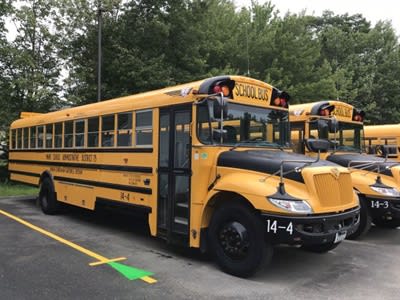
Traversa’s ability to customize times at stops has also benefited Maine School Administrative District No. 75’s bus operations.
Investing in Efficiency
Though Mayo says Traversa has improved the performance of MSAD 75’s transportation department across the board, one of the challenges was securing funding to purchase software for the 46-bus fleet.
“I never imagined the school board would approve a large purchase like this, where we would have to pay a certain fee every year when we were getting everything for free before, especially in a time where we’re cutting down budgets,” Mayo says.
To help the department get approval for funding, Tyler Technologies gave a presentation to MSAD 75’s superintendent and business manager. Mayo pitched the program based on the number of hours he spent at the time working with the free software, compared to Traversa’s ease-of-use, as well as resources saved on training with an inefficient system. Within a year, the department received the funding, and has worked with Traversa since.
Mayo recommends that other districts looking into funding student transportation software do ample research on various products competing in the market. Breaking down which elements of the current system are and are not working can help in searching for the software that’s the right fit for a given school district.
Mayo also suggests consulting experts in other departments to ensure all of the district’s needs are met, and that a new system is a worthwhile investment in the long term.
“That’s why I brought in the IT folks to make sure the IT was going to work. I brought in the business manager to make sure that piece is going to work. I brought in the superintendent to make sure that when we presented to the school board ... it would be OK,” he says. “It’s to bring in those key players also, not to make the sole decision on it.”
While Traversa provides multiple features in its base package, some programs sell features piecemeal, Mayo says, so feature density is also worth considering in terms of budget and long-term value.
Next Steps
Looking toward the future, Mayo says the department is considering purchasing additional Traversa components, such as a trip tracker, parent app, GPS system, and Tyler Drive, which is a console-mounted tablet for school buses.
From maintenance reports to routing to student records, MSAD 75’s transportation department has digitally migrated its work into Tyler Technologies’ system.
“It’s a great group of people and a beautiful program,” Mayo says. “We’re very happy, and it’s really helped us.”
More Management

How to Build a Better Driver Training Program
Ready to boost up your school bus instructor training? Here’s how to pick the right talent and improve recruitment, retention, and safety.
Read More →
CALSTART and Forth Combine to Form Catalyst Mobility
The new name represents a renewed vision for the nonprofit focused on advancing clean, equitable, and affordable transportation solutions that move people and goods.
Read More →
What Makes a Great School Bus Driver Trainer?
Choosing the right school bus driver trainer takes more than experience. Learn six keys to selecting and developing trainers and evaluating program effectiveness.
Read More →


School Bus Contractors Expand Through New Deals, Acquisitions & Partnerships
STA's Canadian division acquires Ontario-based G&L Stevenson Transport while Durham School Services adds a new district contract in California, First Student adds a New Jersey contract, and Minnesota Coaches acquires Halo Transportation.
Read More →
Logan Bus Company Rolls Out AI Phone System for NYC School Bus Families
A summer pilot found that AI agents could handle most routine calls, freeing up time for customer service staff to focus on emergencies and complex family concerns.
Read More →
From Intent to Impact: What I Learned About Leadership from TAPT
A Texas transportation supervisor shares lessons on self-awareness, accountability, managing stress and building trust — and why investing in leadership development matters at every stage of your career.
Read More →
NAPT Names 2026 Award Recipients, Hall of Fame Inductee
Who earned national recognition for their work in student transportation? This year, NAPT named five recipients of its 2026 awards for service, safety, and leadership, plus its newest Hall of Famer.
Read More →
2026 State of Student Transportation Report
Driver shortages. Rising costs. Growing safety expectations. More data, but not enough time to act on it. The 2026 State of Student Transportation Report reveals what transportation leaders say is putting the most pressure on their operations—and where they’re investing next. See how your priorities compare.
Read More →
How to De-Escalate an Angry Person: 5 Steps for Handling Workplace Conflict
What makes emotions run high, and how should you handle an angry colleague or parent? Follow these steps for staying calm, listening, showing empathy, and resolving conflict.
Read More →
What Readiness Looks Like This School Year
Learn about the challenges shaping the 2026–2027 school year, from persistent driver shortages and budget pressure to technology and readiness gaps. See how school districts are responding and adapting in Zonar’s 2026 Back-to-School Readiness Report.
Read More →