




Too Good to Be True? (Part 2)
An engineering expert takes exception to the promises of better fuel economy, extended oil intervals and reduced emissions made by suppliers of fuel additives, engine attachments and other aftermarket products. The second of a two-part article.

In the discussion that appeared in the June/July 2006 issue (“Too Good to Be True?” beginning on pg. 70), I introduced you to the common claims aftermarket suppliers of attachments and additives make for their products. It concluded with a discussion of how, if these products really worked, the U.S. Environmental Protection Agency (EPA) and the engine manufacturers would quickly adopt them for competitive and economic reasons.
If you don’t agree with that argument and believe that supplementary devices or additives will contribute to a better running engine, this installment will give you some questions to ask your provider to ensure that the product claims are valid. The basic question is: “Where’s your data?” Expansions of that question follow.
Reduced emissions
In the EPA emissions regulations, the content of the four major ingredients defined in the first part of this article (particulate matter, hydrocarbons, oxides of nitrogen and carbon monoxide) is measured on a mass basis in grams per brake horsepower-hour (g/BHP-hr).
Aftermarket suppliers will make claims to reduce some or all of these factors, sometimes with accompanying numbers and sometimes not. If the claims include numbers, they may be just percentage reductions and/or quantitative values. The numbers are usually expressed in parts per million (PPM) for HC, NOx and CO and percent opacity (a measure of light transmission through the exhaust stream) for particulate matter (PM).
Note that these are different scales than the EPA requirements. There is no correlation or conversion between PPM and g/BHP-hr nor any correlation between opacity and g/BHP of particulate matter. In fact, the smoke output of diesel engines manufactured after 1994 is so low that it would be difficult to measure an opacity level on a properly maintained engine. These values are obtained by “field” test equipment that is portable and inexpensive and test procedures that involve “sniffing” the tailpipe while the vehicle is at rest with the engine unloaded or on a chassis dynamometer with the engine operating conditions uncontrolled. There is just no way to relate these tests to the certification procedure that the engine manufacturer must follow.
The only legitimate test method for heavy-duty engine emissions performance is the EPA-designed transient emissions test cycle on an engine dynamometer. This procedure involves operating the engine from cold start through a cycle including no-load idle, acceleration, cruise, deceleration, etc., to simulate on-road operation of a vehicle.
The four major emissions components are measured with highly sensitive, expensive equipment; a test cell can cost several million dollars. This is the only method of certifying an engine or a modification to an engine that the manufacturers can use with the EPA. Ask the aftermarket supplier to provide certified test results per the EPA transient test cycle from an EPA-approved laboratory, such as Southwest Research Institute in San Antonio, Texas (www.swri.edu), that show the magnitude of emissions performance improvement that they attribute to the use of their attachment or additive, in the same engine sample, with and without the modification. Any other test method or data is inconsistent and irrelevant.
Increased fuel economy
Claims for this factor are usually supported by customer testimonials about fleet operating experience. Fleet operation evaluation of fuel economy is highly inaccurate. The fuel consumption of the vehicles is affected by many factors other than the material being tested: driver behavior, season of the year, weather conditions, variations in traffic conditions, variation in vehicle loads, etc. These factors can easily be more influential than the impact of the test material.
I cite a personal experience as an illustration: Once, when we were seeking locations for field-testing a new engine product, we found a truck operator who had very good fueling records and carefully maintained vehicles. We chose a candidate test vehicle that was operated by the same driver, over the same general route, with some variation in load. They were able to provide a tabulated one-year summary of fuel consumption on the candidate vehicle with average fuel economy calculated each month. Across that one-year period, the monthly fuel economy varied by 14 percent from minimum to maximum. That variation was much greater than the improvement we hoped to achieve with the new engine. There are too many uncontrolled variables in fleet operation that affect fuel consumption and distort the analysis of the test product.
The only true measure of comparative fuel economy in a complete vehicle is the Society of Automotive Engineers (SAE) “Type II Test.” In this procedure, to evaluate the impact of a fuel additive, you would choose two similar but not necessarily identical vehicles.
For instance, two 65-passenger Type C school buses would be a good match. The make and engines don’t have to be the same. One vehicle is operated throughout the test regime unchanged — same vehicle, same attachments, same fuel in each test. This is the baseline vehicle. The second vehicle is modified with the test material, either an attachment or an additive. Only one modification can be tested at a time. The vehicles are operated over a closed course with the drivers practicing the drive until the course can be completed in the same time interval within 2 percent repeatability.
[PAGEBREAK]
The fuel consumption is measured by weight, not volume. Mass-based fuel consumption is the only true measure. Volume of fuel measured is affected by temperature, mass (weight) is not. The vehicles traverse the course within minutes of each other so that weather conditions are the same for both. There are many more precautions taken to ensure that the vehicles and the power and speed developed are as constant as possible. The first round of testing would be conducted with both units operated in the original configuration. A relationship between the displayed fuel economy of the two vehicles is established. Then the configuration is changed in the test vehicle and the test sequence repeated. The change (if any) in the relative fuel economy of the two vehicles is the impact of the test material. This is a very accurate test method proven by more than 20 years of use and is the only method accepted by the engineering community as valid. Any other test procedure is suspect. Tell the aftermarket supplier that you want proof of fuel economy improvement based on the SAE Type II testing from an independent reputable facility. A good candidate is the Transportation Research Center in East Liberty, Ohio (www.trcpg.com).
Another means of comparing fuel economy involves engine/dynamometer testing with the engine mounted on a test stand and coupled directly to a dynamometer (not a chassis dyno!). This is the engine manufacturer’s standard method of developing engine performance. Ask the aftermarket supplier for certified performance information, with and without the modification, from a reputable laboratory (again, Southwest Research is a candidate) and tested per SAE J1995.
Reduced maintenance costs
This claim is usually related to extended oil-drain intervals. If an aftermarket supplier presents a product that supposedly extends oil life, you must consider some basic facts about lube oil. The oil consists of a base stock, either mineral oil or synthetic, and an additive package. The serviceable life of the oil is determined both by the oxidation of the base stock and the depletion of the additive package. Improved filtration capacity or effectiveness may keep the oil “cleaner” but won’t stop the oxidation of the base stock or depletion of the additives. When the base stock oxidizes and thickens, the lube package — and sometimes the engine — fails. If an additive claims to extend the oxidation life of the base stock, then the concern turns to the additive package.
The package is a complex blend of chemicals to clean contaminants from the engine parts, keep those contaminants suspended in the oil, control foaming, provide anti-scoring protection and more. Even if an additive supplier could replicate the original additive package as the oil ages, how do they or you know when or how much supplemental additives to add to the sump?
An important subset of this factor is synthetic oil. The synthetic base stock does have much greater resistance to oxidation than mineral oil and has much better low-temperature viscosity characteristics to aid in cold starting. But it costs more than regular oil. The synthetic supplier may try to justify and offset the higher initial cost with promises of extended oil-drain intervals. But the same old dilemma arises. If the base stock lasts longer, what about the depletion of the additive package? Because of this, engine manufacturers will accept the use of synthetic oil but will not approve extended drain intervals with it. If the aftermarket supplier suggests extended drains, ask for an approval document from the engine manufacturer on company letterhead that specifically approves extended drains.
Manufacturer-suggested oil-drain intervals are a conservative recommendation intended to protect the life of the engine in a wide variety of user applications and may indeed be shorter than actually needed for your operation. An acceptable method of reducing lube oil change costs is to develop a program customized to your fleet of extending oil-drain intervals based on oil analysis. Enlist the services of a reputable oil analysis firm, select a representative sample of vehicles in your fleet and gradually extend the drain interval while periodically sampling and testing the lube oil. Based on the lab results, establish a time-to-change profile (best based on fuel consumed) that could be longer than the manufacturer’s standard and yet continue to protect the engine. This can be done without the need for special attachments or additives. For a complete discussion of this procedure, go to www.ic-corp.com)., point to “Helpful Hints,” click “Did You Know” and then click on No. 298.
Longer engine life
This factor often involves lubricant additives and filtration systems. As stated earlier, engine manufacturers have worked closely with the lube oil suppliers to optimize the additive packages to extend engine life, particularly under the increasingly difficult conditions surrounding the new emissions compliance designs. All agree that improved filtration will contribute to longer engine life, and the manufacturers have continuously improved their filtration systems to extend both drain intervals and engine life.
Principal among these improvements is development of new fiberglass-reinforced filter media with finer filtration and greater strength. The original equipment filters are very good. If the aftermarket supplier promises something better than the OEM equipment, ask for certified laboratory results on filter testing per these standards: SAE J1858 for oil filters and SAE J1985 for fuel filters. These tests measure the efficiency of filtering out fine contaminants. The testing and report should involve direct comparisons of the engine manufacturer’s original equipment filter(s) versus the aftermarket product.
Manufacturer warranties
If there is a claim that warranty is not affected by the product, ask the aftermarket supplier for a document on company letterhead from the cited manufacturer that declares clear “approval” employment of their product, and don’t accept the conditional language that I described in Part One of this article.
Other factors
Never accept any support of claims based on chassis dynamometer testing. There are too many uncontrolled variables between the engine flywheel and the dynamometer to produce consistent and accurate power, fuel consumption or emissions readings. These variables include engine temperature control, friction losses in the driveline (transmission, rear axle), tire type and composition, tire temperature, load bearing on the tires, etc. The loose control of this type of test provides opportunity to slant the procedure to favor the new product. Be wary of fuel additives that promise to “disperse” water and pass it through the fuel system. Diesel fuel systems don’t like water — it causes corrosion of the metal components. Instead of using additives to carry the water through, use a fuel filter water separator device to remove the water from the fuel before it reaches the fuel system. The vehicle manufacturers provide good water separator systems as standard or optional equipment. If you want to retrofit older buses with a separator unit, look at what the vehicle manufacturer offers as a guide.
A common type of fuel additive is intended to lower the fuel cloud point (formation of wax crystals) to prevent fuel filter clogging (waxing) in cold weather. Those who operate buses in cold climates already know which products work, and many are beneficial. Just ignore any claims about increased fuel economy, etc., and use the product for its primary purpose.
If presented with a demand for standardized testing as described earlier, the aftermarket supplier is likely to respond with, “I can’t afford it,” or, “The engine manufacturers need to do that and won’t cooperate,” or similar escapes. Yes, the testing is expensive, but it’s an investment that could lead to great monetary rewards if legitimate testing proved the product to be beneficial. If the supplier cannot afford to run legitimate tests to certify the validity of their claims, how can you afford to risk the “health” of your fleet based on unsubstantiated claims?
In closing, an article like this cannot cover every possible nuance and claim that could come from these entrepreneurs; it is intended to review the most common. Yet this argument is not intended to imply that all aftermarket products are unreliable; there are many good products available. Your challenge is to recognize which is which.
Hopefully, after having read this article, you will ask for certifiable industry standard test results to substantiate the claims when you are confronted with promising products. Remember that the more complex and extravagant the claims, the more likely they are to be exaggerated and unverifiable. Good luck and be alert.
Dan Herman is retired and doing some consulting after nearly 42 years with International Truck and Engine Corp. He spent more than 30 years as an engineer involved with design and development of vehicles and engines.
More Maintenance

The Essential Guide to School Bus Maintenance and Student Safety
Your district's buses carry students to school every day. This guide shows how predictive maintenance powered by fleet data helps keep buses reliable, drivers accountable and students safer from the first bell to the last stop.
Read More →
Kerry Brothers Grows Michigan School Bus Repair Network
The acquisition of Downriver Truck and Bus expands Kerry Brothers’ school bus maintenance footprint across southeast Michigan, adding repair capacity, diagnostic resources, and state inspection support.
Read More →
Noregon Introduces CAN Bus Diagnostic Tool, Expands JPRO Features
CAN Mentor and the latest JPRO update aim to simplify vehicle network diagnostics and improve repair efficiency for technicians of all experience levels.
Read More →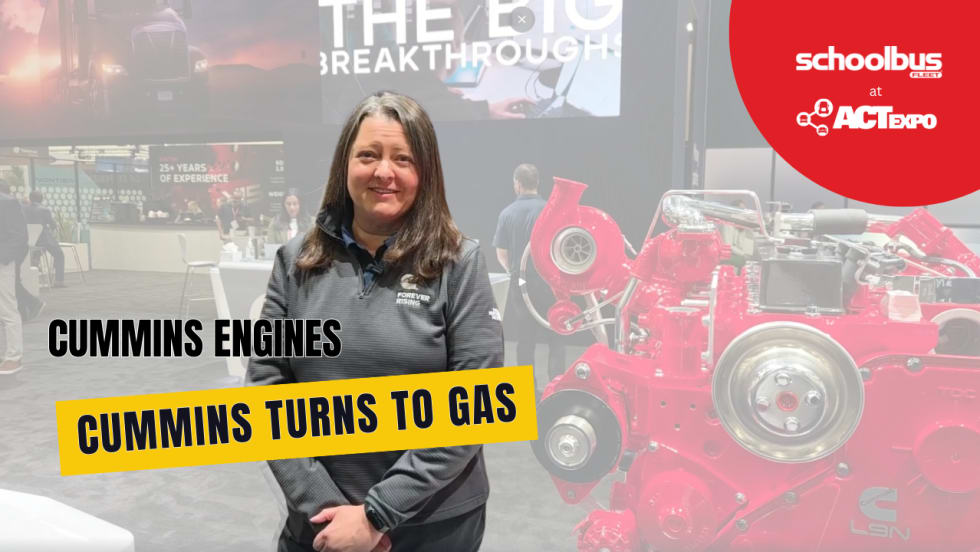
Cummins on Smarter, Simpler Engine Innovation
Cummins discusses its first-ever gasoline engine for school buses, EPA 2027, and why bus fleets still want durable, simpler internal combustion options.
Read More →
Report: 72% of Diesel School Buses Now Use Advanced Low-Emission Engines
New data shows advanced low-emission diesel technology continues expanding across school bus fleets, even as electric bus adoption gains momentum.
Read More →
Vampire Tools' CAIMAN 7.5-Inch Multi-Purpose Screw Extractor Long-Nose Pliers with Crimper
Vampire Tools introduced the VAMPLIERS Caiman 7.5-inch multi-purpose pliers, combining screw extraction, cutting, crimping, and gripping functions into a single tool designed for fleet maintenance professionals.
Read More →
How Advanced Diagnostics Helps Bus Fleets Stay Ahead of Repairs
Chat with Noregon’s Kevin Smallhorn at ACT Expo about bus diagnostic tools, telematics integration, CNG maintenance support, and strategies to help reduce downtime and improve uptime.
Read More →
How School Bus Fleets are Getting Ahead of Breakdowns
Don’t let bus downtime wear you down. Here’s how bus operators are shifting from manual processes to AI-powered, data-driven maintenance systems for improved reliability and safety.
Read More →
Pennsylvania School Bus Maintenance Team Praised for Dedication to Safety
Matthews Bus Company’s West Jefferson received a letter of commendation from the Pennsylvania State Police for their fleet inspections.
Read More →
From Chaos to Clarity: How School Districts Are Running Leaner Transportation Operations
Covering 38 routes on a Friday afternoon. Buses idling while routes overlap. Parents calling nonstop about late arrivals. Sound familiar? This whitepaper explores how district transportation leaders solved these exact problems — and what measurable results followed.
Read More →