




Tips and Tactics From the Top 100
Some of the largest school bus fleets in the country share best practices in operations, maintenance, driver training and recruitment, and other areas.

Detroit Public Schools
Submitted by Dale Goby, executive director of transportation
When using the life-cycle costing approach to purchasing school buses, we recognized that fuel consumption and environmental concerns are two issues that will increase in importance as the vehicles progress in age to their 15-year projected life.
One of the ways we addressed fuel consumption and environmental contamination is to specify the Allison MD3060 transmissions. By doing so and through careful research working with engine, transmission and bus manufacturer engineers, we were able to program the transmission so that the engine shifts gears at lower rpm. This lower shift point reduces fuel consumption, reduces wear on the engine, and reduces pollution from the engine. This activity has resulted in a 10 percent reduction in fuel consumption.
Another strategy that we’ve adopted to reduce fuel consumption is a bus idling policy enforced with programmed shutoff.
Engine diagnostic information indicated that the average bus in our fleet was idling an excessive 37 percent of the time. Consequently, we initiated a policy that uses the “black box” program in the Caterpillar engines to automatically shut off the bus engine when it exceeds the idle time limit.
By setting the black box idle limit, we will reduce our fuel consumption and exhaust emission and be a better environmental citizen. (Note: Not all school buses are equipped with the black box, so this technology is not available to all.)
San Diego Unified School District
Submitted by Alexandra Robinson, transportation director
In an effort to make sure the “central office” and the various school board members and community members understand our business, we have developed a Celebrity Rider program.
Here’s how it works. We send out invitations to various “celebrities” — who are, for the most part, officials within the district — and offer them a chance to ride with the “best.”
They are picked up early and then ride along the routes and see what we do. We try to follow up their morning ride with a tour of the department and fleet sections so we can give our “road show” and help them understand what it is we do. This has increased their awareness and certainly helped with morale.
Polk County Schools — Bartow, Fla.
Submitted by Fred Murphy, assistant superintendent for support services
We implemented a recruiting program that lets us target non-high school graduates. The program, called Driving for Education (DFE), allows us to train and hire non-graduates in a temporary capacity.
Once you enter the program, you must enroll in a GED preparatory program at one of our adult education centers.
As a DFE driver, you are assigned a morning and afternoon run. You make your morning run, and then you are allowed to drive your bus to one of our adult education centers, where you participate in a GED program. You then leave in time to make your afternoon bus run.
You are given nine months from the time of hire to complete the GED program. Special consideration is given for those needing an extension of the nine-month time limit. Once you receive your GED, you are permanently assigned to the next available open route in your geographic area. Also, once you pass the GED test, we reimburse you the cost of the test.
We have a graduation ceremony each August for all of the drivers who completed their GED during the previous year. Family members are invited to attend. In the 10 years of the program, we have graduated and hired approximately 50 people. We also have received wonderful local press coverage. Every time an article appears, we receive calls from possible participants.
While you might think that 50 participants is not many for a 10-year investment, we see it as 50 more than we would have gotten, and, more importantly, it’s 50 high school graduates who otherwise would not have gotten their diploma. The program has proven to be a win-win for all concerned. We get qualified drivers, and they get a high school diploma.
As a high school dropout who eventually earned a college degree, I recognize the importance of education and try to impart that all-important message: “It’s never too late to go back to school.”
[PAGEBREAK]
Spotsylvania County (Va.) Public Schools
Submitted by Kermit G. Shaffer, transportation director
Our emphasis has turned to security and safety. We have several ongoing training programs. We now train all drivers in dealing with student health issues. All our drivers are trained in CPR and First Aid. They also receive training in insulin administration and how to recognize symptoms of hypo- or hyperglycemia.
We also are working with them, through a joint operation with the sheriff’s office, on recognizing dangers on and around their buses. We have discussed how to recognize and respond to IEDs (improvised explosive devices). In conjunction with the SWAT team, we provided them with a demonstration of what to expect when a team “takes” a bus.
We have begun to install GPS units in our buses for automatic vehicle location. We have equipped 62 units so far and will expand it each year until all buses are equipped. We also are running a pilot program for Child Safety Alarm, a system that will automatically sound an audible warning (voice) for children to move out of the danger zone prior to the bus moving.
School District of Hillsborough County — Thonotosassa, Fla.
Submitted by Karen Strickland, general manager
We’ve implemented hands-on technician certification. They’re required to be certified by three master mechanics and approved by a supervisor prior to performing specialty tasks on vehicles.
These tasks are itemized by job classification. An example is a brake repair. Only district-certified technicians can perform this task. This procedure provides verifiable documentation that an employee has had the proper training to perform the task.
Our school district has also implemented a stringent tow truck training program to ensure that there is a documented record of the capabilities of the operators. The district’s two tow trucks expedite the ability to transport or recover buses in a fleet of more than 2,000 vehicles. The tow trucks are not used for vehicle recovery when buses are in major accidents.
We have converted all buses with the Allison MD3060 and 2000 series transmissions to Test Engineering Specification 295 (TES 295) synthetic fluids. This extends transmission oil drain intervals by 300 percent, protects transmission components, improves shift quality and extends transmission life.
Shelby County Schools — Columbiana, Ala.
Submitted by Jerry Davidson, transportation coordinator
One of the best things we have done over the past couple of years was to purchase a tire changer and a balancer. The initial cost of the two pieces was approximately $20,000. We made up for the cost of the equipment in the first year of use with the reduction of labor hours. Now the $20,000 we save every year can be used for other purposes.
Northside Independent School District — San Antonio
Submitted by Rafael Salazar, transportation director
We converted two of our older (1988) Carpenter buses into tow trucks at a cost of $10,000 per vehicle. In less than a year, we have saved our annual proposed contract amount of $6,000. We will recoup our investment in less than three years.
To find new employees, I added a human resources coordinator to our department. This person interviews all prospective candidates and also performs exit interviews of departing employees. In addition, the person arranges job fairs and oversees the recruitment process.
[PAGEBREAK]
DeKalb County Schools — Tucker, Ga.
Submitted by Lenny Webb, assistant director
An evaluation of the field trip operation revealed that an excessive amount of time was being consumed by manually typing trip completion information into the STIMS tracking system. This lost-time problem was resolved by implementing a mechanized method of inputting data through the use of an optical mark reader system.
After each trip, school bus drivers “bubble in” specifics of the trip on a specially designed form. Forms, given to managers for quality control and approval, are then routed to the Field Trip Unit (FTU).
FTU personnel accumulate forms and run them through the scanner. In only minutes, forms are scanned, and the resulting data is loaded into the STIMS program, where it is processed.
With minimal effort, hundreds of trips are processed in STIMS, typing errors are reduced and the exhaustive effort of typing literally thousands of keystrokes is eliminated. Time saved by using this system is better utilized for analysis and support. We’re confident that this system ensures better utilization of resources and enables a higher level of service.
Gwinnett County Public Schools — Lawrenceville, Ga.
Submitted by Grant Reppert, transportation director
By using state professional development funds, we have been able to contract with the Pupil Transportation Safety Institute (PTSI) to develop up to 25 two-hour training modules. We teach our drivers three modules per year.
PTSI also provides other valuable services in our partnership, such as leadership development training, national standards/best practices and others.
Currently, PTSI is developing a national certification program for bus drivers through our partnership. I hope to use this national certification as a lever within the educational community to raise the recognition and compensation of my drivers.
Prince George’s County Public Schools — Upper Marlboro, Md.
Submitted by Michael Dodson, transportation director
Since early 2003, we’ve been busy retooling the way we conduct many of our day-to-day functions.
In March 2003, I began to look at the many facets of the department and develop a plan for the future. After identifying the needs of the department, I set in place a reorganization plan that would address the needs of students, parents, educators and board members.
With a plan in hand, I challenged my staff to build a transportation department that could be a model for systems throughout the country. As a result of the reorganization plan, specialized positions were created to focus on critical areas to increase departmental efficiency.
One of the enhancements was the creation of a Transportation Academy. The objective of the academy is to further the education of those employees interested in advancing their career in the field of pupil transportation.
Another priority for the department was the installation of GPS cell phones on the entire fleet of buses. The system is designed to provide real-time locations of all school buses in the fleet. This information can be used to aid in the daily operations, such as informing parents of a late bus or notifying school-based staff of a bus arrival time. The system also allows for detailed analysis of the routing system that provides directions for the school buses.
In December, the transportation department will begin to implement a host of enhancements to its training department. “Training 2010” will be a new approach to the way the department trains new hires and current employees. Every aspect of the training process is being reviewed, and adjustments are being made in the areas that may fall short. By setting a date of 2010, the department has positioned itself to meet the ever-changing demands of pupil transportation. One of the benefits of this initiative will be the ability to retain the dedicated professionals who transport our students each day, as well as to continue recruiting the best possible candidates.
More Management
How to Build a Better Driver Training Program
Ready to boost up your school bus instructor training? Here’s how to pick the right talent and improve recruitment, retention, and safety.
Read More →
CALSTART and Forth Combine to Form Catalyst Mobility
The new name represents a renewed vision for the nonprofit focused on advancing clean, equitable, and affordable transportation solutions that move people and goods.
Read More →
What Makes a Great School Bus Driver Trainer?
Choosing the right school bus driver trainer takes more than experience. Learn six keys to selecting and developing trainers and evaluating program effectiveness.
Read More →


School Bus Contractors Expand Through New Deals, Acquisitions & Partnerships
STA's Canadian division acquires Ontario-based G&L Stevenson Transport while Durham School Services adds a new district contract in California, First Student adds a New Jersey contract, and Minnesota Coaches acquires Halo Transportation.
Read More →
Logan Bus Company Rolls Out AI Phone System for NYC School Bus Families
A summer pilot found that AI agents could handle most routine calls, freeing up time for customer service staff to focus on emergencies and complex family concerns.
Read More →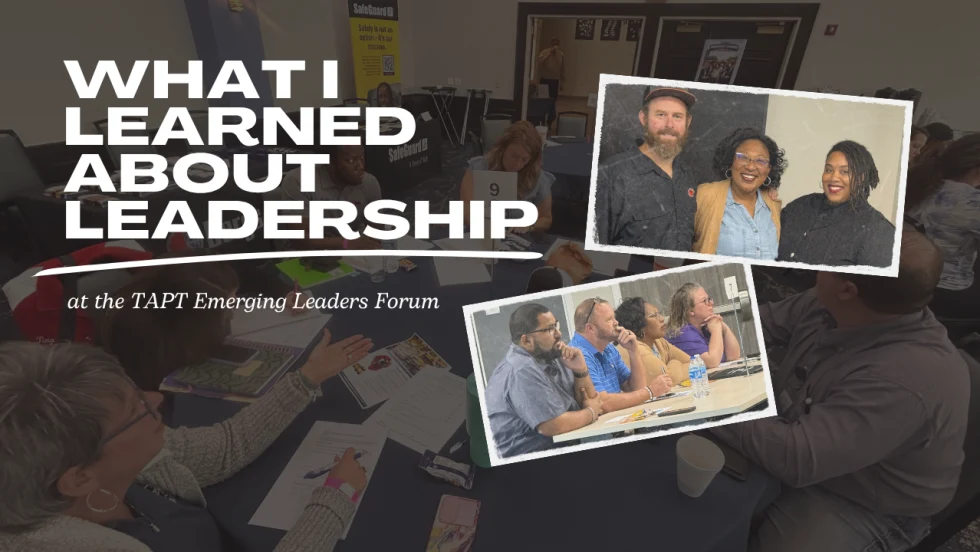
From Intent to Impact: What I Learned About Leadership from TAPT
A Texas transportation supervisor shares lessons on self-awareness, accountability, managing stress and building trust — and why investing in leadership development matters at every stage of your career.
Read More →
NAPT Names 2026 Award Recipients, Hall of Fame Inductee
Who earned national recognition for their work in student transportation? This year, NAPT named five recipients of its 2026 awards for service, safety, and leadership, plus its newest Hall of Famer.
Read More →
2026 State of Student Transportation Report
Driver shortages. Rising costs. Growing safety expectations. More data, but not enough time to act on it. The 2026 State of Student Transportation Report reveals what transportation leaders say is putting the most pressure on their operations—and where they’re investing next. See how your priorities compare.
Read More →
How to De-Escalate an Angry Person: 5 Steps for Handling Workplace Conflict
What makes emotions run high, and how should you handle an angry colleague or parent? Follow these steps for staying calm, listening, showing empathy, and resolving conflict.
Read More →
What Readiness Looks Like This School Year
Learn about the challenges shaping the 2026–2027 school year, from persistent driver shortages and budget pressure to technology and readiness gaps. See how school districts are responding and adapting in Zonar’s 2026 Back-to-School Readiness Report.
Read More →