




Tennessee District Adds Behavior Monitors, Drops Disciplinary Referrals
With five rotating bus monitors, Dickson County Schools is working to improve student behavior, boosting safety for drivers and passengers.
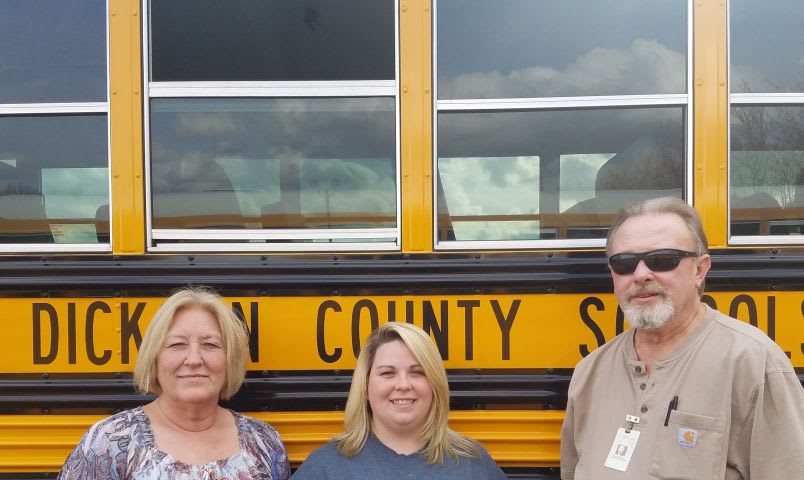
Dickson County Schools is working to improve student behavior by placing monitors on some buses as needed. From left: Melissa Garton, transportation coordinator; bus monitor Beth Meadows; and bus driver Steve Manley.
Dickson County Schools is working to improve student behavior by placing monitors on some buses as needed. From left: Melissa Garton, transportation coordinator; bus monitor Beth Meadows; and bus driver Steve Manley.
Safety issues on school buses affect districts everywhere. From yelling to walking while the bus is in motion, children often don’t realize that their behavior creates serious safety concerns for drivers, and can potentially harm their classmates.
To combat behavioral issues on buses, one district in Tennessee has created a school bus monitor program in hopes of not only breaking bad habits, but educating children on proper safety procedures.
Melissa Garton, transportation coordinator for Dickson County Schools, has worked in school transportation for 20 years. She says the biggest change over the years has been in regards to discipline — a contributing factor, she believes, to the problem of not being able to retain school bus drivers.
“I don’t want to make it sound like our kids are awful, because they’re not,” Garton says. “Some of our buses are not as well-behaved as others.”
Monitoring Behavior
After talking with other districts in the area, Garton decided to implement a bus monitor program to provide a rotating set of eyes and to aid drivers.
“We’ve always had monitors on [buses with] our special-needs students,” Garton says. “So when the drivers come in … talking about, ‘We’re having this discipline problem or that discipline problem,’ it kind of just hit me one day that maybe if we had some floating monitors who could be shuffled to some of our buses that give us so much trouble … that that might help us keep our drivers and help with the safety of the students on the bus.”
The district approved a budget for five monitors, beginning in the 2015-16 school year.
Monitors rotate through buses or are assigned on an as-needed basis. With 68 regular routes and about 5,800 students riding a bus daily, monitors can stay on a bus for a couple of days or a couple of weeks, depending on student behavior improvement.
All monitors are trained in student management, undergo background checks and drug testing, receive CPR certification, and are taught how to interact with special-needs students, in case they have to substitute for one of the special-needs monitors.
“One of the keys is communication. The bus driver and the monitor, they have to be on the same page.” Steve Manley, school bus driver
Dickson County (Tenn.) Schools
Focus on Driving
So far, the response has been overwhelmingly positive. Student write-ups have dropped by over 70% on the buses that now have monitors on board.
“Drivers are coming in talking about how much it’s helped their route; it gives them time to focus more on driving than the disciplinary issues that might be on the bus,” Garton says. “More kids are sitting down now because they’re getting that second person telling them all about bus safety.”
“I had some issues and the monitor was able to actually go back and intermingle with the kids while we were rolling,” bus driver Steve Manley says. “And that just in itself, the presence of a monitor on the bus was a big help. And some of the disciplinary problems that I was having back there, she was able to [deal] with it firsthand and … with her help, those problems went away.”
On his bus, one of the biggest issues is that because seats have gotten taller, it has become more difficult to see what is going on behind him. With a monitor who can watch the students, Manley can focus on driving, rather than having to worry about discipline.
Beth Meadows, who started as a monitor at the beginning of the school year, says the students like to get up and roam around the bus while it’s in motion.
“That’s what their biggest thing is,” she says. “They want to go from one seat to the other while the bus is moving.”
Meadows believes that children respond better when it is explained to them why they shouldn’t do something, instead of just being told not to do it. Rather than just telling kids to sit still or not to yell, Meadows explains to them how and why their behavior is potentially dangerous.
“I try to teach them that if you get up while the bus is moving, if we have to stomp on the brakes or ... if anything happens, they can get hurt,” she says. “I explain to them, when the bus is moving, please don’t get up, because if we have to stop, it’s going to hurt you and everybody else is going to be in danger. So, let’s not do that.”
Since starting the program, Manley has basically stopped having to write children up for disciplinary reasons.
“One of the keys is communication,” he says. “The bus monitor and the driver, they have to be on the same page.”
Monitors also help by encouraging older students to set positive behavior examples for younger students.
“When you get all grades together, you have all different personalities, all different age levels that are trying to mingle,” Garton says.
To help, Meadows tries to persuade older students, especially those who have younger siblings, to be safety examples.
“I tell them, ‘You need to teach your brother or sister to sit down in a bus, so when you’re not here next year or you’re driving ... when you’re not on the bus, they know to sit down and not to move and they won’t get hurt,’” she says.
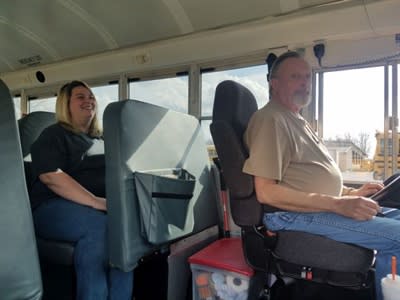
Since the district started adding monitors, Manley (seen here with Beth Meadows) has stopped having to write children up for disciplinary reasons. The program relies on clear communication between the monitor and driver, and the monitor and students.
Monitor Benefits
In addition to the program benefitting drivers and students, the monitors themselves appear to be pretty happy with the position.
“The hours helped a lot because working here I get day care for my kids,” Meadows says. “They get to go there while I’m on the bus monitoring. And if I get done, I can go get them anytime. They work with me anytime I need it. And I get the [school] holidays off.”
Before becoming a monitor, Meadows was a stay-at-home mom. Her two children, 6 and 8 years old, both attend public school in Dickson County.
Some of the monitors already work for the school district, and they use the job to help supplement their income. An extra perk, Garton says, is that they get a ride to and from work every day.
Garton and Manley would like to see the program expand to include more monitors, but they will have to make do with five for the time being.
“If it was financially feasible, it would be nice to have one on every bus,” Manley says. “But it’s like any other program. It’s a work in progress.”
More Management

How to Build a Better Driver Training Program
Ready to boost up your school bus instructor training? Here’s how to pick the right talent and improve recruitment, retention, and safety.
Read More →
CALSTART and Forth Combine to Form Catalyst Mobility
The new name represents a renewed vision for the nonprofit focused on advancing clean, equitable, and affordable transportation solutions that move people and goods.
Read More →
What Makes a Great School Bus Driver Trainer?
Choosing the right school bus driver trainer takes more than experience. Learn six keys to selecting and developing trainers and evaluating program effectiveness.
Read More →


School Bus Contractors Expand Through New Deals, Acquisitions & Partnerships
STA's Canadian division acquires Ontario-based G&L Stevenson Transport while Durham School Services adds a new district contract in California, First Student adds a New Jersey contract, and Minnesota Coaches acquires Halo Transportation.
Read More →
Logan Bus Company Rolls Out AI Phone System for NYC School Bus Families
A summer pilot found that AI agents could handle most routine calls, freeing up time for customer service staff to focus on emergencies and complex family concerns.
Read More →
From Intent to Impact: What I Learned About Leadership from TAPT
A Texas transportation supervisor shares lessons on self-awareness, accountability, managing stress and building trust — and why investing in leadership development matters at every stage of your career.
Read More →
NAPT Names 2026 Award Recipients, Hall of Fame Inductee
Who earned national recognition for their work in student transportation? This year, NAPT named five recipients of its 2026 awards for service, safety, and leadership, plus its newest Hall of Famer.
Read More →
2026 State of Student Transportation Report
Driver shortages. Rising costs. Growing safety expectations. More data, but not enough time to act on it. The 2026 State of Student Transportation Report reveals what transportation leaders say is putting the most pressure on their operations—and where they’re investing next. See how your priorities compare.
Read More →
How to De-Escalate an Angry Person: 5 Steps for Handling Workplace Conflict
What makes emotions run high, and how should you handle an angry colleague or parent? Follow these steps for staying calm, listening, showing empathy, and resolving conflict.
Read More →
What Readiness Looks Like This School Year
Learn about the challenges shaping the 2026–2027 school year, from persistent driver shortages and budget pressure to technology and readiness gaps. See how school districts are responding and adapting in Zonar’s 2026 Back-to-School Readiness Report.
Read More →