




Technology Showcase: A/C Systems
Here, we provide details on a variety of innovative school bus air conditioning offerings from six manufacturers.

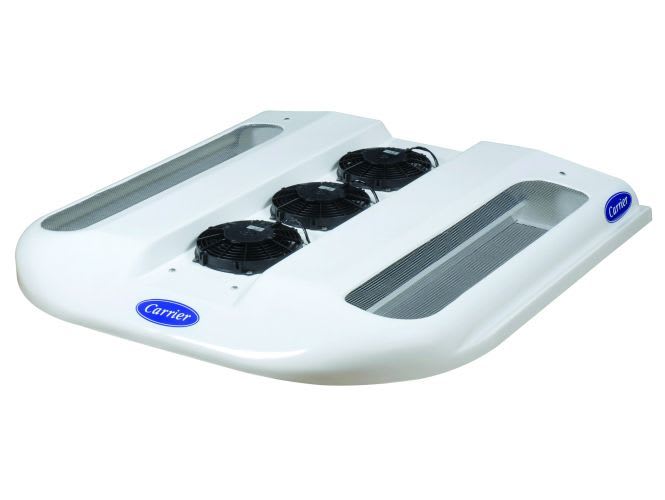
Carrier made the efficient K-410 unit smaller and lighter than its predecessor while maintaining the same level of performance and efficiency.
Trans/Air Mfg.
The Trans/Air FM55 flush mounted evaporator, conservatively rated at 55,000 BTU/hr (65,000 IMACA), has become one of the company's most popular models for the school bus market. In a Type A bus, one FM55 is commonly used in addition to a driver's factory system. For the Type C bus, two evaporators — one in the front and one in the rear bulkhead
— are utilized for more capacity.
The FM55 was designed specifically for the school bus market in early 2000 to get the evaporator out of the passenger area. It is designed to preclude the possibility of students or aides hitting their head on an evaporator that hangs down from the ceiling. Four thumb screws provide easy access to the oversized inlet filter and other service items, making
the FM55 popular among service managers and mechanics, Trans/Air says.
The company's new R120 roof top condenser assembly utilizes the latest parallel flow aluminum condenser technology. Benefits include greater capacity to reject heat and a 40-percent reduction in weight. The dual circuited assembly can be used with two independent systems in one
bus. The R120 is also easy to mount, since it is designed to fit the curvature of the most popular school and commercial buses.
Trans/Air also offers the EC 4.0 control system. This new school bus climate control system combines the functions of the EC 3.0 multiplexed electrical system and the EC 2.5 electro-mechanical control system into one feature-rich and functional package. The EC 4.0 system includes compressor protection features (cycling and voltage protection) and will
properly sense the temperature in the return air stream for accurate temperature control.
[IMAGE]458[/IMAGE]Thermo King
Thermo King's ShuttleAire S-30 II is a series of environmental control systems for small vehicles. The product line meets a wide range of applications, including small buses, vans, ambulances, security vehicles and special-purpose vehicles. The S-30 II is supported by a worldwide service organization and is engineered for reliability, low maintenance
and high performance for the life of the vehicle.
Standard features of the S-30 II include heavy-duty fin and tube coils and R-134a refrigerant. Version 1000 (cool only) is rated at 24,908 BTU/hr, with a maximum of 30,026 BTU/hr. Version 1004 (cool and heat) has 9 percent less cooling capacity than Version 1000.
Thermo King also offers the ShuttleAire SR-50, a lightweight, one-piece rooftop system for mid-size applications. Features include a side duct or unique center duct discharge system, heavy-duty fin and tube coils, and the ClimaAIRE control system for optimum temperature control.
[PAGEBREAK]
[IMAGE]459[/IMAGE]Rifled A/C Systems
New innovations are in the works at Rifled Air Conditioning Systems. This year will see the development of a new skirt-mounted stacked condenser configuration. This new unit will have an emphasis on ease of serviceability and reduction in bus downtime, the company says.
All major components will be accessible utilizing a hinged screen and condenser, allowing for easy coil cleaning, service of fans and drier replacement without having to work on one's back underneath the bus.
Rifled says that bulkhead units are fast becoming a popular alternative to the long-proven free blow. They provide minimal cabin intrusion while maintaining BTUs and CFMs. Rifled has bulkhead units specifically designed for all major school bus manufacturers. The company says it was one of the first to have the bulkhead unit on the market, starting with the IC Bus application.
[IMAGE]460[/IMAGE]Carrier Transport A/C
Carrier's new high-performing Ultra Low Profile K-410 roof-mount condenser unit, designed to minimize the weight placed on the roof of a bus as well as reduce overall height, is being applied in various school, shuttle and paratransit bus applications across North America.
Carrier made the efficient K-410 unit smaller and lighter than its predecessor while maintaining the same level of performance and efficiency. At 5.7 inches tall, the low height of the K-410 unit increases roof clearance and provides a cleaner, sleeker look to the air conditioning installation. At 49 pounds, the lightweight design makes the K-410 unit a good fit for both conventional- and hybrid-drive buses.
By relocating the air conditioning condenser from the typical position under the bus floor to the roof, the capacity and operating efficiency of the air conditioning system improves because the system uses cleaner air from the top of the bus through the unit's heat exchanger, according to
the company.
The K-410 unit uses non-ozone-depleting HFC-134a refrigerant and delivers a high cooling capacity (82,000 BTU/hr). The design specifications include a one-piece "drop in" construction to simplify and reduce the time it takes to complete the installation. The unit's modular construction allows for improved access to internal components, making it easier
to service.
Carrier also recently expanded its product offerings with a new family of Micro Channel Heat Exchangers (MCHX), including the popular CM-2 and CM-3 skirt-mount condensers. The MCHX condensers, ranging in capacity from 60,000-80,000 BTU/hr, were developed to improve the efficiency of
the air conditioning condenser while reducing the a/c system's weight and the amount of R134a refrigerant and oil required per bus.
[PAGEBREAK]
[IMAGE]461[/IMAGE]American Cooling Technology
American Cooling Technology Inc. (ACT) offers several in-wall mount evaporators designed to air condition all sizes and types of buses. These evaporators range from 35,000 BTU/hr to 55,000 BTU/hr.
The EZ-2 in-wall evaporator is rated at 55,000 BTU/hr. It's constructed of heavy-duty lightweight aluminum and internally enhanced copper tubing, and it utilizes dual blower assemblies with resistors to increase airflow and limit amperage requirements. The EZ-2 offers enhanced performance,
serviceability and ease of installation.
ACT products are manufactured in the U.S. and are supported by a two-year unlimited-mileage limited warranty and the company’s nationwide network of authorized service performance centers.
[IMAGE]462[/IMAGE]ACC Climate Control
ACC Climate Control has a new lightweight in-wall system for small bus applications. It’s a compact system that is available with a single or dual blower evaporator. The single three-speed blower system is rated at
30,000 BTU and 295 CFM. The dual blower system is rated at 38,000 BTU and 590 CFM. The evaporator’s features include a washable filter, long-life blowers, an ABS plastic drain pan and a powder-coated body.
The evaporator cover has thumb screws, allowing for easy filter change. The condenser is equipped with a dual fan and rated at 47,000 BTUs. This lightweight, low-profile condenser is designed to be mounted vertically. This mounting allows for easy installation, because no cutting of the bus skirt for additional airflow is required. The evaporator’s dimensions are 30 inches in length by 12.375 inches in height by 9.5 inches in width. The condenser’s dimensions are 24.5 inches in length by 10.5 inches in height by 6.25 inches in width.
More Maintenance
The essential guide to school bus maintenance and student safety
Reactive maintenance puts students at risk of breakdowns, delays and roadside emergencies. This guide gives transportation directors a data-driven framework to predict failures, extend bus lifespans and improve fleet reliability across every route.
Read More →
The Evolution of DEF Header Technology: What School Bus Operations Should Know at Replacement Time
See what school bus fleets should consider when replacing DEF headers to improve reliability, reduce repeat repairs, and control maintenance costs.
Read More →
Kerry Brothers Grows Michigan School Bus Repair Network
The acquisition of Downriver Truck and Bus expands Kerry Brothers’ school bus maintenance footprint across southeast Michigan, adding repair capacity, diagnostic resources, and state inspection support.
Read More →
Noregon Introduces CAN Bus Diagnostic Tool, Expands JPRO Features
CAN Mentor and the latest JPRO update aim to simplify vehicle network diagnostics and improve repair efficiency for technicians of all experience levels.
Read More →
Cummins on Smarter, Simpler Engine Innovation
Cummins discusses its first-ever gasoline engine for school buses, EPA 2027, and why bus fleets still want durable, simpler internal combustion options.
Read More →
Report: 72% of Diesel School Buses Now Use Advanced Low-Emission Engines
New data shows advanced low-emission diesel technology continues expanding across school bus fleets, even as electric bus adoption gains momentum.
Read More →
Vampire Tools' CAIMAN 7.5-Inch Multi-Purpose Screw Extractor Long-Nose Pliers with Crimper
Vampire Tools introduced the VAMPLIERS Caiman 7.5-inch multi-purpose pliers, combining screw extraction, cutting, crimping, and gripping functions into a single tool designed for fleet maintenance professionals.
Read More →
How Advanced Diagnostics Helps Bus Fleets Stay Ahead of Repairs
Chat with Noregon’s Kevin Smallhorn at ACT Expo about bus diagnostic tools, telematics integration, CNG maintenance support, and strategies to help reduce downtime and improve uptime.
Read More →
How School Bus Fleets are Getting Ahead of Breakdowns
Don’t let bus downtime wear you down. Here’s how bus operators are shifting from manual processes to AI-powered, data-driven maintenance systems for improved reliability and safety.
Read More →
Pennsylvania School Bus Maintenance Team Praised for Dedication to Safety
Matthews Bus Company’s West Jefferson received a letter of commendation from the Pennsylvania State Police for their fleet inspections.
Read More →