




Study Addresses School Bus Behavior Management Challenges
Strategies perceived to be the most effective include bus monitors and surveillance cameras, followed by referrals, pulling over, assigned seating, and promotion of driver-student relationships.
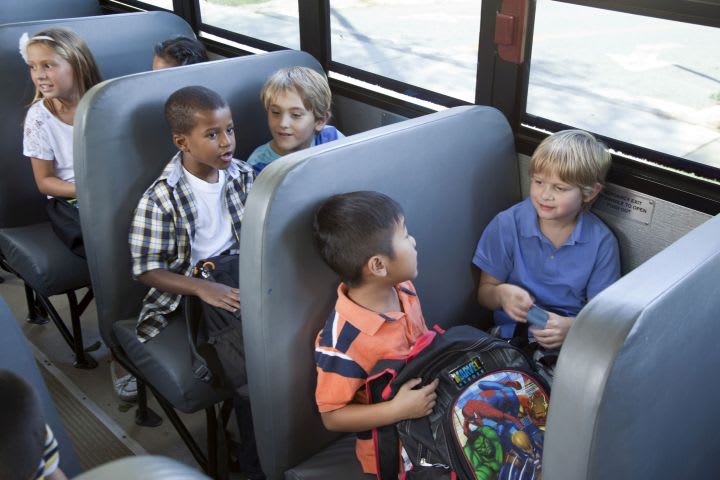
Photo courtesy National Highway Traffic Safety Administration
Photo courtesy National Highway Traffic Safety Administration
In the past few years, several incidents involving fighting or bullying on school buses have made local and national headlines. These events have raised important questions about the prevalence of misconduct on buses, as well as the efforts made by transportation departments toward student management.
Funded by the National Institute of Justice, RTI International and the National Association for Pupil Transportation conducted a two-year study that included a survey of more than 2,500 district-level transportation directors to understand the nature of misconduct on buses, the approaches used to create safe and positive school bus environments, and the challenges of transportation-based behavior management. The following are highlights from the study’s core findings.
1. Most common forms of misconduct: violations of basic rules, profanity, and bullying.
About two out of three respondents indicated that violations of basic rules (e.g., yelling, moving seats) were common, and one out of four reported that bullying was common. Fewer than 15% reported that fighting, substance use, sexual harassment, or sexual activity were common. Although respondents believed that most infractions were minor, they also emphasized that low-level violations can have dangerous implications because they threaten the driver’s ability to focus on the road. Many respondents also believed that student behavior has become significantly worse during their careers.
2. District composition associated with misconduct levels.
Large and urban districts and those with more minority or special-education students were found to have the highest levels of perceived and documented misconduct. Respondents also underscored several conditions that promote misbehavior, including long or afternoon commutes and crowded buses.
3. Several student management strategies employed.
On average, transportation departments use more than 12 behavioral management strategies on their buses. In addition to disciplinary referrals, the most common strategies include encouraging drivers to know their students, promoting relationships between drivers and school officials, allowing drivers to pull over when misconduct occurs, using assigned seating, and installing surveillance cameras. Larger districts and those with more special-education students tend to use a greater variety of strategies.
4. Bus monitors and surveillance cameras seen as most effective strategies.
The strategies perceived to be the most effective for student management include bus monitors and surveillance cameras, followed by referrals, pulling over, assigned seating, and promotion of driver-student relationships. Conversely, the strategies perceived to be the least effective were seat belts and entertainment (i.e., showing movies or playing music on the radio). However, perceptions often depended on the type of district; for instance, those with more special-education students tended to perceive strategies to be less effective, whereas respondents from smaller districts perceived several strategies to be more effective than their urban counterparts (e.g., encouraging drivers to get to know their students).
5. Variety of approaches used to determine whether strategies are working.
Almost all districts get feedback from their drivers, and at least 65% get feedback from students or parents. Although 70% track referrals before and after strategies are implemented, fewer than half have strategies formally evaluated or observe buses after new strategies are applied. Many also described data-driven approaches to student management, including using referral data to inform responses to misconduct or driver training programs, isolate issues to specific schools or buses, or assess trends in referrals and misconduct over time.
6. Numerous student management challenges described.
The most common challenges were parents not believing (or cooperating with) the transportation department when told that their child had misbehaved, a lack of support from school administrators, a lack of respect for drivers, and a lack of consistency or follow-through in how schools handle problems. Respondents also described a need for bus monitors and cameras, insufficient training for drivers, and problems recruiting and retaining drivers.
Taken together, the project advanced our understanding of the nature and extent of misconduct on buses and the approaches used for student management. Although scientific evaluations of these strategies are needed to build confidence in their effectiveness, the project has identified a short list of promising approaches and the conditions under which they are perceived to be effective. A recently published article in the Journal of School Violence has more information about this study, and can be found here. The final report for this project will also be published online by the National Institute of Justice in 2019.
More Management

How to Build a Better Driver Training Program
Ready to boost up your school bus instructor training? Here’s how to pick the right talent and improve recruitment, retention, and safety.
Read More →
CALSTART and Forth Combine to Form Catalyst Mobility
The new name represents a renewed vision for the nonprofit focused on advancing clean, equitable, and affordable transportation solutions that move people and goods.
Read More →
What Makes a Great School Bus Driver Trainer?
Choosing the right school bus driver trainer takes more than experience. Learn six keys to selecting and developing trainers and evaluating program effectiveness.
Read More →


School Bus Contractors Expand Through New Deals, Acquisitions & Partnerships
STA's Canadian division acquires Ontario-based G&L Stevenson Transport while Durham School Services adds a new district contract in California, First Student adds a New Jersey contract, and Minnesota Coaches acquires Halo Transportation.
Read More →
Logan Bus Company Rolls Out AI Phone System for NYC School Bus Families
A summer pilot found that AI agents could handle most routine calls, freeing up time for customer service staff to focus on emergencies and complex family concerns.
Read More →
From Intent to Impact: What I Learned About Leadership from TAPT
A Texas transportation supervisor shares lessons on self-awareness, accountability, managing stress and building trust — and why investing in leadership development matters at every stage of your career.
Read More →
NAPT Names 2026 Award Recipients, Hall of Fame Inductee
Who earned national recognition for their work in student transportation? This year, NAPT named five recipients of its 2026 awards for service, safety, and leadership, plus its newest Hall of Famer.
Read More →
2026 State of Student Transportation Report
Driver shortages. Rising costs. Growing safety expectations. More data, but not enough time to act on it. The 2026 State of Student Transportation Report reveals what transportation leaders say is putting the most pressure on their operations—and where they’re investing next. See how your priorities compare.
Read More →
How to De-Escalate an Angry Person: 5 Steps for Handling Workplace Conflict
What makes emotions run high, and how should you handle an angry colleague or parent? Follow these steps for staying calm, listening, showing empathy, and resolving conflict.
Read More →
What Readiness Looks Like This School Year
Learn about the challenges shaping the 2026–2027 school year, from persistent driver shortages and budget pressure to technology and readiness gaps. See how school districts are responding and adapting in Zonar’s 2026 Back-to-School Readiness Report.
Read More →