Students on Board: New Breed of Rideshares Provide Tech-Powered Pupil Transportation
Before alternative student transportation became a growing industry, app-based providers were already using cars and SUVs to fill gaps in traditional school bus service.
Thomas McMahon・Executive Editor
April 5, 2018
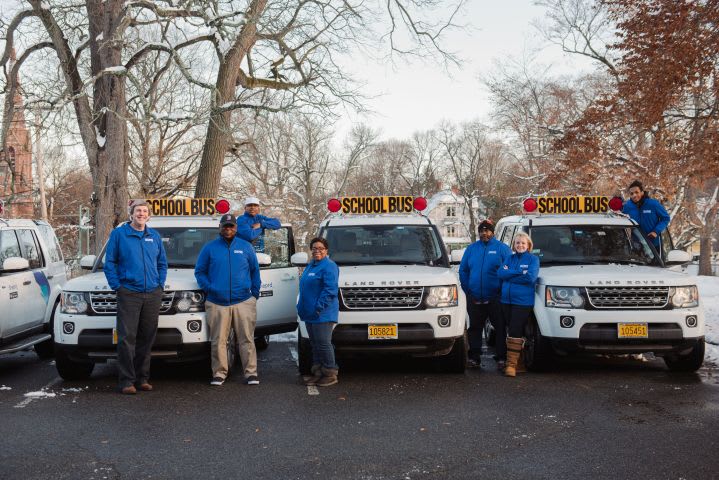
Sheprd uses Land Rovers and other SUVs to transport students.
Credit:
Sheprd
9 min to read
Editor's note: This article was originally published in April 2018 and reviewed in September 2026 to add updated links to newer School Bus Fleet coverage. For a newer look at alternative student transportation and the companies currently operating in the space, read "Rethinking the Route: A Deep Dive into Alternative Transportation for School Districts."
Snow blankets the trees and buildings of Newton, Massachusetts, as a vehicle with a “SCHOOL BUS” sign above the windshield rolls through the town.
Ad Loading...
Despite the familiar yellow and black sign and the red lights that frame it, the vehicle itself is not school bus yellow. Like the wintry landscape around it, the vehicle is white. And it’s a Land Rover.
Meet the “modern school bus,” as Sheprd bills its fleet of sleek SUVs.
The Newton-based startup is one of a handful of tech-powered companies that offer transportation for children to and from after-school activities, or even to and from school itself. These “Uber for kids” services — as some have dubbed them — have taken root around big cities like Boston, Los Angeles, and San Francisco, catering to busy parents who need help shuttling their busy children.
Executives from these companies say that rather than replacing the traditional yellow school bus, their services help fill in gaps where a big bus isn’t available or wouldn’t be economical. Even some school bus industry insiders see app-based ridesharing as a model that will likely become a bigger part of the pupil transportation scene in the near future.
“It’s going to force school transportation service providers to rethink things,” says Mike Martin, executive director of the National Association for Pupil Transportation (NAPT). “It’s important for them to figure out how to utilize and integrate these nontraditional types of service in their business model because their customers — the taxpayers — want it.”
How Rideshare Services Began Partnering With School Bus Operators
The first high-profile connection between a yellow bus operator and a ridesharing service came in November. Student Transportation Inc. (STI), North America’s third-largest school bus contractor, announced that it took a minority stake in an industry “disruptor”: Los Angeles-based HopSkipDrive.
HopSkipDrive provides app-based customized transportation services for schoolchildren and their families. That includes getting kids to after-school activities, sports practices, music lessons, and even doctor appointments.
So why would a school bus contractor like STI invest in a so-called industry disruptor like HopSkipDrive?
Thomas Kominsky, chief growth officer and head of non-asset businesses for STI, says that the investment is a proactive move that embraces a new way to enhance service.
Ad Loading...
“I don’t think the rideshare economy is going to totally infringe on the school bus,” Kominsky says. “It’s certainly going to impact the fringes of our industry.”
Kominsky points out that a ridesharing service isn’t designed to take on, for example, a contract to transport 100,000 students in a large school district. But he says that HopSkipDrive can provide efficient service for a smaller private school, for instance, or for transporting a homeless student to his or her school of origin under the McKinney-Vento Act.
“In certain areas where we already have density, we can partner with HopSkipDrive on a hybrid solution, moving smaller segments of our passengers [when] it’s not as economic on a school bus,” Kominsky says. “It’s a really nice supplement to our business and the issues that everybody faces in student transportation.”
“In certain areas where we already have density, we can partner with HopSkipDrive on a hybrid solution, moving smaller segments of our passengers [when] it’s not as economic on a school bus.” - Thomas Kominsky, chief growth officer, Student Transportation Inc.
How HopSkipDrive Screens Drivers and Tracks Rides
Joanna McFarland and two other working moms launched HopSkipDrive in 2016. McFarland, the company’s CEO, says they built the service to address the logistical challenges they face as parents, as well as their expectations for safety.
Ad Loading...
“HopSkipDrive drivers are ‘CareDrivers’ — they are caregivers first and drivers second,” McFarland says.
Applicants need to have at least five years of experience caring for children. They go through a 15-point screening process that includes fingerprinting and a driving record check. “We also meet every CareDriver in person,” McFarland adds.
HopSkipDrive’s drivers use their own vehicles, which have to be four-door models that are not more than 10 years old. The vehicles have to pass a 19-point inspection by a certified mechanic, according to the company.
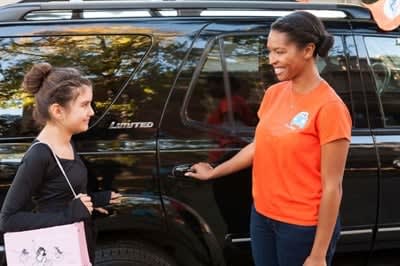
When parents book a ride for their child, the app shows them a profile of the driver, including a photo. Parents can provide specific pickup and drop-off instructions for the driver, including a personalized code word to use when picking up their child.
Parents get notifications when their kid is picked up or dropped off, and they can track the ride with the app. Also, HopSkipDrive uses a smartphone program called Zendrive to monitor driver behavior in real time.
Ad Loading...
McFarland says that in places where many individual families take their kids to and from school, the ridesharing aspect of HopSkipDrive can help reduce traffic by placing up to four passengers per vehicle. The app even offers a feature in which multiple families can arrange a carpool with a HopSkipDrive driver.
“It’s a real opportunity to help schools cut down on the number of cars entering a campus,” McFarland says.
HopSkipDrive’s app gives parents notifications when their child is picked up or dropped off. They can also choose a personalized code word for the driver to use at pickup.
HopSkipDrive
How Early Student Rideshare Companies Selected Drivers
Zemcar is another app-based ridesharing platform that provides transportation for children. The Cambridge, Massachusetts-based company is currently covering the greater Boston area.
Zemcar’s services include transportation to and from school and after-school activities. The company’s drivers are independent contractors who use their own vehicles. Parents book rides with the app, and they can interview and select preferred drivers to build what the company calls a “Circle of Trust.”
“They get to decide who takes their kids. … Parents really like that,” says Larissa Vigil, director of operations for Zemcar. She adds that the drivers also appreciate the relationship-building aspect of the platform. “They like making connections with the families, getting to know them.”
Ad Loading...
As for Zemcar’s screening process, the operations team conducts video interviews with applicants for the first round. Then they collect more information, such as making sure that the applicant’s vehicle is up to date on state-required annual inspections, is covered by insurance, and is not more than 10 years old.
The next round is an in-person coaching session, which covers how the app works, safe driving practices, and how to handle any issues that arise with passengers.
“We run through some high-level scenarios … what would you do, how do you approach that. They get a sense generally of how to manage any situation,” says Amanda Robbins, a safety and security adviser for Zemcar.
For applicants who pass through the initial rounds, the next step is background checks.
“They don’t drive till [the background checks] come back clear,” Vigil says.
Ad Loading...
Zemcar allows parents to schedule recurring transportation service for their children. They can also order on-demand rides.
In an interesting twist on video surveillance, Zemcar’s app offers parents the option to view real-time video of their child throughout the ride.
“They can not only track the car, but also watch a live video feed,” Vigil says. “Parents really like that, and drivers as well. … If anything happens, it’s comforting for them to know that someone’s watching.”
Zemcar allows parents to schedule recurring transportation or on-demand rides for their children.
Zemcar
Using Smaller Vehicles for Dynamic Student Transportation
Sheprd also offers transportation for children in the Boston area — specifically the suburban town of Newton. CEO Nick Jasset launched Sheprd in early 2017 with backing from InMotion Ventures, Jaguar Land Rover’s venture capital group.
As with other ridesharing services, parents use an app to book rides for their children. Sheprd can shuttle students to and from school and a network of local after-school facilities that have partnered with the company. The cost is $17 per ride.
Ad Loading...
Jasset says that the majority of Sheprd’s trips are taking kids from school to after-school programs, covering dynamic transportation needs where it doesn’t make economic sense to use a large school bus
“It’s not something that lends itself to rerouting a 70-pasenger bus,” he says.
Perhaps the most attention-grabbing aspect of Sheprd’s service is the school bus sign and lights affixed to the top of the company’s vehicles, which include white Land Rovers and Chevy Traverses. The basis for those school bus components is a Massachusetts regulation known as 7D, which applies to smaller vehicles that are hired to transport students on fixed routes (see sidebar below).
Since Sheprd follows the 7D rules, its vehicles are identified with the “SCHOOL BUS” lettering, and they have to carry such safety equipment as fire extinguishers and flares. They also have to undergo daily pre-trip inspections by the drivers. Massachusetts also has a certification process for 7D drivers, which includes background checks, physicals, and a written exam. Sheprd’s drivers are 7D certified, and they operate the company’s 7D fleet rather than their own vehicles. Jasset notes that the drivers are “W-2 employees, not independent contractors.”
Also, Sheprd goes beyond the 7D requirements in a number of ways, such as stocking the Land Rovers and Traverses with emergency blankets, seat belt cutters, and flashlights. The company’s drivers go through a training series that includes app orientation, a “mock shift,” a driving test, and ride-alongs with staff.
Ad Loading...
Another notable precaution that Sheprd has voluntarily implemented: Before each shift, the company requires its drivers to use a breathalyzer app called BACtrack.
“If they fail, they’re not given a shift assignment,” Jasset says.
“They can not only track the car, but also watch a live video feed. Parents really like that, and drivers as well.” - Larissa Vigil, director of operations, Zemcar
Could App-Based Student Transportation Scale?
As for Zemcar, the Cambridge-based company’s independent drivers and the personal vehicles they use don’t follow the 7D specifications. Vigil says the company’s service doesn’t fall under that state regulation “because our rides are organized by the parent and we do not have fixed routes.”
(Information published by the Massachusetts Registry of Motor Vehicles confirms that fixed routes are a factor in determining whether the 7D requirements apply. However, as of press time, the agency had not fulfilled SBF’s requests for clarification in the case of Zemcar.)
Ad Loading...
Vigil says that there is increasing demand for Zemcar’s service in Massachusetts and beyond, which could fuel further growth for the company.
“We don’t have anything set in stone yet, but we would definitely like to expand,” she says.
Jasset of Sheprd notes that a certain degree of population density is needed for a service like his to survive by booking enough trips — say, five students per hour, per vehicle. It might not work in a rural area, but Jasset sees a suburb like Newton as a good testing ground. The company’s current goal is to get 3% of local families using Sheprd.
“Once we get that kind of market share, we can start moving to neighboring cities and new states,” he says.
HopSkipDrive has been operating in Southern California and the San Francisco Bay Area. In April, the company launched service in Denver. Meanwhile, the partnership with STI is expected to facilitate expansion to other parts of the country where the school bus contractor already has operations in place.
Ad Loading...
“We can reduce that overhead burden and give them a head start,” Kominsky says, adding that STI can also talk to local parents about the new service “to build up demand before HopSkipDrive enters a market.”
NAPT’s Mike Martin says that all school bus operators should be taking a close look at these app-based services and the way they harness technology to meet the needs of parents and their children.
“If you’re not thinking like that right now, you’re already behind the curve,” Martin says. “It’s going to require everyone in the industry to use data as the basis for decision-making. I think that’s a good thing.”
What Are Massachusetts 7D Student Transportation Vehicles?
If you’re in Massachusetts and you see a car or SUV with a “SCHOOL BUS” sign on top — like the white Land Rovers and Chevy Traverses operated by ridesharing service Sheprd — here’s why:
Section 7D of Massachusetts law lays out rules for vehicles that carry eight or fewer passengers (not including the driver) and are “used in the business of transporting school pupils for hire under terms of contract or otherwise.” The regulation comes into play for fixed-route service that is provided on a regular basis for an entire school year.
Among the requirements for 7D vehicles are black “SCHOOL BUS” lettering on a yellow background and red flashing lights (but not a stop arm) to be used when students are boarding or exiting.
Also, 7D vehicles need chock blocks, a fire extinguisher, and three flares on board, and they have to undergo daily pre-trip inspections by their drivers.
There is also a state certification process for 7D drivers. Requirements include being at least 21 years old, passing criminal and sex offender background checks, having a “satisfactory” driving record, passing eye and physical exams, and passing a written knowledge exam. Licensed school bus drivers are allowed to operate 7D vehicles without a 7D certificate.
According to the latest information available from the Massachusetts Registry of Motor Vehicles at the time of original publishing, there are more than 5,000 7D vehicles and about 7,000 7D drivers registered in the state.
The new name represents a renewed vision for the nonprofit focused on advancing clean, equitable, and affordable transportation solutions that move people and goods.
Choosing the right school bus driver trainer takes more than experience. Learn six keys to selecting and developing trainers and evaluating program effectiveness.
STA's Canadian division acquires Ontario-based G&L Stevenson Transport while Durham School Services adds a new district contract in California, First Student adds a New Jersey contract, and Minnesota Coaches acquires Halo Transportation.
A summer pilot found that AI agents could handle most routine calls, freeing up time for customer service staff to focus on emergencies and complex family concerns.
A Texas transportation supervisor shares lessons on self-awareness, accountability, managing stress and building trust — and why investing in leadership development matters at every stage of your career.
Who earned national recognition for their work in student transportation? This year, NAPT named five recipients of its 2026 awards for service, safety, and leadership, plus its newest Hall of Famer.
Driver shortages. Rising costs. Growing safety expectations. More data, but not enough time to act on it. The 2026 State of Student Transportation Report reveals what transportation leaders say is putting the most pressure on their operations—and where they’re investing next. See how your priorities compare.
What makes emotions run high, and how should you handle an angry colleague or parent? Follow these steps for staying calm, listening, showing empathy, and resolving conflict.
Learn about the challenges shaping the 2026–2027 school year, from persistent driver shortages and budget pressure to technology and readiness gaps. See how school districts are responding and adapting in Zonar’s 2026 Back-to-School Readiness Report.