




State Directors Home In on Seat Belt Issues
State pupil transportation directors gathered in Myrtle Beach, S.C., in late October to cover issues of national concern, such as increasing schoo...

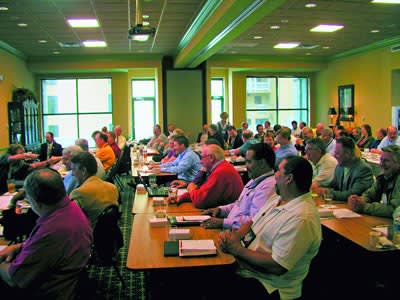
State pupil transportation directors gathered in Myrtle Beach, S.C., in late October to cover issues of national concern, such as increasing school bus security and reducing emissions.
Several sessions at the National Association of State Directors of Pupil Transportation Services’ (NASDPTS) annual conference were dedicated to discussion of seat belts on school buses.
The National Highway Traffic Safety Administration had just released its final rule dealing with belts on buses, and agency officials — including Acting Administrator David Kelly — were on hand to explain the agency’s stances. The final rule mandates lap-shoulder belts on small school buses but not large buses, instead providing guidelines for voluntary installation on large buses.
The conference program showed a push toward embracing lap-shoulder belts for large buses, with Indiana state director Pete Baxter, industry advocate Cal LeMon and former NASDPTS Executive Director Charlie Gauthier each giving speeches in support of adding the safety devices — and calling for funding to do so.
“Cost has never been a socially acceptable reason for ignoring proven safety technology,” Gauthier said. In addition to increasing occupant protection, he said, equipping school buses with lap-shoulder belts improves the school bus industry’s public image and reduces opportunities for litigation.
Security concerns
Bill Arrington and Steve Sprague of the Transportation Security Administration (TSA) spoke to the state directors about pupil transportation security issues, including TSA’s risk assessment of the school bus industry that was mandated by last year’s HR 1 act.
Arrington said that the assessment had already been completed but was still going through the review process.
Although the officials didn’t go into detail on the contents of the assessment, Sprague noted that “you’re not going to be surprised by it.”
One specific security concern that the officials discussed was keeping suspected terrorists from becoming school bus drivers. Sprague said that TSA wants to ensure that anyone who is rejected from getting a hazardous-materials endorsement because he or she is on a list of suspected terrorists would not be able to get a CDL and become a school bus driver.
The TSA officials also introduced Charles Hall of HMS Co., the company that has taken over Highway Watch and School Bus Watch.
The programs are now being called Eyes on the Road, although Hall said that the name may change. A new call center, through which school bus and truck drivers can report highway security concerns, has been established. The number is (888) 217-5902.
New engine technology
Officials from school bus and engine OEMs spoke to the state directors about alternative fuels and new engine technology to meet the EPA’s 2010 emissions requirements.
Thomas Built Buses officials gave details on selective catalytic reduction (SCR), which uses a catalyst to convert nitrogen oxides, or NOx. The engines with SCR will require the use of a diesel exhaust fluid, which is a 32.5-percent urea solution and will be readily available.
Thomas Built also discussed the forthcoming Hybrid Saf-T-Liner C2 school bus. The company has been testing a prototype with the goal of reducing emissions and improving fuel economy by up to 30 percent or more.
Cummins engines will be among those using SCR to meet the 2010 requirements. Company officials said that the engine itself won’t change much; the change has more to do with the aftertreatment system.
Blue Bird officials discussed their propane and CNG school bus offerings, both of which meet the 2010 requirements.
Blue Bird’s propane-powered Vision uses a liquid propane injection (LPI) system, which is significantly more efficient than older technology. Company officials described LPI as “not your father’s propane fuel system.”
Officials from IC Bus and parent Navistar said that instead of SCR, their engines will use exhaust gas recirculation (EGR) to meet the emissions requirements. The officials called EGR a “mature technology” and noted that it does not require added urea distribution infrastructure.
IC also gave an update on its hybrid school bus, which a number of school districts and contractors have been running over the past couple of years. Company officials also noted that the IRS recently added their hybrid bus to a list of vehicles that qualify for the Alternative Fuel Motor Vehicle Credit.
More Safety

How to Build a Better School Bus Driver Training Program
Is it time to strengthen your driver training? Here’s how to pick the right talent and improve recruitment, retention, and safety. This video is brought to you by IC Bus.
Read More →
Recent School Bus Accidents Leave 2 Dead, 2 Injured
Four school bus crashes in Florida, Illinois, and Georgia highlight risks in transportation lots, at bus stops, and during student loading and unloading.
Read More →
When Every Second Matters, Clarity Keeps Routes Moving
From routine delays to urgent incidents, strong communication practices help drivers, dispatchers, schools, and families respond with confidence.
Read More →

What Happens When a School Bus Catches Fire — and What Can Help
School bus fires are rare but can be devastating. Learn how advances in fire suppression and asset protection help fleets detect fires earlier, reduce damage, and improve safety.
Read More →
Geotab Launches Tool to Help Fleets Investigate Road Incidents
Geotab Investigations combines telematics data, video, documents, and other evidence to help fleets reconstruct incidents, resolve claims, and determine what happened.
Read More →
Texas Sixth Grader Wins 2026 National School Bus Safety Poster Contest
Sai Darshana Yekolu of Moseley Middle School in Prosper, Texas, was named the newest winner for her artwork, bringing the theme of “Safe Rides, Everyday Heroes” to life.
Read More →
Doing More With Less: How Transportation Directors Can Prioritize Safety Amid Budget Uncertainty
With diesel prices soaring and nearly one-third of transportation directors expecting budget cuts, maintaining student safety has never been more challenging. Download this guide to learn how leading districts are prioritizing risk, funding critical safety technology, and building stronger budget cases with data.
Read More →
Walton County Schools Adds Gatekeeper Stop-Arm Enforcement System
The Florida district will deploy Gatekeeper’s updated Student Protector technology, which now incorporates AI to improve video evidence.
Read More →
How To Build a More Secure School Bus Yard During and After Hours
As thefts and overnight security threats continue, school transportation leaders are combining stronger operational practices with AI-enabled surveillance to better protect buses, facilities, and staff.
Read More →
FMCSA Names New Chief Safety Officer: What School Bus Operators Should Know
Steve Dowling is set to lead the federal agency's efforts to advance commercial motor vehicle safety and reduce crashes, fatalities, and injuries on the nation's roadways.
Read More →