




Spring Branch ISD Takes Two-Sided Approach to Success
Spring Branch Independent School District in Houston believes it can provide better transportation service to its students by splitting the program. O...
Spring Branch Independent School District in Houston believes it can provide better transportation service to its students by splitting the program. One division is responsible for transporting approximately 500 special-needs students, while the other takes care of the 18,000 other students.
“Special-needs routes change almost daily, and we need to customize the routes to fit these students’ needs,” says Henry Behne, transportation administrator. That means that the district’s 53 small buses are used strictly to transport special-needs students, while the 193 large buses (65 or more passengers) are used for transportation of regular students.
This division of duties has helped personnel specialize within their area, as the two systems function independently. Each section has its own set of drivers, supervisors and dispatchers. The only common staff is the district administration, such as the payroll department. Still, Spring Branch sends two separate operation cost reports and route service reports to the state.
According to Behne, even the buses’ radio frequencies are separated, though the two frequencies can bleed over into the other side. “When we talk to regular buses it’s simply their side, and when we talk to special buses it’s simply their side,” he says.
Training for success
Splitting the transportation department has made it easier to customize driver training as well, which is highly prioritized at Spring Branch. “We set a pretty high standard for our drivers, as far as dress code, their performance on the bus, in dealing with the students and their performance in actually driving the equipment,” Behne says. “Our standard is probably higher than a lot of other districts.”
That standard includes making sure the drivers conform to a high degree of professionalism. They’re required to possess a handbook of policies and procedures and maintaining a strong policy for inappropriate driving and speeding.
Since he believes in training his drivers himself, Behne does not weigh credentials heavily when hiring new drivers. He will even hire non-licensed drivers and allow them a two-week window to obtain their CDL.
During those weeks, the new hires are guided through field training on the bus and 20 to 25 hours of classroom type training to prepare them for the CDL test. After they pass the written part of the test, they are taken to the Department of Public Safety to complete the driving test.
The district adds wheelchair-restraint training and other specialized training to the standard training for its special-needs drivers on a regular basis, usually quarterly. Behne often brings in speakers from outside who have experience working with special-needs children.
“We’ve brought parents in to do training, so the drivers can see what it’s like working hands-on with their particular child,” he says. “And it’s been good for the parents because they feel like they’re a part, and it’s good communication between the drivers and the parents on how we can serve the kids better.”
Spring Branch does not require drivers to be certified by the time of hire. “That’s a state requirement; it’s not a district thing,” Behne explains. “We’ve got our training program here to get them licensed, to get them going, and the state requires them to be certified within a six-month period of time.” In the meantime, they operate under an emergency credential.
However, Spring Branch is required by state law to conduct a criminal history and driving record check of all employees and to have drivers undergo a physical exam at the time of hire.
Once hired, if drivers are cited for moving violations, they are removed from the job until the extent of their conviction is determined. “If they’re not penalized, then they’ll be backpaid for that time,” Behne says. “But if they were found driving inappropriately, then they’re taken away from driving, and they’re out of that position for at least a full year.”
In severe cases of driver misconduct, an accident review board, consisting of a police officer, a risk manager, department managers and drivers, is consulted. If the board determines a behavior inexcusable, the driver can be terminated immediately.
Practice makes perfect
“We’ve done really well,” Behne says, reflecting on the effectiveness of the driver-training program, and he has records to prove it. Most of the training policies were enacted in 2002 and resulted in a 50 percent reduction in accidents over one year.
The district invented a rating system comparing accidents for this school year to those of the previous school year. The system had the following categories for accidents: injury, backing, preventable, reportable and at-fault.
This school year, the district has had 33 accidents, compared to 78 a year ago. The district has had no serious injuries this year, and the number of non-serious but reportable injuries decreased from nine to three.
Moreover, the number of injuries resulting from backing up went down from six to five, and preventable accidents (where the district could have done something better to avoid the accidents but where they were not necessarily at fault) were cut in half, from 52 to 26. Reportable accidents (any damage over $500) decreased from 41 to 15, and at- fault accidents (district was to blame) dropped from 50 to 26. All worker’s compensation claims were reduced by half also, Behne says.
Untangling the Web
An area in which Behne feels Spring Branch could improve its performance, however, is communication. “Probably the greatest challenge right now is good communication to the parents and making sure they know what we’re doing, where we’re going to be and what we’re doing with our routes,” he says.
The district has been effectively using the Internet for its public relations information, and Behne would like to see the transportation department follow that lead. Therefore, Spring Branch’s highest priority is to redesign the transportation department’s Website, so parents can log on easily and receive updated information regarding the transportation of their children.
Spring Branch has tested the effectiveness of Web-based communication already with an electronic pilot program for field trips that has been in place for about a year. Customers who wish to book a bus for a field trip need to submit an electronic request through the district’s Website. This paperless process has proven itself valuable to the district, Behne says.
Furthermore, this month, Spring Branch is implementing an electronic registration program for their special-education students. After the district receives IEP papers for a student, the student’s route is decided and his/her information is added to a Web-based database. The overall process will stay the same but become electronic, enabling the district to enroll a student into a route quicker.
Also, it will give the district more fingertip-type information at the click of a mouse, Behne says. “In case there is a crisis or something on a bus, we can pull that information up a lot faster than if we were on manual system.” In addition, Spring Branch is planning this spring to complete a database for all its special programs that are not part of the regular school routes, such as summer school, after-school programs and vocational programs, to further enhance the transportation service.
Savings are up
Not only would expanded Internet service improve communication, but it could help the district save money by cutting administration costs. And saving money is something Spring Branch’s transportation department is no stranger to. “We’ve saved a ton of money on overtime expenses,” Behne says. “We’ve saved $130,000 from last year, and that’s really good.”
As a matter of fact, last year the district saved so much money they were able to buy three new buses simply by redistributing job shifts. Instead of having a small group of people working overtime, the district developed a system that required the hours to be spread among all employees.
If extra work unexpectedly arises, it is assigned to the employees who have the fewest hours, Behne says. “It’s been good for us because it saved us in overtime cost,” he says, “and it’s been good for the drivers in that now I’ve got more people given the opportunity to make some money.”
The district’s per-mile cost for regular student transportation is $4.44, including electricity, depreciation, fixed assets, building maintenance, salaries, overtime, vehicle maintenance, clerical, fuel and purchase costs of the buses. Cost per mile for special-needs education at Spring Branch is $2.58, which is more than double the state’s funding of $1.08 per mile.
Teamwork keys success
Ultimately, if more employees are making money thanks to the district’s redistribution of hours, they are also likely to be satisfied and content. Because keeping employees happy is another of Spring Branch’s top priorities, that pleases Behne. “Our drivers are all happy here, and I think that’s part of the reason we’re fully staffed with drivers when a lot of people aren’t,” he says. “It’s because they enjoy working here.”
Likewise, according to Behne, the district tries to involve the drivers in an activity once a month to make sure they feel valued above and beyond just their route. That has helped boost driver morale and team effort because it has created a nice atmosphere to work in.
“The thing we do the best is that we invest in our drivers,” Behne says. “We make sure that they know they are going to get backing and support. They’re the ones that make or break us, so we let them know how important they are to the district and to the kids we are transporting.”
Similarly, Spring Branch does not honor the process of rewarding individual workers for outstanding performance but rather recognizes the district’s performance as a whole. “Nobody is a superstar here,” Behne says. “Everybody is equal — they just have different job responsibilities. We don’t put anybody on a pedestal. We’re a group, and we try to do everything as a unit.”
Keeping ‘em running
An important part of that unit is the Spring Branch maintenance department. The district is relatively small geographically, so the buses usually wear out their parts before they wear out their motors and drivetrains. “We don’t really put that many miles on them as far as long-distance miles are concerned,” Behne says.
Currently, Spring Branch has 44 regular buses and 13 special-needs buses that are between 1 and 5 years old, 73 regular and 39 special-needs buses that are between 6 and 10 years old, and 76 regular buses and one special-needs bus that are older than 10 years. The district tries to replace all buses by the time they reach 15 years of age.
Spring Branch uses a computerized fleet maintenance software — Fleet Vision — to keep track of when preventive maintenance checkups are needed.
Moreover, all buses are manufactured by International Truck and Engine Corp. because those parts are easily accessible in the area, Behne says.
Additionally, the drivers are responsible for some preventive maintenance through their own pre- and post-trip inspections. Also, trained personnel fuel the buses for the drivers and give the buses an overall check during each fueling process. Last but not least, “We’ve got a good shop staff,” Behne says. “We’ve got guys who are on top of it.”
More Management
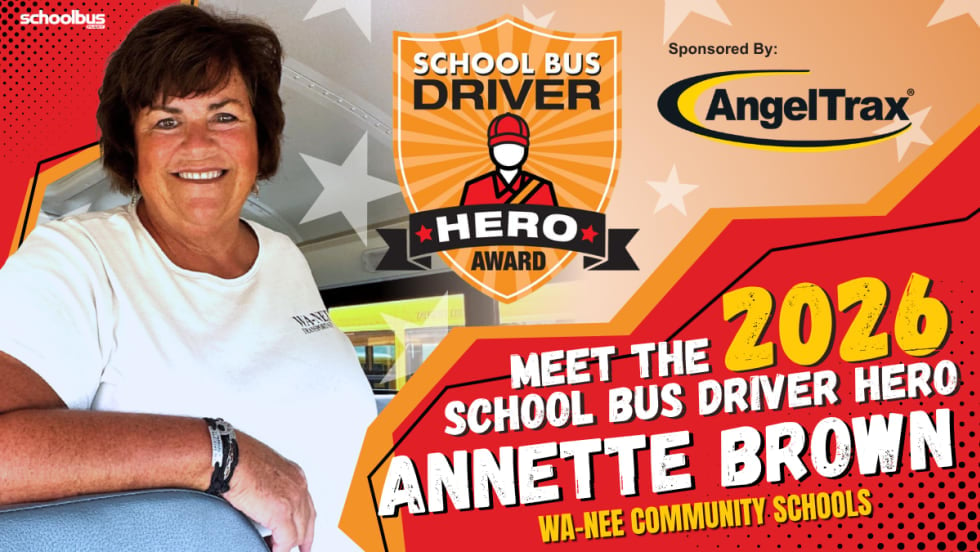
Annette Brown Always Takes the Extra Time: Meet Our 2026 School Bus Driver Hero
For more than 30 years, the Wa-Nee Community Schools driver has treated students like family, combining safety, compassion, and servant leadership to make a lasting difference on and beyond the school bus.
Read More →
How to Build a Better Driver Training Program
Ready to boost up your school bus instructor training? Here’s how to pick the right talent and improve recruitment, retention, and safety.
Read More →
CALSTART and Forth Combine to Form Catalyst Mobility
The new name represents a renewed vision for the nonprofit focused on advancing clean, equitable, and affordable transportation solutions that move people and goods.
Read More →

What Makes a Great School Bus Driver Trainer?
Choosing the right school bus driver trainer takes more than experience. Learn six keys to selecting and developing trainers and evaluating program effectiveness.
Read More →
School Bus Contractors Expand Through New Deals, Acquisitions & Partnerships
STA's Canadian division acquires Ontario-based G&L Stevenson Transport; Durham School Services adds a new district in California; First Student expands in New Jersey; and Minnesota Coaches rebrands and acquires Halo Transportation.
Read More →
Logan Bus Company Rolls Out AI Phone System for NYC School Bus Families
A summer pilot found that AI agents could handle most routine calls, freeing up time for customer service staff to focus on emergencies and complex family concerns.
Read More →
From Intent to Impact: What I Learned About Leadership from TAPT
A Texas transportation supervisor shares lessons on self-awareness, accountability, managing stress and building trust — and why investing in leadership development matters at every stage of your career.
Read More →
NAPT Names 2026 Award Recipients, Hall of Fame Inductee
Who earned national recognition for their work in student transportation? This year, NAPT named five recipients of its 2026 awards for service, safety, and leadership, plus its newest Hall of Famer.
Read More →
2026 State of Student Transportation Report
Driver shortages. Rising costs. Growing safety expectations. More data, but not enough time to act on it. The 2026 State of Student Transportation Report reveals what transportation leaders say is putting the most pressure on their operations—and where they’re investing next. See how your priorities compare.
Read More →
How to De-Escalate an Angry Person: 5 Steps for Handling Workplace Conflict
What makes emotions run high, and how should you handle an angry colleague or parent? Follow these steps for staying calm, listening, showing empathy, and resolving conflict.
Read More →