




Self-Driving Trucks Are Here — Could Buses Be Far Behind?
If autonomous school buses are in our future, they will still need a pupil transportation professional on board to keep an eye on the kids and to make sure that loading and unloading are carried out safely.

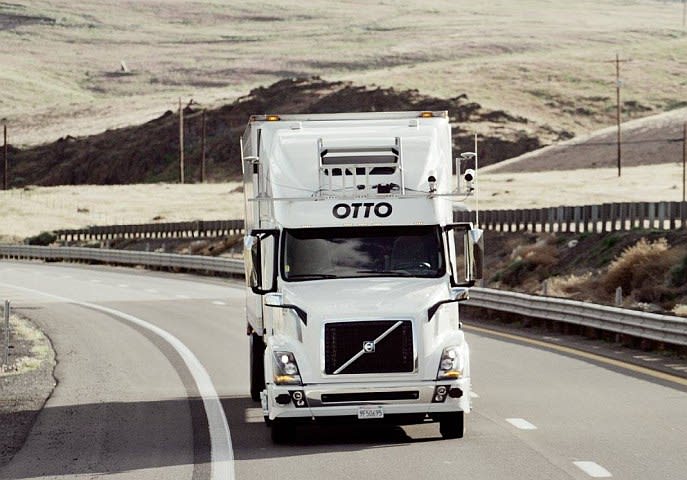
A company called Otto is currently testing self-driving trucks, which it touts as a way to avoid accidents and increase safety in long-haul transit.
A company called Otto is currently testing self-driving trucks, which it touts as a way to avoid accidents and increase safety in long-haul transit.
Could computers replace school bus drivers?
That may sound like a far-fetched question, but it’s essentially the same concept that was tied to the trucking industry in a recent Los Angeles Times article.
The story, alarmingly titled “Robots could replace 1.7 million American truckers in the next decade,” presented evidence that automated vehicle technology could soon be used to haul freight on the nation’s highways without the need for human hands on the wheel.
For example, a company called Otto — now owned by Uber — is currently testing self-driving trucks, which it touts as a way to avoid accidents and increase safety in long-haul transit.
The company has developed a self-driving kit to retrofit existing trucks with sensors, software, and other equipment. According to its website, “Otto hardware and software is tuned for the consistent patterns and easy to predict road conditions of highway driving.”
A video on the website shows a white big rig emblazoned with the Otto logo cruising along a highway while the supposed “driver” sits in the rear of the cab, calmly writing in a notepad.
Part of the company’s message is that the self-driving system would allow human truck drivers to sleep while their vehicle moves itself down the highway, preventing fatigue-related crashes. Taking the driverless concept a step further, one of Otto’s co-founders, Lior Ron, told the Los Angeles Times that the company’s technology could eventually enable trucks to navigate the long highway stretches of their trips with no human on board.
So, moving back to my opening question, could this technology work for school buses?
At first blush, the answer seems to be a resounding “no,” mainly due to an important distinction: Long-haul trucks carry lifeless cargo, while school buses carry living, breathing children. Just as young pupils wouldn’t be left alone in a classroom with a robot for a teacher, they wouldn’t be piled onto a self-driving school bus with no adult on board.
Another key difference is the operating conditions. Unlike long-haul trucks on the open highway, school bus routes primarily cover residential areas. Also, school buses make frequent stops to load and unload passengers, who often must cross the street in front of the bus.
Many SBF readers will recall that we delved into this topic in 2014, with an article titled “Will Ramped-Up Vehicle Tech Bring Smarter, Safer School Buses?”
Two years later, there’s even more ramping up on the automation front, such as Uber testing self-driving cars in Pittsburgh. The feds have even gotten in on the action: In September, the Department of Transportation issued a policy for testing and deployment of automated vehicles.
As our Nicole Schlosser noted in the 2014 SBF article, automated and connected vehicle technologies have the potential to enhance safety in a number of ways that don’t necessarily entail replacing the driver. Examples include collision mitigation systems, adaptive cruise control, and pedestrian detection.
Furthermore, it’s not hard to imagine how more advanced automation could make school bus drivers’ jobs more manageable — for example, freeing them up to address behavioral issues or other student concerns while the bus is moving.
As long as children go to school, they’ll need a way to get there, and so far there’s no better vehicle for the task than the yellow bus. If autonomous school buses are in our future, they will still need a pupil transportation professional on board to keep an eye on the kids and to make sure that loading and unloading are carried out safely.
As truck driver Scott Spindola told the Los Angeles Times, “You need a human being to deal with some of the problems we have out on the road.”
That’s doubly true for school buses.
More Management

How to Build a Better Driver Training Program
Ready to boost up your school bus instructor training? Here’s how to pick the right talent and improve recruitment, retention, and safety.
Read More →
CALSTART and Forth Combine to Form Catalyst Mobility
The new name represents a renewed vision for the nonprofit focused on advancing clean, equitable, and affordable transportation solutions that move people and goods.
Read More →
What Makes a Great School Bus Driver Trainer?
Choosing the right school bus driver trainer takes more than experience. Learn six keys to selecting and developing trainers and evaluating program effectiveness.
Read More →


School Bus Contractors Expand Through New Deals, Acquisitions & Partnerships
STA's Canadian division acquires Ontario-based G&L Stevenson Transport while Durham School Services adds a new district contract in California, First Student adds a New Jersey contract, and Minnesota Coaches acquires Halo Transportation.
Read More →
Logan Bus Company Rolls Out AI Phone System for NYC School Bus Families
A summer pilot found that AI agents could handle most routine calls, freeing up time for customer service staff to focus on emergencies and complex family concerns.
Read More →
From Intent to Impact: What I Learned About Leadership from TAPT
A Texas transportation supervisor shares lessons on self-awareness, accountability, managing stress and building trust — and why investing in leadership development matters at every stage of your career.
Read More →
NAPT Names 2026 Award Recipients, Hall of Fame Inductee
Who earned national recognition for their work in student transportation? This year, NAPT named five recipients of its 2026 awards for service, safety, and leadership, plus its newest Hall of Famer.
Read More →
2026 State of Student Transportation Report
Driver shortages. Rising costs. Growing safety expectations. More data, but not enough time to act on it. The 2026 State of Student Transportation Report reveals what transportation leaders say is putting the most pressure on their operations—and where they’re investing next. See how your priorities compare.
Read More →
How to De-Escalate an Angry Person: 5 Steps for Handling Workplace Conflict
What makes emotions run high, and how should you handle an angry colleague or parent? Follow these steps for staying calm, listening, showing empathy, and resolving conflict.
Read More →
What Readiness Looks Like This School Year
Learn about the challenges shaping the 2026–2027 school year, from persistent driver shortages and budget pressure to technology and readiness gaps. See how school districts are responding and adapting in Zonar’s 2026 Back-to-School Readiness Report.
Read More →