





Video Safety Solutions: 13 Tips for Driver Adoption [Netradyne]
Safety, Savings, and Insights: Innovations in Internal Camera Monitoring Systems
Video cameras have proven a useful tool for monitoring events and conditions not just outside the school bus, but inside as well. But which system is right for you, and how can you convince drivers of the value? Check out these tips.
June 8, 2022
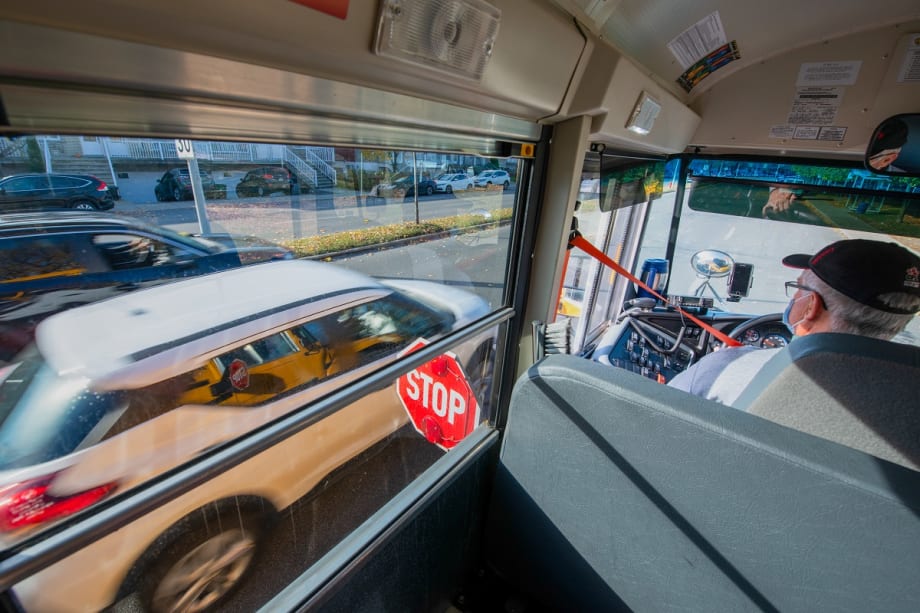
Internal cameras don’t just benefit the students on board; they also assist school bus drivers and districts, ensuring accurate information is recorded in case of accidents or false claims, capture driver behavior, and can save money in the long run.
Photo: BusPatrol
10 min to read
Don’t wait for an emergency or any other reason to wish you had a camera system in your fleet’s school buses, because like Cher, you can’t turn back time. Rather, the benefits of internal cameras in school buses are numerous and once installed, you’ll likely wish you had them sooner. Just ask the folks at a South Carolina school that upgraded its own system after a hijacking incident.
Benefits of In-Cab Cameras
School districts don’t just benefit from having video evidence in an emergency, though. Safety and protection of students and the driver, proof of fault, driver coaching opportunities, and stop-arm violation detection are other reasons a good monitoring system can come in handy.
Chad Anderson, territory manager at REI, says, “The additional information from camera systems really helps paint a picture of what happened and allows the school to easily prove or disprove any allegations made against them and their drivers.”
Richie Howard, AngelTrax president and CEO, adds that it also provides much-needed peace of mind, allowing administrators and drivers to focus on doing their job effectively and efficiently.
It can also improve student behavior on the bus, says Jean Souliere, CEO and founder at BusPatrol. “Students know that their behavior is being monitored by the school district, even when they are not in the bus driver’s direct line of vision.”
Additional benefits include:
Prove fault or liability on event details to protect against false accusations.
Monitor student behavior to report bullying, misconduct, and proof of being on the bus.
Capture driver behavior and monitor fatigue, seat belt usage, or distracted driving, and allow for driver coaching — or rewards for good driving.
Give administrators and emergency responders real-time access to live video inside the bus to form an action plan based on what is happening.
Reconstruct accidents.
Conduct contact tracing.
Save money in litigation, lawsuits, or insurance premiums.
Addressing Driver Resistance
Some school bus drivers may be hesitant to embrace a video system inside their bus due to concerns of being disciplined or monitored. But many drivers who have an already installed system have seen the benefits first-hand. Some even say it’s made them a safer driver and they don’t want to drive without it.
To convince drivers, provide transparency and remind them of the larger benefits, including what’s in it for them. To build buy-in from the start, host 1:1 meetings to explain how the system works, answer questions, and collect feedback. Have the drivers test run a bus with the system already in place — and watch the footage — or talk to other drivers who use it to learn about their experiences.
“Position cameras as a wingman, not a watchdog,” Netradyne recommends. “Fleet drivers are not at fault in 80% of collisions, and video cameras provide that proof.”
Once the system is installed, communicate successes with the technology and acknowledge drivers demonstrating good or improved driving.
“This is not about penalizing or punishing, it is about recognition and rewarding those drivers that go the extra mile (pun intended),” Matt Eckert, director of school bus product sales at Rosco Vision, says.
“Envy serves as a powerful tool,” Adam Kahn, president of Netradyne, adds. “When a driver gets recognized, the rest of the community tends to emulate that driver. Praise is viral and powerful.”
If the pushback is coming from a union and interior recording is not allowed, John Fontana, senior program manager of videomatics for Rosco Vision, says that recording can be turned off or a lens cover offered to comply with rules.
Features to Look For
Some additional features to consider in your next camera system include:
Vendor installation, training, and ongoing support.
Equipment life span.
Video quality, shutter speed, frame rate, etc.
Tamper resistance.
Auto-start recording.
GPS availability.
Digital noise reduction.
Installation and equipment requirements.
How and where the data is stored, and cloud capabilities.
Number of camera views/inputs.
Analytics, trending, safety scoring features.
Integration with other onboard systems like telematics.
Driver Monitoring System (DMS) capabilities.
Real-time tracking and live video views.
Ease of maintenance and updates of previous hardware and software generations.
“Every school system needs cameras covering the interior and exterior of each bus,” Howard reminds. “One of the most important benefits to look for is a provider who prioritizes customer service in every step of the process. And as with any equipment on the bus, the camera system needs to be checked regularly for tampering and proper functioning.”
“Another area of growing importance is software, data, and cloud security,” Chris Akiyama, vice president, school bus, for Safe Fleet, says. “Due diligence on country of manufacture, software development, intellectual property ownership, cloud, and software security measures should be a focus. Involve your IT team in the evaluation.”
“Ask a lot of questions,” advises Ron Deming, territory manager at REI. “Be very specific on what you are looking to accomplish with your camera system. Make sure you speak to a minimum of three vendors. Then with information in hand, make sure to speak with your peers in the state to see how they like their systems and how they have been useful to them. Hardware is important but make sure to find out about customer service support as well, which is just as important.”
Robert Scott, SVP at 247Security, also cautions against the use of subcontractors. “If you use a formal RFP process, beware of low price, low value, as all systems are definitely not created equal,” he says.
Cost is always a factor when making a decision, and Souliere shares that BusPatrol follows a unique model: It is violator funded. “[This] means that communities can access advanced safety technology such as cloud-connected safety cameras at zero cost,” he says. “The entire BusPatrol school bus safety program, including installation and maintenance, is funded uniquely and exclusively from violation revenue generated from illegal school bus passes. The drivers that put children at risk pay for the technology that protects them.”
Getting Started & Available Solutions
If your district is ready to make the next step of installing a new — or maybe your first — internal camera system, it’s important to pick the right solution for your needs.
Many experts suggest a phased approach. “We recommend starting with a formal video policy," Akiyama says. “The policy should cover who can access video, for what purpose, and how long you keep video as evidence. A pilot project can help you evaluate performance and ease of use in your specific environment.”
To ensure your system lasts, REI recommends reformatting the hard drive, doing a system check annually, and occasionally cleaning the hardware, especially the camera lenses.
To help make the landscape easier to navigate, SBF rounded up the following information from suppliers.
247Security
One notable feature of the 247Security system is that it can take a curved image of the entire bus and present it as a clear, flat image easy to assess.
Photo: 247Security Inc.
247Security Inc. offers video solutions that can meet all video requirements both inside and outside the bus. It offers live tracking, live view, and wireless management with a complete suite of reporting capabilities. All of this is provided through one piece of hardware: video, wireless, cell and GPS connectivity built into one DVR. The super low-profile OmniView camera records in 360° degrees of 1080p resolution, and the TruView DVR Viewer takes the HD 360° curved image and transforms it into curve-free, natural images with incredible detail.
AngelTrax
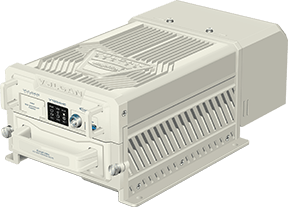
The Vulcan Series V1284HC is a feature-rich, 12-channel MDVR can record eight HD channels in 1080p and four IP channels in 1080p up to 4MP and comes with a 3.5-inch hard drive for extreme storage capacity.
Photo: AngelTrax
AngelTrax is a designer, manufacturer, and provider of high-definition in-vehicle mobile surveillance with products including the Vulcan Series MDVRs and MNVRs with patented Hybrid Component technology, IP cameras, high-definition cameras, live view, live tracking, driver behavior management, and patented Virtual Synchronized Mapping technology. AngelTrax’s patented Hybrid Component modular design increases fleet performance levels by allowing the recording unit to be upgraded or repaired in minutes, not days. The 12-channel V1284HC MDVR can record an entire year of video on one hard drive and is backed by a five-year limited warranty.
BusPatrol
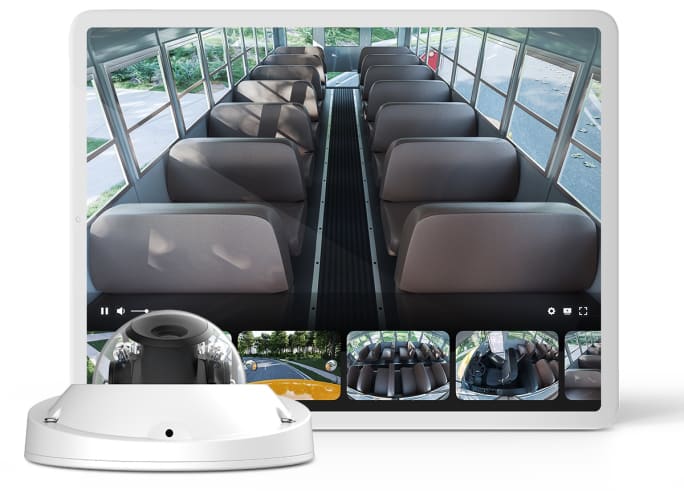
BusPatrol follows a unique cost model for its camera systems that is violator funded, meaning schools have zero cost.
Photo: BusPatrol
Knowing that older systems made accessing video challenging and required student transportation professionals to retrieve hard drives physically from the bus, BusPatrol introduced a new infrastructure offering local and cloud-connected video access. Today, the BusPatrol Student Safety Platform is cloud-based, deployed across the full fleet, and entirely funded by violators. The platform includes internal cameras, GPS, installation, maintenance, cloud features, and data charges. Up to 12 interior, side, front, and rear cameras provide a 360° high-definition view of the bus with audio. Footage can be retrieved locally from a tamper-proof DVR box, requested through a cloud platform, or viewed ‘live’ while the bus is running. A driver can activate a silent alarm system to send a message to the office to live stream into the bus. The program implementation and maintenance are managed by BusPatrol’s team, with years of experience managing safety programs on thousands of buses across the country.
REI
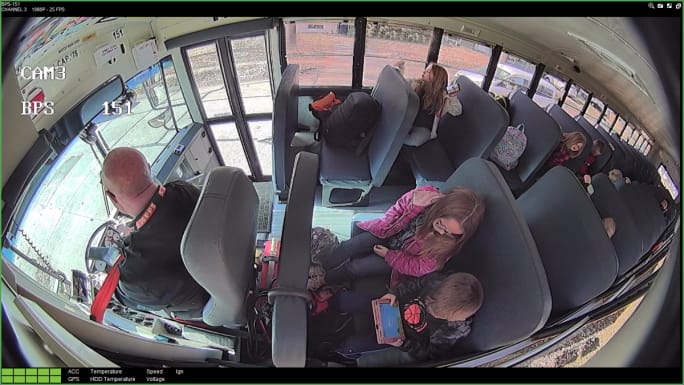
REI says the real value in HD video is its indisputable evidence of events, including details leading up to, during, and after incidents. Users have proof for parents, law enforcement or legal proceedings.
Photo: REI
REI designs, engineers, and quality tests analog, AHD, and IP cameras for interior and exterior surveillance views in up to 1080p HD resolution. Features like ultra-wide-angle lenses provide up-to-180˚ horizontal fields of view, maximizing coverage with fewer cameras. See down into seats, both sides of the aisle, from the windshield to the rear door, the bus danger zone, and the driver’s POV. When cameras are integrated with ARMOR Software Suite for wireless fleet management and REI cloud service, up to 12 channels are available for live viewing and are accessible anytime, anywhere with internet-connected devices. The company’s safety solutions roster also includes an AI-assisted collision avoidance system with audible/visual alerts to prevent and mitigate collisions.
Rosco Vision

Executives from Rosco Vision said that many times, cameras have captured collisions and incidents where the driver was not at fault but was being blamed. Rosco’s small-sized system also uses AI to capture distracted driving behaviors.
Photo: Rosco Vision
Rosco offers several recording options: a single camera (forward facing), dual camera (forward and in-cab facing), and multi-camera (forward, in-cab, interior, exterior). Cameras include local data storage (SD or micro-SD cards) as well as cloud storage on its RoscoLive Fleet Management Platform. The company’s AI-powered cameras can detect distracted driving behaviors such as drowsiness, phone use, yawning, etc., as well as dangerous driving behaviors including, speeding, harsh braking, and aggressive acceleration. AI technology combined with the fleet management platform allows managers to have visibility into the efficiency and safety of their entire fleet. All windshield-mounted recorders fit in the palm of one’s hand and range from $400 to $1,000+, depending on features and number of cameras needed.
Safe Fleet
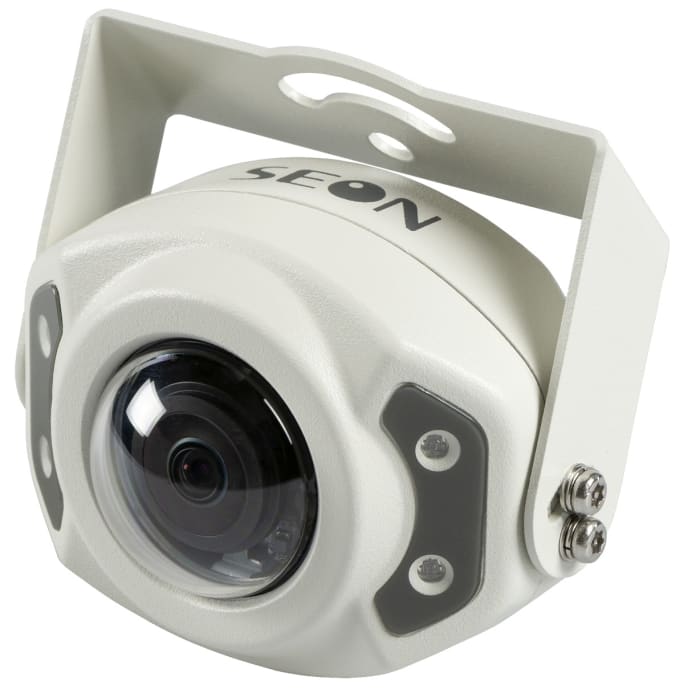
Safe Fleet’s HD3U cameras can be placed throughout the bus in a crisscross configuration to gain maximum coverage with the least number of cameras and capture views deep within high seat backs.
Photo: Safe Fleet
Safe Fleet’s video solutions are designed and purpose-built for school buses. Rigorous stress and environmental testing are performed to ensure reliability and long-lasting performance. Ultra-wide interior cameras streamline the number of cameras required on each bus. Cameras vary in size and form factor for discrete to standard applications and resolutions are available up to 4K to cover the entire range of use cases, budget constraints, and feature requirements. The company offers a low-profile internal camera as well as external systems to tell the full story of what happened through additional context.
Netradyne
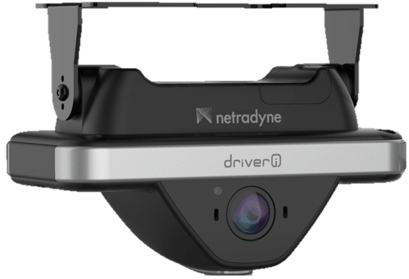
The Driver-i system from Netradyne was built with driver recognition in mind. Its president Adam Kahn advises using the “carrot versus the stick” approach to get drivers on board with the technology.
Photo: Netradyne
Netradyne’s Driver-i is a vision-based driver recognition fleet safety camera platform built to reinforce good driving behavior. It provides actionable data, automatically coaching and improving safety performance. Driver-i provides visibility into the entire driving experience, highlighting positive driving while addressing performance improvements within seconds or minutes. Driver-i is available in two form factors: the D-430, four camera system provides a 270-degree external view, and the D-210, which is a dual facing camera featuring inward and outward-facing cameras. Each system has the option to add up to four auxiliary camera views, providing visibility around and inside the vehicle.
Zonar Systems
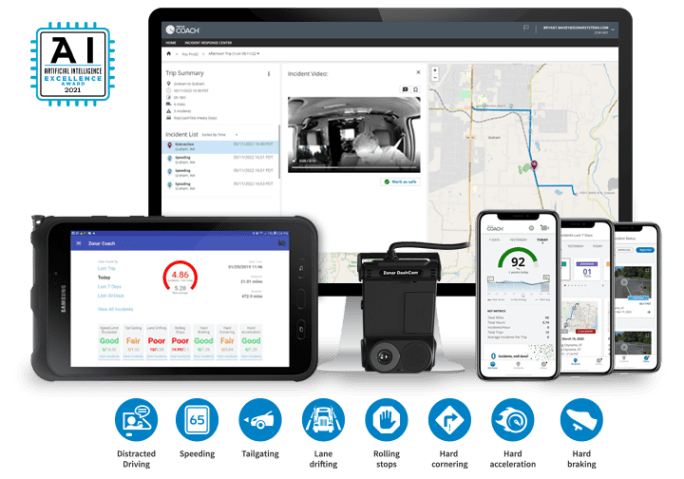
Zonar Coach is an advanced driver assistance system that can identify proper and risky driving behavior and provide feedback in real time.
Photo: Zonar Systems
Zonar Coach is an advanced driver-assistance system that turns punitive driver training into a proactive, data-based approach. Coach’s dual-facing camera, Zonar Dashcam, features an HD dual-facing lens that uses artificial intelligence and a g-force accelerometer to detect eight key unsafe behaviors. Once an unsafe behavior is detected (e.g., speeding) the camera provides a real-time, audible alert, so drivers can self-correct in the moment. Safety managers can view fleet scores, trends and video incidents to better understand what happened before and after — especially in the event of a false claim.
The Future of Internal Camera Systems
While Safe Fleet estimates that school bus adoption is in the 85% to 95% range, Akiyama says the bigger struggle for fleets is staying on top of advancements and managing legacy platforms and backwards compatibility. Another reason to think critically about the supplier you choose.
“The feedback I have heard from transportation professionals is that the ‘next best thing’ isn’t always needed or wanted,” says Cheyenne Bybee territory manager at REI. “Focusing on perfecting the basics in my opinion is very important. Trending more is the software aspect and having an all-in-one solution for everything from GPS to routing and student ridership.”
As technology advances, more features are likely to come standard with internal cameras down the road. These may include facial recognition, Advanced Driver Assistance Systems (ADAS), collision avoidance warnings, intelligent danger-zone detection and violation prediction, the replacement of external mirrors with digital camera systems, automated processes, and report generation.
And as systems continue to become more affordable and the benefits fully realized, Kahn is hopeful the use case justification becomes stronger and adoption increases even more.
Subscribe to Our Newsletter
More Safety

How to Build a Better School Bus Driver Training Program
Is it time to strengthen your driver training? Here’s how to pick the right talent and improve recruitment, retention, and safety. This video is brought to you by IC Bus.
Read More →
Recent School Bus Accidents Leave 2 Dead, 2 Injured
Four school bus crashes in Florida, Illinois, and Georgia highlight risks in transportation lots, at bus stops, and during student loading and unloading.
Read More →
Sponsored•September 8, 2026
When Every Second Matters, Clarity Keeps Routes Moving
From routine delays to urgent incidents, strong communication practices help drivers, dispatchers, schools, and families respond with confidence.
Read More →

What Happens When a School Bus Catches Fire — and What Can Help
School bus fires are rare but can be devastating. Learn how advances in fire suppression and asset protection help fleets detect fires earlier, reduce damage, and improve safety.
Read More →
Geotab Launches Tool to Help Fleets Investigate Road Incidents
Geotab Investigations combines telematics data, video, documents, and other evidence to help fleets reconstruct incidents, resolve claims, and determine what happened.
Read More →
Texas Sixth Grader Wins 2026 National School Bus Safety Poster Contest
Sai Darshana Yekolu of Moseley Middle School in Prosper, Texas, was named the newest winner for her artwork, bringing the theme of “Safe Rides, Everyday Heroes” to life.
Read More →
Sponsored•August 27, 2026
Doing More With Less: How Transportation Directors Can Prioritize Safety Amid Budget Uncertainty
With diesel prices soaring and nearly one-third of transportation directors expecting budget cuts, maintaining student safety has never been more challenging. Download this guide to learn how leading districts are prioritizing risk, funding critical safety technology, and building stronger budget cases with data.
Read More →
Walton County Schools Adds Gatekeeper Stop-Arm Enforcement System
The Florida district will deploy Gatekeeper’s updated Student Protector technology, which now incorporates AI to improve video evidence.
Read More →
How To Build a More Secure School Bus Yard During and After Hours
As thefts and overnight security threats continue, school transportation leaders are combining stronger operational practices with AI-enabled surveillance to better protect buses, facilities, and staff.
Read More →
FMCSA Names New Chief Safety Officer: What School Bus Operators Should Know
Steve Dowling is set to lead the federal agency's efforts to advance commercial motor vehicle safety and reduce crashes, fatalities, and injuries on the nation's roadways.
Read More →