




Safety Initiatives Strengthen Training for Drivers and Students
Award-winning Georgia school districts share details on their efforts to sharpen school bus safety skills.
by Hal Mattern
August 13, 2018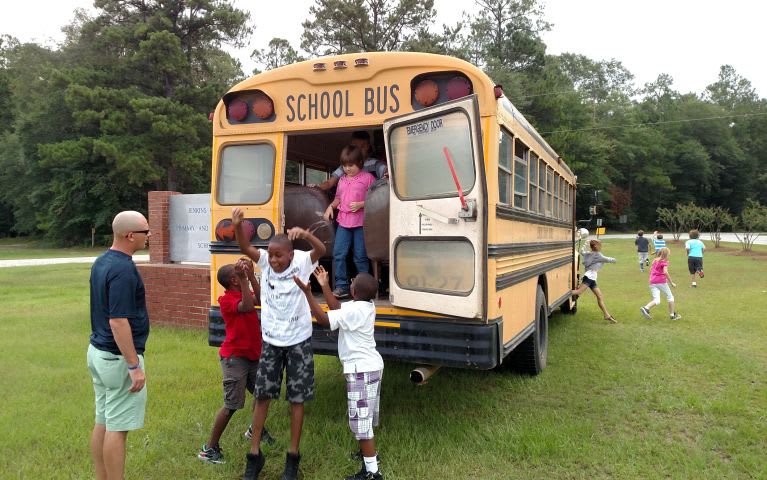
Jenkins County School System conducts an emergency evacuation drill.
6 min to read
Jenkins County School System conducts an emergency evacuation drill.
Georgia school districts with successful pupil transportation safety programs appear to have a few things in common: They go above and beyond state requirements for driver training, and they are dedicated to teaching their students about safety procedures and proper school bus behavior.
Also, in many cases, they hire former school bus drivers to oversee pupil transportation, resulting in innovative safety and training programs that reflect their firsthand experience and knowledge.
“I think the drivers are more accepting of my ideas for changes and see that I share their passion for student safety because I was a driver,” says Jerene Jones, who is now transportation manager for Catoosa County Public Schools in Ringgold, Georgia. “I’ve been there. I understand the seriousness of their responsibilities, their needs, and their frustrations.”
Catoosa is one of eight school districts in Georgia that recently received the state’s first Pupil Transportation Safety Awards in recognition of their efforts to ensure student safety (see sidebar below). Here are details on several of the award-winning districts’ safety initiatives.
Trial by Fire
Innovation is a strong suit at the Jenkins County School System in Millen, where former school bus driver Talmadge Fries is director of transportation services.
“I like to think outside the box when I see things that don’t work,” Fries says.
He notes that the district’s old pupil evacuation plan for buses didn’t work or, more specifically, “was boring.” So he implemented a new plan for drivers and students at a district elementary school in 2010. It has since spread to all of the district’s schools and supplements a new state evacuation curriculum.
Shortly after the program started, one of the district’s buses caught on fire.
“The students all got out safely,” Fries says. “They were calm and they did everything they learned. They were even taking pictures of the fire on their cellphones.”
Students undergo training every three months to keep the information fresh on their minds. When they take students on field trips or to athletic events, the drivers give a safety presentation before the bus leaves because many of the students might not ride the bus to and from school.
Fries says the presentation is similar to the instructions flight attendants give to passengers on planes. It includes information about using emergency exits and roof hatches.
“If something does happen, they know how to get off the bus,” he says.
Fries says the pupil safety training has resulted in fewer accidents, and when there is an incident, such as a brake overheating and smoking, the children exit the bus in a calm and orderly manner.
The Jenkins County district also applied for, and received, a $1,500 grant to pay for school bus stop warning signs in areas with obstructed views, blind curves, and large numbers of students boarding school buses. The grant pays for the signs, and Jenkins County and the city of Millen install them for the school district.
Jenkins County School System is also planning to provide training to local fire and rescue personnel so they will know how to operate lifts and evacuate buses. Fries says the district is donating a surplus bus to the fire department for training that will include setting it on fire (after any usable parts are removed).
“All you can do is try to protect the students,” Fries says. “As a general rule, safety comes first. You just try to be innovative to keep children safe.”
He adds that Georgia has some of the most stringent school bus safety regulations in the country, and the Jenkins County School System’s regulations are even more stringent than the state’s.
That also is true of other districts that won the state Pupil Transportation Safety Awards, especially when it comes to driver training.
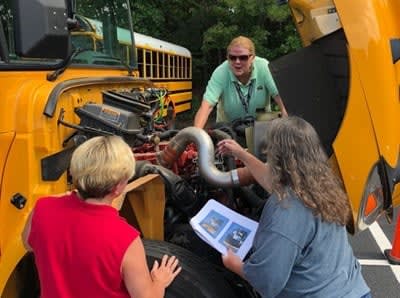
Jackson County trainers (from left) Tina Johnson, Kim Nash, and Anita Sears inspect an engine, which is part of state-required driver training.
Testing Skills, Offering Incentives
Pickens County Schools in Jasper conducts annual skills testing for its drivers that includes parallel parking, which is common during field trips, and backing up, which is necessary in the rural district when buses encounter dead ends.
“We demand more of our drivers because we are in a rural area,” says former school bus driver Cherri Howell, the district’s transportation supervisor. “I go out and ride with them and evaluate their driving.”
School nurses train drivers on how to react to and treat seizures, and CPR training is offered to drivers.
To retain drivers, the district expects to give them a $2-an-hour raise this year and implement bonuses of $250 after five years of service and $500 after 10 years.
Howell says it was nice to be recognized with the safety award, but she stressed that her department didn’t implement safety policies in order to earn recognition.
“We’ve been having drivers do this for a long time,” she says. “We go above the Department of Education training requirements. It’s not like I made them do anything special to win an award.”
It isn’t just drivers who are expected to focus on safety.
“It involves the whole department, including mechanics,” Howell says. “All of our technicians are certified in bus inspections.”
The Jackson County School System in Jefferson also is offering incentives to attract and retain drivers. The district offers employees $500 referral bonuses if they recruit new drivers who complete six months of successful employment.
Drivers who have perfect attendance for a month receive a $50 bonus. If they don’t miss a day for a year, they are invited to a celebration during which they can win the chance to drive one of the district’s new buses during the next school year.
“It is incentive-based,” says David Farmer, the district’s director of transportation. “A driver with only a few years of experience has the same chance as a 20-year veteran to drive a new bus.”
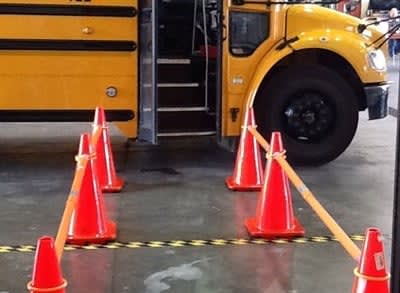
Catoosa County uses safety chutes at all school unloading zones, designed to keep exiting students walking 12 feet away from the bus.
Boosting Safe Behavior
The award-winning Georgia districts have also implemented innovative safety programs for students.
Jones says Catoosa County Public Schools requires assigned seating on buses and doesn’t allow boys and girls to sit together, and there are strict rules about staying seated and behaving. Also, safety chutes are used at all school unloading zones, designed to keep exiting students walking 12 feet away from the bus.
Catoosa’s elementary and middle school health and physical education teachers conduct classes using the Georgia Department of Education bus safety curriculum, after which bus safety education team members provide training.
Jones says the policies are working. Drivers have better control of their buses, and there is increased awareness of safety and accountability by drivers and students.
“Accidents have greatly decreased and student injuries [mainly from not staying seated] have been reduced,” Jones says.
Pickens County Schools encourages good student behavior by naming an elementary student rider of the week for being a good steward on the bus. The winners get certificates, their name posted on the bus, and their choice of a prize, such as extra recess, ice cream, or an exemption from a homework assignment.
The Jackson County School System has its drivers choose student helpers who are taught to use the two-way radio on the bus in case the driver is incapacitated.
The district also conducts a student-focused bus safety program at its elementary and middle schools twice a year. Instructors use a little wooden bus for interactive and role-playing exercises. The program focuses on bus safety, proper behavior, and emergency procedures.
Farmer of the Jackson County School System says that as a result of the district’s focus on pupil transportation safety and driver training, there are fewer accidents.
“We invest in our drivers, and in return they buy into our goal of keeping students safe,” he says. “Our No. 1 goal is that all children are picked up safely and dropped off at home safely every day. After all, we are transporting the world’s most precious cargo: children.”
Subscribe to Our Newsletter
More Safety
Illegal School Bus Passing Drops 24% in New York Districts
With fewer than 5% of citations involving repeat offenders, Westchester County officials said enforcement, education, and community partnerships are helping change driver behavior.
Read More →
School's Back. Here's What Happened to Traffic, Speeding & Distraction
What happens to traffic when school resumes? New data analysis examines changes in distracted driving, congestion, and speeding around schools.
Read More →
Geotab Expands Fleet Safety Tools With Video Coaching, Risk Insights
New safety and video capabilities aim to help fleet managers assess risk, support drivers, and take targeted action through video coaching, red-light violation detection, and more.
Read More →

How to Build a Better School Bus Driver Training Program
Is it time to strengthen your driver training? Here’s how to pick the right talent and improve recruitment, retention, and safety. This video is brought to you by IC Bus.
Read More →
Recent School Bus Accidents Leave 2 Dead, 2 Injured
Four school bus crashes in Florida, Illinois, and Georgia highlight risks in transportation lots, at bus stops, and during student loading and unloading.
Read More →
Sponsored•September 8, 2026
When Every Second Matters, Clarity Keeps Routes Moving
From routine delays to urgent incidents, strong communication practices help drivers, dispatchers, schools, and families respond with confidence.
Read More →
What Happens When a School Bus Catches Fire — and What Can Help
School bus fires are rare but can be devastating. Learn how advances in fire suppression and asset protection help fleets detect fires earlier, reduce damage, and improve safety.
Read More →
Geotab Launches Tool to Help Fleets Investigate Road Incidents
Geotab Investigations combines telematics data, video, documents, and other evidence to help fleets reconstruct incidents, resolve claims, and determine what happened.
Read More →
Texas Sixth Grader Wins 2026 National School Bus Safety Poster Contest
Sai Darshana Yekolu of Moseley Middle School in Prosper, Texas, was named the newest winner for her artwork, bringing the theme of “Safe Rides, Everyday Heroes” to life.
Read More →
Sponsored•August 27, 2026
Doing More With Less: How Transportation Directors Can Prioritize Safety Amid Budget Uncertainty
With diesel prices soaring and nearly one-third of transportation directors expecting budget cuts, maintaining student safety has never been more challenging. Download this guide to learn how leading districts are prioritizing risk, funding critical safety technology, and building stronger budget cases with data.
Read More →