




Recruiting, From Start to Finish
Putting an excellent driver behind the wheel of a school bus is the end result of a long search, from putting the call out for qualified candidates to background checks and interviews. Experts weigh in on fine-tuning the process.


Scott Prewett
Without a doubt, the economic changes the job market has undergone over the past few years have had an impact on the number of people who are out of work and looking for new employment.
In March, the state with the highest unemployment rate was Michigan, at 14 percent, according to the U.S. Bureau of Labor Statistics. Nevada, Rhode Island, California and Florida rounded out the top five, at 13.4, 12.6, 12.6 and 12.3 percent, respectively.
For school transportation operations, an uptick in unemployment may cause a corresponding uptick in applications for the job of school bus driver, in effect eliminating driver shortages. Despite having a larger pool of applicants to hire from, experts say this is no time to relax hiring standards and rush to fill open positions.
“With more people out of work, you would think the favor turns in the direction of the employer,” says Scott Prewett, chief technology officer for Exaktime. “The question becomes, how do I weed out the boat loads of applicants to get the one or two that I need to hire for the positions I need to fill?”
First Student’s director of recruiting, Frank Steele, describes the hiring process as filling the top end of a funnel and distilling the initial batch of candidates down to find the highest-quality people. “In the current recruiting climate, we have had an easier time in filling the top end of the funnel,” he says. “However, the same challenges remain that are consistent through any economic term. It’s a very special and unique skill set to be a good school bus driver. To find those people, the quality of people we insist on hiring, that’s the challenge, and that’s relatively consistent.”
[IMAGE]510[/IMAGE]
Putting out feelers
Jeff Walker, transportation services manager at Middleton-Cross Plains Area School District in Middleton, Wis., says that in his experience, classified ads are no longer the most effective way to advertise open positions. “They are so expensive, and I don’t feel that I get the application pool for what I pay for the ad,” he says. “Instead, I try to use word-of-mouth for recruiting.”
Walker keeps his eyes open for good candidates when he’s out and about. “There have been a number of times that I’ve run into someone who I thought may make a great bus driver, and I’ll ask them if they’ve ever thought about being a school bus driver,” he says. “Many are interested when I tell them what the pay, benefits and flexible hours are.” He also focuses his efforts on students at the nearby university. “I especially encourage the education majors because it looks excellent on their resumes,” he says.
Steele says posting ads with the major job search Websites can gather a large number of candidates, but casting a wide net online does not necessarily result in a larger number of qualified applicants. “We get a lot of candidates, but it seems like we have this big mass and then we get through this distillation process and come out with one or two,” he says.
For agencies that have the manpower to cull through large numbers of incoming resumes, Internet classifieds are a sure source of a high volume of responses. For smaller operations, the flood of applications may be overwhelming and, in the end, unnecessary.
First Student is beginning to look at the realm of social media for publicizing open positions and networking with candidates. For an employer who maintains a Facebook or LinkedIn page just for personal use, posting a brief notice of an open job could spark interest from an online contact.
Steele says First Student also hosts job fairs, open houses and live radio broadcasts from their location facilities. During the on-air events, area residents are invited to come fill out applications and be interviewed for open positions.
[IMAGE]508[/IMAGE]
Recruiting from within
While external advertising is often necessary, employers also recommend looking to internal personnel for referrals. “There’s the old saying in recruiting that great people know great people,” Steele says, “so what better place to go than to your current employee base?”
“They can tell the story better than anybody,” says Bridget Lindsay, field recruiting manager for First Student.
Prewett suggests providing an incentive for referrals and making that incentive significant enough to prompt employees to take the time to think seriously of potential candidates. Breaking the incentive into two parts — one payment to the referring employee on the hire date and a second payment on the one-year anniversary of the hire — can also ensure a good hire.
“They’re incentivized both to make a good referral but also have a good referral that sticks,” he says. “You’re using your good employees and their innate understanding of the job as they flip through the Rolodex in their heads. You can make the incentive offer to everybody, and at the same time you’re paying the most attention to your best employees’ recommendations. It is such a powerful tool, especially when you consider the high cost of getting rid of a bad employee. If you look at the emotional time, the managerial time, the time that’s required going through a formal correction process, the cost for going through the process of getting rid of someone who is a bad hire, it’s kind of staggering. A lot of times, it’s equal to twice an annual salary for that person.”
Walker says that his district “has a lot to offer its drivers, and I encourage drivers to talk to other drivers when they are on field trips and try to get them to apply. Plus, our drivers get a finders fee for a successful recruit.”
[PAGEBREAK] [IMAGE]509[/IMAGE]
Do your homework
Even if a candidate is referred by an outstanding current employee, and initial interviews with the candidate go smoothly, completing extensive criminal and financial background checks is a step that can’t be skipped.
“We’ve had candidates that interviewed beautifully,” Prewett says, “but the background checks were just a disaster. People go through hard times and we’re willing to make an allowance for it. But if we see a pattern of irresponsibility, that always has a bearing on their work life.”
At First Student, the background checks are the objective portion of the driver selection process, while the face-to-face interviews are subjective, Steele explains. “The scope of our background screening is rather unique to our business,” he says. “We do a very stringent background check.”
Checking references can also give employers a better sense of the quality of a job candidate, but coordinating the communications with a candidate’s past employers can be a delicate business, Prewett says. “Whenever someone calls us for a referral, we’re very reticent to give out information about an employee that used to work for us because of our legal liability,” he says. However, if the potential employer notifies the candidate that references will be checked and asks the candidate to arrange the phone calls in advance, liability is eliminated for the past employer, who can be more candid, knowing that the candidate is aware of the conversation. “If the candidate balks at arranging the conversation, you’ve uncovered something,” Prewett says.
The art of the interview
In an industry where safety is the focus, the opportunity to dig deep with candidates and establish their level of commitment comes in the interview.
“What we’re trying to get at through interviews is, first and foremost, a commitment to safety, and No. 2, school bus drivers can’t just be about the paycheck. They have to have a true customer service orientation and a desire to positively impact children’s days,” Steele says. “As we put it in one of our school bus advertisements, an ideal candidate has to love bad knock-knock jokes, appreciate broken science fair projects and have the ability to help kids with band instruments that are twice their size. There are easier jobs out there than being a school bus driver.”
“The very first question on my interview is, ‘Driving a school bus involves maneuvering a 40-foot vehicle with up to 80 students packed into a small area, while driving on windy and hilly roads in all types of weather. Why would you want to do this?’” Walker says. “If an applicant does not mention something about kids or serving the community, the interview is basically over! I hire only people who have a genuine interest in serving the school district and working with students.”
Lindsay says an interviewer should ask tough questions to understand what drives and motivates candidates and how they’re going to interact with students and parents. “When there’s a gray area, we want to get a second opinion,” she says. “We really want to make sure we’re hiring the right people.”
The interviewer should focus on determining how the candidate will react to the stressful situations that are part of the day-to-day experience of driving a bus, Steele says. “You have kids screaming and yakking, the traffic is bad, we’re on tight deadlines, we have parents standing at the base of the ramp who’ve had an issue and want to have a conversation with you,” he says. “It’s very important to find out what types of customer service situations the candidates have been in previously and how they dealt with and ultimately resolved those situations.”
Prewett recommends conducting more than one interview, with more than one interviewer. He prefers to conduct an interview to assess skills and job history, and another that uncovers talents. “Some of the exceptional drivers throughout the country that have records of millions of miles accident free, you find that they had innate talents that enabled them to perform the way they did,” he says. “I’m talking about what comes to you so naturally, you don’t even think about it.”
Interviewers can recognize talents when they ask about conflict resolution or reacting to an emergency or other stressful situation and the candidate can immediately recall a recent example and recounts the incident as though his or her actions were no big deal, Prewett says.
He also says having interview questions written down and documenting the interview with notes during the conversation is key in avoiding illegal interview practices and ensuring all candidates face an even playing field.
“If you write questions out, you increase the likelihood that you’re interviewing all your candidates equally,” he says. “Most of the lawsuits that occur for illegal interview practices come from mistakes that were made inadvertently,” such as asking about health conditions, residence or other prohibited questions, Prewett explains.
Weighing the options
In deciding whether or not to hire a candidate, Walker says he weighs his options. “Did you hire them because you knew they would be a great employee and asset to your team or because you needed a route filled? I enjoy driving a bus every now and again, and strongly dislike dealing with employee discipline, so my rule is, I would rather spend a couple hours a day driving a bus if we’re short-staffed than spend a couple hours a day dealing with unhappy parents, worked-up administrators and employee discipline [as a result of a bad hire],” he explains.
[IMAGE]511[/IMAGE]
Contractor employs recruiting strategy
First Student tailors its outreach efforts to the local community in order to find the best candidates for jobs at their locations. “We take a look at the market, the demographics, and we try and get out into the community to find the people that live and work where they’re going to be transporting children,” Lindsay says. “There isn’t anybody that’s going to care more about transporting children in the community than the community members themselves.”
Lindsay says First Student partners with local organizations like state unemployment agencies, senior centers, churches and other community groups to find good candidates. Steele says they have great success working with people who are already demonstrating that they care about kids, like members of parent-teacher associations (PTAs). First Student gives presentations at PTA meetings to create interest. Steele says stay-at-home parents and retirees are ideal school bus driver candidates, due to the flexible hours and opportunity to work with children. “I cannot tell you how many thousands of drivers work for us that get to see their grandkids every day and change their buses and routes with them every year,” he says.
Another strategy targets residents living within a certain radius of a First Student facility, as some of the best employees have been people who live close by, Steele says. “Door hangers and going out in the immediate neighborhoods to talk to people has been helpful for us as well,” he says.
More Management

5 Questions: How CharterUP Brought a Marketplace to Student Transportation
What does it take to bring a transportation marketplace into K-12? Hear firsthand what CharterUP has learned about the unique needs of schools and bus operators.
Read More →
EverDriven Expands TripCentral Transportation Management Platform to All Partner Districts
The platform provides school districts with real-time trip tracking, student transportation scheduling tools, and pickup and drop-off management capabilities.
Read More →
6 School Transportation Trends to Watch: 2026 District Survey Results
School bus buying is up, fuel choices are shifting, and driver shortages persist. This and more in the latest K-12 public school survey, plus the largest fleets in the U.S.
Read More →
The 100 Largest School Bus Fleets in America: 2026 Rankings
Which public K-12 school districts are the largest in the nation in terms of bus fleet size? Here are the new standings of the top 100 district fleets.
Read More →
EverDriven Launches Route Consolidation Calculator to Estimate Diesel Savings
As diesel prices hit record highs, the largest alternative transportation provider says a 10% route consolidation could save a 120-route district more than $78,000 a year in fuel alone.
Read More →
Zum Secures Continued Financing Support for School Bus Expansion
Generate Private Credit has financed approximately $75 million in school bus deployments across three states, supporting more than 500 buses as Zum expands across the county.
Read More →
Beyond Discipline: A Different Approach to Student Behavior on the Bus
After implementing a dean of students program in Oregon, North Clackamas is seeing positive improvements. Here’s how it worked. The Route is brought to you by IC Bus.
Read More →
A Dean of Transportation's Different Approach to Student Behavior on the School Bus
After implementing a dean of students program in Oregon, North Clackamas is seeing positive improvements on the bus. Here’s how it worked.
Read More →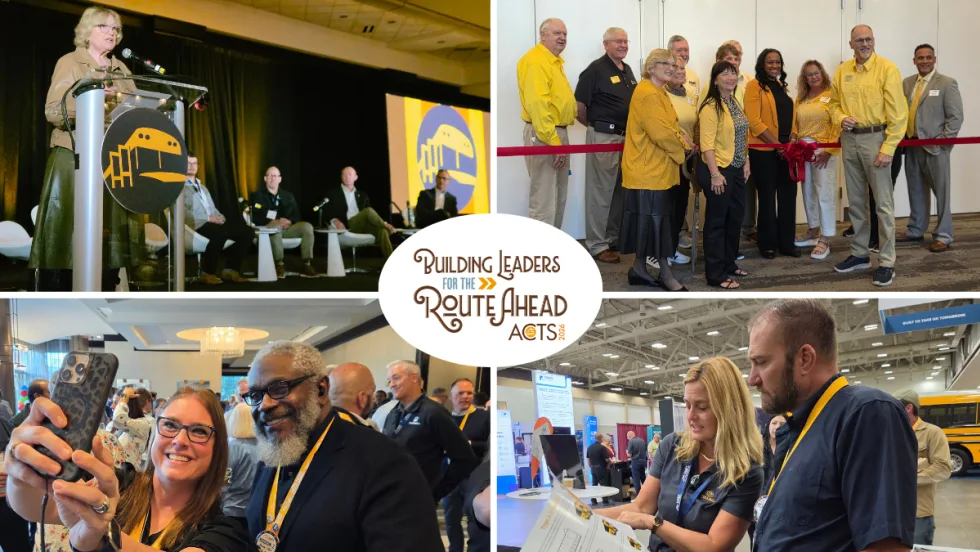
Inside NAPT ACTS 2026: Highlights from Louisville
From federal updates and student behavior strategies to new school bus technology and industry awards, see highlights from NAPT ACTS 2026 in Louisville.
Read More →
Meet the 2026 School Bus Driver Hero Winner: Annette Brown
We caught up with Wa-Nee Community Schools' Annette Brown on site at SBFX, where she was named the 2026 School Bus Driver Hero Award winner. Hear about her reaction, what she loves most about being a school bus driver, and more!
Read More →