




Public awareness: It's not going to drive itself
The message that most often gets to the American public about school bus transportation is consistently negative. Thus, when a tragedy occurs, there is no residual good will to discourage overreaction.
I can hear my dad as if he were still standing next to me. I was trying to figure out how to fit a 19-inch black-and-white television into a 1970 VW Beetle that was already stuffed with things that I absolutely had to have at college. The problem was that the only place I could fit the television was on the driver's seat, which meant that there wouldn't be enough room to fit my six-foot-six frame behind the wheel. "It's not going to drive itself," he said. As I began the arduous task of unpacking and then re-packing that little red Bug, I thought about the lesson my dad was trying to teach me. He didn't offer any advice, which meant he thought the answer was within my grasp. Nor did he offer to help, which meant he thought I had the power to control my own fate. In short, the lesson he was trying to teach me was that no one can solve your problems except you.
We need to find a solution
Ironically, the school transportation industry faces a "little red Bug" dilemma of its own right now, and the essence of the solution is the same. The American public seems to form opinions about child safety issues based on anecdotes that occur close to home, or what they've heard from friends and co-workers, or from television. This is especially true of school bus safety. Hence, in a community where there has been a recent school bus-related fatality, there is likely to be sentiment that "more needs to be done" to make school buses safer. This is likely to be true, even if it's the first such incident and the crash involved catastrophic, inescapable circumstances. Like it or not, this is the unalterable reality of school bus transportation. In fact, school bus transportation is such a socially sensitive public policy issue that any school bus-related incident, especially one involving fatality or serious injury, typically results in "bright light" media interest. School bus news, therefore, tends to be ad hoc and frequently reactive as well as defensive. As a consequence, the message that most often gets to the American public about school bus transportation is consistently negative. Thus, when a tragedy occurs, there is no residual good will to discourage overreaction. In spite of this obstacle, the American public probably has a very good overall impression of school buses and their safety record. But most give little thought to school bus safety because school transportation professionals do their job so well and because school bus transportation is connected to an aspect of their community, i.e., educating children, that they overwhelmingly support politically. School buses are so safe, it seems, that nobody really cares about them. The only consistently positive impressions of school bus transportation come in the form of routine back-to-school or National School Bus Safety Week messages. These stories, however, are so lacking in genuine news value that they are either ignored by the news media or covered superficially out of a sense of obligation. As a result, these stories have no staying power, if they're even heard at all.
Let's speak up for ourselves
Because of this, NAPT President Don Carnahan thinks that the school transportation industry needs to recognize another unalterable aspect of reality: "No one is going to speak up for us if we do not speak up for ourselves," Carnahan says. "We know that school bus transportation is the safest form of ground transportation in America. We need to make sure that the American public knows it too." I can hear my dad as if he were still standing next to me. I was trying to figure out how to fit a 19-inch black-and-white television into a 1970 VW Beetle that was already stuffed with things that I absolutely had to have at college. The problem was that the only place I could fit the television was on the driver's seat, which meant that there wouldn't be enough room to fit my six-foot-six frame behind the wheel. Carnahan's strong feelings are one of the major reasons that the boards of directors of both the NAPT and the National Association of State Directors of Pupil Transportation Services (NASDPTS) are committed to launching a nationwide public awareness campaign to effectively promote school bus safety. Both organizations are convinced that more useful communication with the media and the public at large will encourage a more reasoned response to typical school bus news.
PR initiative in the works
In fact, the NAPT and NASDPTS are so sure that a public awareness campaign is necessary that Carnahan and NASDPTS President Terry Voy are poised to enter a joint agreement with Strat@comm, a nationally recognized public relations firm in Washington, D.C., to launch this initiative imminently. It's expected to be a done deal by the time this magazine reaches you. To this day, my three older sisters and I laugh about my little red Bug story now. Moreover, we have all incorporated my dad's idiom into our daily lives. There's not a problem that we face, either individually or collectively, that doesn't eventually present the opportunity to zing each other with that unforgettable remark, meaning, of course, that no one can solve your problems except you. Only time will tell if my dad's quip will have as big an impact on the public's impressions of school transportation as it had on my sisters and me. But I agree with Don. One thing's for sure. It's not going to drive itself.
Michael J. Martin is executive director of the National Association for Pupil Transportation
.
More Management

EverDriven Launches Route Consolidation Calculator to Estimate Diesel Savings
As diesel prices hit record highs, the largest alternative transportation provider says a 10% route consolidation could save a 120-route district more than $78,000 a year in fuel alone.
Read More →
Zum Secures Continued Financing Support for School Bus Expansion
Generate Private Credit has financed approximately $75 million in school bus deployments across three states, supporting more than 500 buses as Zum expands across the county.
Read More →
Beyond Discipline: A Different Approach to Student Behavior on the Bus
After implementing a dean of students program in Oregon, North Clackamas is seeing positive improvements. Here’s how it worked. The Route is brought to you by IC Bus.
Read More →
A Dean of Transportation's Different Approach to Student Behavior on the School Bus
After implementing a dean of students program in Oregon, North Clackamas is seeing positive improvements on the bus. Here’s how it worked.
Read More →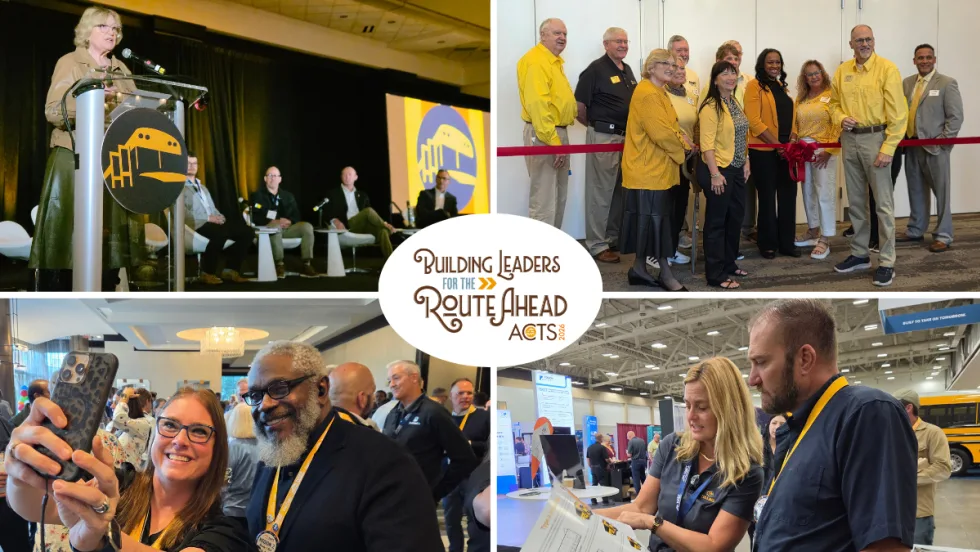
Inside NAPT ACTS 2026: Highlights from Louisville
From federal updates and student behavior strategies to new school bus technology and industry awards, see highlights from NAPT ACTS 2026 in Louisville.
Read More →
Meet the 2025 School Bus Driver Hero Winner: Annette Brown
We caught up with Wa-Nee Community Schools' Annette Brown on site at SBFX, where she was named the 2026 School Bus Driver Hero Award winner. Hear about her reaction, what she loves most about being a school bus driver, and more!
Read More →
Predictability Is Like Ketchup (According to 6-Year-Olds)
To students, a different school bus can feel like a full-blown crisis. One driver reflects on why familiar routines, showing up on time, and being reliably boring matter more than we think.
Read More →
Samsara Launches Free Driver Rewards Program
The new Driver Perks program gives eligible professional drivers access to discounts and offers without adding a cost for participating fleets.
Read More →
How Tax-Exempt Municipal Leases Can Help Finance School Buses
Let’s explore school bus financing options, including municipal leases, vendor payable accounts, and balloon payments, and how they can help stretch fleet budgets.
Read More →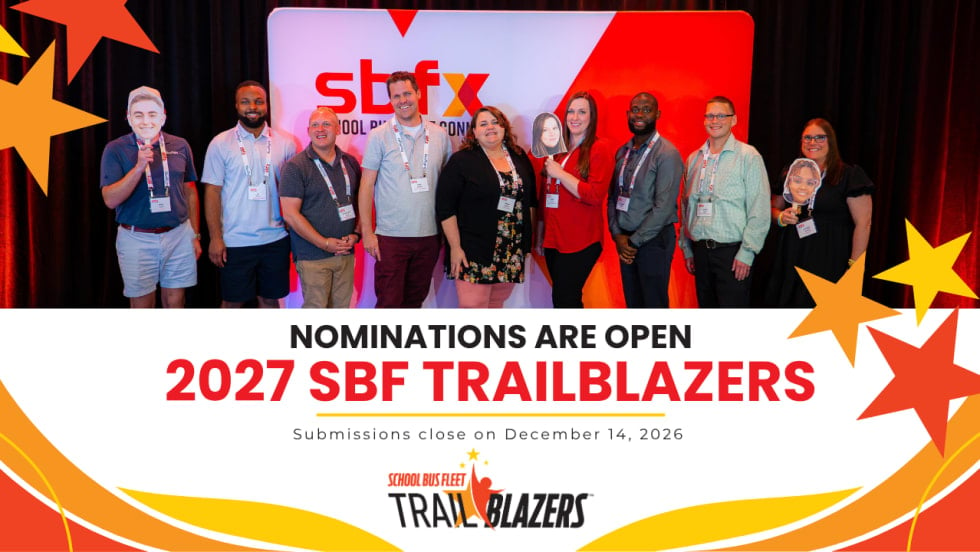
Nominate Rising School Transportation Pros Under 40!
We’re searching for the next generation of leaders making an impact across the K-12 student transportation industry to recognize as SBF’s 2027 Trailblazers. Nominations are open now!
Read More →