




Propane Bus Offers Appealing Alternative
Blue Bird’s new propane-powered Vision Type C aims to decrease emissions while improving fuel economy and performance in alternative-fuel vehicles.

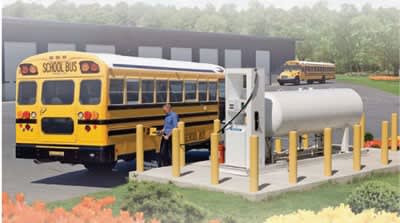
Last November, Blue Bird Corp. unveiled its propane-powered Vision Type C school bus at the National Association for Pupil Transportation’s trade show in Kansas City, Mo.
In July, the company will launch a demonstration program for the new bus, sending two units to dealers in Texas and California.
While some school bus operators have been running propane buses in their fleets for decades, Blue Bird officials say that the new Vision model is the first dedicated propane school bus to be offered by a major manufacturer in the U.S. since 2002. Many propane buses currently on the road are aftermarket conversions.
The production of the propane Vision has been a collaborative endeavor. The Propane Education Research Council provided funding for the project, and Blue Bird received guidance from the Texas Railroad Commission, which is a state agency that oversees propane and other fuels. Also, CleanFUEL USA developed the propane system that powers the bus.
Locations may vary
Rusty Mitchell, Blue Bird’s manager of new product development, says that while the use of propane-powered vehicles tends to be more prevalent in Texas, the fuel is readily available throughout the country.
In Oregon, Portland Public Schools and its contractor, the local branch of Laidlaw Education Services, run approximately 200 propane-powered buses. Phil Weber, director of transportation for the district, says the two operations began using the alternative fuel in the early 1980s. Concerns about diesel prices and increasingly stringent air quality regulations drove the decision.
Alvin (Texas) Independent School District has 93 propane-powered buses in its fleet of 153. The propane vehicles are all aftermarket conversions, although the district did purchase some OEM models in the 1990s.
Alvin Independent has been using propane since the 1970s, and at one point, the entire fleet was running on the fuel.
Improving technology
Dennis Whitaker, Blue Bird’s vice president of engineering, says that in the past, some propane-powered buses haven’t been very efficient.
Indeed, Butch Passmore, fleet maintenance manager at Alvin Independent, says that propane buses in the district’s fleet that use older vapor technology average half the miles per gallon of the district’s diesel buses (3.7 mpg vs. 7.3 mpg).
However, the propane still ends up costing the district less per mile, because the already-lower per-gallon price of propane is brought down even more with the current 50-cent-per-gallon federal rebate for using propane.
The new propane Vision uses a liquid propane injection (LPI) system, developed by CleanFUEL USA, that is expected to be significantly more efficient than the older technology.
The LPI system replaces the gasoline injectors in the GM 8.1L Vortec engine with propane injectors, delivering the propane to the cylinders in liquid form. Officials involved with the project say that this process results in more complete combustion, lower emissions and improved fuel economy and performance.
Surveying the benefits
A key benefit of using propane is its relatively low environmental impact. The propane system available in the Vision received Environmental Protection Agency certification with a rating of 0.5 grams of non-methane hydrocarbons and nitrogen oxides per brake-horsepower-hour. This is lower than the EPA requirement for 2007 diesel engines.
Blue Bird’s Mitchell says that using propane also reduces reliance on foreign fuel, because almost 90 percent of U.S. propane is domestically produced.
Another benefit, Weber of Portland Public Schools points out, is that propane is not as volatile in its pricing as diesel is. “In two years, we’ve seen about a 60 cent change from low to high” in the cost of propane, Weber says.
The district is currently paying about $1.23 per gallon of propane. Weber says that economy of scale helps in securing a good price — the district and the Laidlaw branch purchase a combined 740,000 gallons of fuel per year.
Alvin Independent’s Passmore says that his operation has seen reduced maintenance costs for its propane vehicles. “Brakes and tires last longer on propane buses, because they don’t have the extra weight of diesel engines,” Passmore says.
And he notes that propane engines require just half the amount of oil during service that a comparable diesel engine requires. “Also, we’ve found that the propane engine accelerates faster,” Passmore says. “That was a big surprise.”
Getting set up
Mitchell says that CleanFUEL USA has committed to working with customers of the propane-powered Vision throughout the country to help establish infrastructure for the vehicles.
Passmore says that most propane dealers will furnish fleets with the equipment needed to run their vehicles on the alternative fuel. His district had taken advantage of that offer in the past, but when they moved to a new site, they decided to spring for upgraded equipment: an 18,000-gallon tank and Clean Fuel Technology dispensers.
In Portland, the Laidlaw branch has propane tanks at its terminal. The Portland Public Schools buses are refueled by a truck that delivers propane from the contractor’s site, allowing the district to avoid storage costs.
More Alternative Fuels
Alt-Fuel Moves: Electric Bus Rollouts, Bidirectional Charging & Propane Growth
See which fleets are adding electric and propane school buses as districts and operators invest in charging infrastructure, bidirectional technology, and alternative-fuel expansion.
Read More →
Nobody Told Diesel Prices They Were Supposed to Come Down
With diesel prices surging, school bus fleets have new reason to stress-test fuel costs, consider diversification, and calculate what each route really costs to operate.
Read More →
Why Gasoline School Buses Are Making a Comeback
Gasoline is gaining ground in full-size school buses. See how today’s options stack up against diesel on cost, maintenance, emissions, performance, and more.
Read More →
EPA Opens $180M DERA Funding Round for Diesel Upgrades
The 2026 Diesel Emissions Reduction Act program seeks applications from eligible organizations to accelerate the retirement of legacy diesel vehicles.
Read More →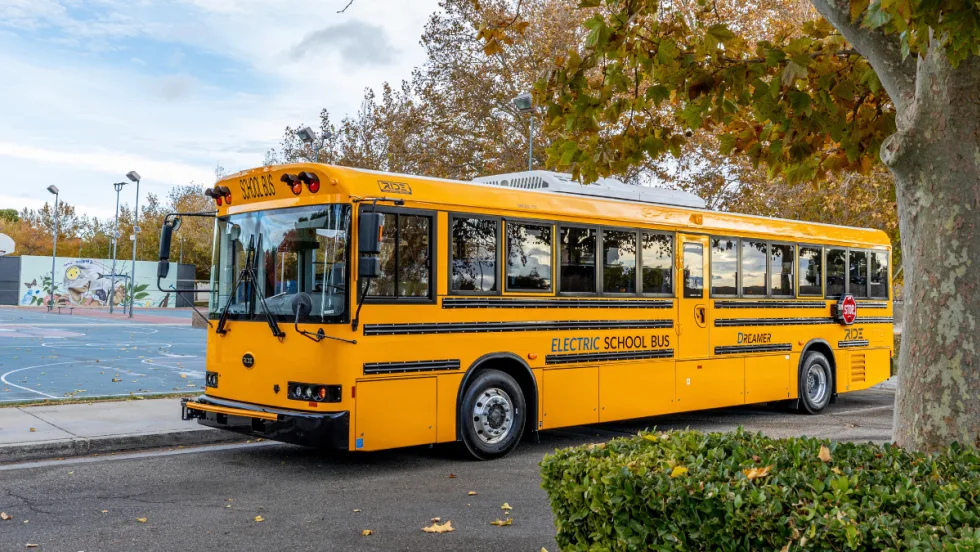
The Secret Life of an Electric School Bus Battery
Batteries change throughout years of daily routes, but degradation doesn’t necessarily mean the end. Here’s what operators should know about performance, safety, and second life.
Read More →
CALSTART and Forth Combine to Form Catalyst Mobility
The new name represents a renewed vision for the nonprofit focused on advancing clean, equitable, and affordable transportation solutions that move people and goods.
Read More →
Alt-Fuel Moves: New Buses, Charging Hubs & Real-World EV Testing
Propane and electric school bus deployments continue to grow as districts add new vehicles, expand charging infrastructure, and gather more real-world operating data.
Read More →
Fewer Electric School Bus Models Reshape the U.S. Market
WRI’s latest buyer’s guide points to a consolidating electric school bus market, but fewer options may reflect a maturing industry rather than fewer meaningful choices for school bus operators.
Read More →
The Fuel Budget You Can Actually Predict: How Propane Autogas Keeps Money in the Classroom
Learn how propane autogas helps school districts manage fuel costs with predictable pricing, lower maintenance, and reduced emissions from former transportation director Joel Stutheit.
Read More →
Hendrickson, Driventic Introduce New Electric Powertrain for School Buses
ELECTRAAX, the electrified, lightweight drive axle offers integrated ePowertrain efficiency and modular flexibility for Class 6–7 school bus use.
Read More →