




Opportunities for Stimulating Special-Needs Training Abound
Instruction in this area is important for school bus drivers and aides to successfully work with students with disabilities, and changing how the information is delivered and who delivers it helps promote trainee engagement. There are numerous resources within and outside of school districts that can enliven sessions and motivate employees.

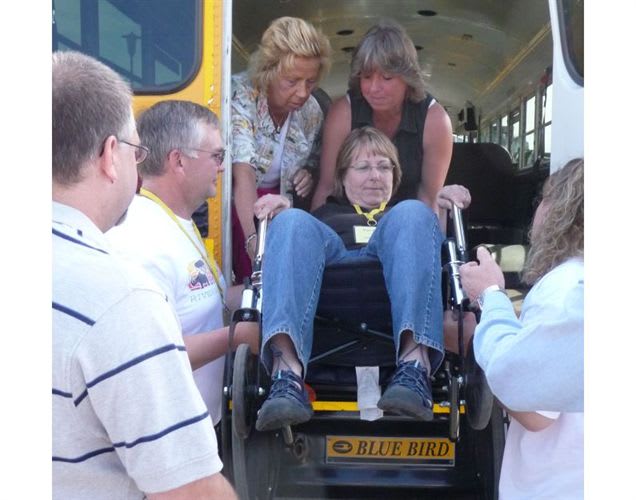
Jean Zimmerman (top left) of the School District of Palm Beach County in West Palm Beach, Fla., heads special-needs training sessions at school districts around the country. Her sessions offer trainees opportunities to work in the bus with special-needs equipment.
When it comes to transporting students with special needs, pupil transportation and special-education officials, along with therapists and disability experts, agree that understanding students’ disabilities and how to work with the students is an integral part of ensuring a successful transportation experience.
“We have to see things through the students’ eyes and step into their realm. Once we’re able to do that and we understand them a little better, it makes a huge difference in how we work with these students,” says Michelle Brower, special-needs coordinator for Douglas County School District in Castle Rock, Colo.
Providing training for school bus drivers and aides is the best way to achieve this understanding and endow them with knowledge to effectively serve students.
“There are strategies that can really make a difference in the kids’ lives, so training is critical,” explains Jocelyn Taylor, an education specialist for the Utah State Office of Education whose expertise is in autism. “It will also make the adult’s job much more enjoyable if they understand how to work with the students they transport.”
Training session topics
Cheryl Wolf, safety and training supervisor for Lafayette (Ind.) School Corp., offers extensive special-needs training for her drivers and bus aides. Her sessions comprise five modules, including sensitivity training. The staff learns the importance of being respectful of the students’ personal space and of letting students do things themselves, such as latching their own seat belt, if they are able to.
In addition to sensitivity training, many pupil transportation operations cover confidentiality, equipment and how to properly use it, behavior and health plans as well as loading, unloading and evacuation procedures.
Pete Meslin, transportation director at Newport-Mesa Unified School District (USD) in Costa Mesa, Calif., says he also discusses with his staff the different types of disabilities to help them become familiar with them, as well as ways for the staff to communicate and work as a team.
Pauline Gervais, executive director of transportation services for Denver Public Schools, feels that it is equally important for school bus drivers and aides to receive bullying and harassment awareness training.
“Students with disabilities are more vulnerable to harassment and can be taken advantage of,” Gervais explains. “It is the responsibility of the driver and the attendant to ensure that students with disabilities are safe on the bus as well as at the bus stop. It is important to consider the student’s ability, age and gender when assigning seats on the bus.”
Approaches to keep drivers and aides engaged
As with any type of training, the drivers and bus aides must remain engaged during the sessions so that they retain the information and can apply it to their jobs. Changing how the information is delivered and who delivers it can help prevent people from tuning out.
“Drivers don’t want to hear things the same way twice, so we make a very big effort to switch up the training,” Meslin says. “Sometimes it will be a classroom setting with our trainers or me doing the presentation or sometimes it will be a special-education teacher, an autism expert, an occupational therapist or a nurse giving a presentation.”
Meslin also takes his drivers on field trips and organizes training sessions in a game show format. For the field trips, drivers are usually brought to special-needs students’ educational setting — in the classroom or the places where they have their community-based instruction. The drivers watch the students participate in the learning experience to gain a better understanding of how they process information.
For the game show-style training, Meslin says he sets up a Jeopardy-like game, dividing participants into teams and directing questions at them. Drivers can work in teams or individually, and small prizes are awarded for correct answers.
In recent months, Denver Public Schools’ transportation department has begun a practice of having the trainers and administrative officials (including Gervais) take turns teaching classroom training sessions. Gervais has found this approach to be successful because the trainees hear the information from different people and it also requires all of the instructors to become familiar with every component of the department’s training curriculum.
Taylor advocates using coaching to train school bus drivers and bus aides. She feels that having a coach in the bus to demonstrate how to communicate with students, how to properly buckle in a student, etc., is the most effective training method.
[PAGEBREAK][IMAGE]449[/IMAGE]
Look within your district for resources
There are many special-needs training resources that are available to the industry, and taking advantage of them is another way to keep sessions fresh and interesting.
Before looking elsewhere, transportation directors, therapists and special-education experts recommend requesting assistance from the personnel in a school district’s special-education department, including school nurses, occupational therapists, physical therapists, behavior specialists and disability experts.
This is something that Meslin does frequently. Several months ago, one of the district’s autism specialists visited the department to discuss the disability. “It’s this type of training that allows our drivers to get more information than they would get from our trainers or from me,” Meslin explains. “To hear it from people whose job is specifically to study disabilities and the associated behaviors provides them with more in-depth information.”
Meslin also encourages co-training with the special-education department. For instance, he has the drivers who are likely to serve special-needs students go to training sessions with the special-education teachers and therapists who will be working with these students so that everyone understands what one another’s challenges are and how they can help each other best serve the students.
Meslin notes that district-wide support is key to achieving co-training opportunities. “If I didn’t have a supportive climate in my district, it wouldn’t work. Co-teaching and shared training wouldn’t happen if the district didn’t recognize that it takes teamwork to work with these students.”
Continuing education classes could also be considered. Brower says that Douglas County School District often offers continuing education classes to its teachers — including its special-education teachers — and transportation personnel are allowed to attend the classes on a space-available basis.
Local and state organizations can provide disability information, instruction
Entities at local and state levels can be helpful as well. Meslin cites the Red Cross, colleges and local branches of disability-related organizations, such as the Epilepsy Association.
In the case of colleges, he says that they may offer special needs-related classes that may be useful to pupil transporters, and many times the colleges are willing to send out student teachers to instruct the personnel at a transportation operation.
In regard to the Epilepsy Association and other such organizations, Meslin says that they are usually very forthcoming when it comes to requests for training.
“They’re more than willing to help us. They realize that sharing their knowledge helps us do a better job serving their population,” he adds.
For those operations that transport students with autism, Brower suggests turning to the National Autism Association. She says that the association’s Website and its staff are helpful in providing information about this disability.
“Your local children’s hospitals are very good for information, and normally they have a Website for parents, the community and educators that can be a good resource,” Brower adds.
State pupil transportation organizations and state directors can also serve as sources of information. Gervais notes that the top officials at state associations often have contacts at organizations that provide special-needs training, while state directors generally have a wealth of knowledge on this topic because they visit operations around their states and have details on operations’ training practices.
[PAGEBREAK][IMAGE]452[/IMAGE]
Solicit the expertise of conference speakers
Attending the National Conference and Exhibition on Transporting Students with Disabilities & Preschoolers and reaching out to speakers who present at the annual event is another way to obtain invaluable information to enliven training sessions.
The conference offers sessions on timely issues related to special-needs transportation and disabilities. Moreover, the speakers are often disability experts and people who work with special-needs students daily, and they are happy to provide their expertise to operations.
Jo Mascorro, a consultant who provides training on behavior intervention practices, effective communication, parenting skills and programming for students with severe disabilities, is scheduled to present at next month’s conference, to be held March 5-10 in Orlando, Fla., and Gervais said Mascorro spoke at Denver Public Schools’ transportation department in January.
Jean Zimmerman, a physical therapist and supervisor of occupational and physical therapy for the School District of Palm Beach County in West Palm Beach, Fla., is another conference speaker who frequently heads special-needs training sessions for pupil transportation departments around the country.
Zimmerman’s sessions comprise a classroom portion followed by a hands-on portion in and around a school bus (she, along with many pupil transporters, feels this is an effective format for training). In her sessions, Zimmerman covers the characteristics of various disabilities and how they can affect the transportation process, as well as such topics as child safety restraint systems and evacuations.
The hands-on component of the session involves comprehensive instruction on how to use the equipment necessary to transport students with special needs, like wheelchairs and wheelchair tiedowns.
“I have the trainees go through the process of loading and unloading motorized wheelchairs, and we train them on the correct way to tie down the wheelchairs and use the occupant restraint system,” Zimmerman explains.
Zimmerman also works with trainees on proper lifting techniques for transporting students out of the bus during an evacuation and the different types of transfers that may be needed during an evacuation.
“At the Transporting Students with Disabilities & Preschoolers conference, I will be premiering a training curriculum that I have completed with the assistance of the Pupil Transportation Safety Institute (PTSI) on evacuating students with disabilities,” Zimmerman says. “I have written this curriculum based on requests from bus drivers, monitors, trainers and supervisors that I have met as I have traveled.”
Zimmerman’s curriculum will be available from PTSI at the end of February.
Additional resources
• The Road to Compliance for Special Needs Drivers and Confidential Records: Training for School Bus Drivers by Peggy Burns, owner of Education Compliance Group Inc.
• The National Highway Traffic Safety Administration’s Child Passenger Safety Restraint training course. The course is available at the Transporting Students with Disabilities & Preschoolers conference.
• The Pupil Transportation Safety Institute’s Transporting Children With Special Needs curriculum.
• Bruce Cram, chief operating officer for Douglas Enterprises Transportation Services in Martin, Ga., recommends Dr. Ray Turner’s Website, www.whitebuffalopress.com, which offers such materials as articles and handbooks on special-needs transportation as well as IEP guidance.
Tips for working with special-needs students
Beyond receiving training to help them understand students’ disabilities, drivers and aides must listen to these kids and become familiar with their needs.
“We want our staff to get to know what the students need on an individual level,” Meslin says. “We encourage people to seek out information — talk with the students’ teachers, physical therapists and parents, and find out what’s working in the classroom.”
Knowing how to communicate with the students can also help to make the ride more enjoyable for them. Taylor offers the following tips:
• Use a calm voice and calming phrases, such as “I will help you” and “It’s OK.” Also, get down to the student’s eye level when speaking to him or her. (“One thing I’ve learned from Jocelyn’s presentations is that you have to give these students time to process what you say,” Wolf notes.)
• Photos that show students successfully riding a school bus are also effective. The visual component of communication can also include a schedule of the bus ride with photos that show each aspect of the ride — boarding, sitting in one’s seat, buckling up, disembarking, etc. The visuals can be distributed to each student or placed on the back of the bus seats, or the aide can point to the photos to direct students.
• If a student needs a prompt, the driver or aide can put his or her hands on the student’s shoulders from the back and gently move the student forward, put pressure on the shoulders to indicate “stop” or gently turn the shoulders to indicate that the student should walk in a certain direction.
• If a student needs a prompt, the driver or aide can put his or her hands on the student’s shoulders from the back and gently move the student forward, put pressure on the shoulders to indicate “stop” or gently turn the shoulders to indicate that the student should walk in a certain direction.
More Special Needs Transportation
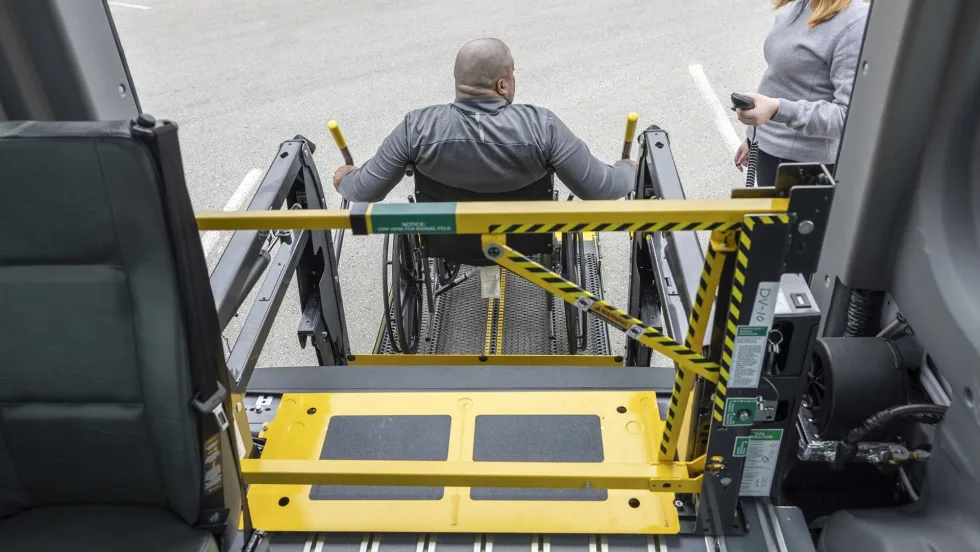
BraunAbility Introduces New Safety Barrier for Wheelchair Lifts
LiftSentinel is designed to add another layer of protection during wheelchair loading and unloading and can be retrofitted to many existing commercial lift installations.
Read More →
HopSkipDrive Launches New Safety, Driver Consistency Features for 2026-27 School Year
The company’s free ride recording, live ride tracking, and consistent driver assignments aim to improve safety and continuity for diverse student transportation needs.
Read More →
The Most Common Wheelchair Securement Mistakes on School Buses (and How to Fix Them)
Small missteps in wheelchair securement can have serious consequences. Here are 32 tips from experts to reduce risk and increase student safety on the bus.
Read More →
Inside AMF Bruns’ New Showroom: School Bus Securement Solutions Explained
Go inside AMF Bruns America’s new Ohio showroom with Maritza Valentin to see its FutureSafe technology, driver training tools, securement systems, and seating innovations.
Read More →
What AMF Bruns’ New Facility Means for Customers [Video]
Inside AMF Bruns’ new Stow, Ohio, operations: See how expanded space and innovation will enhance customer support and operations.
Read More →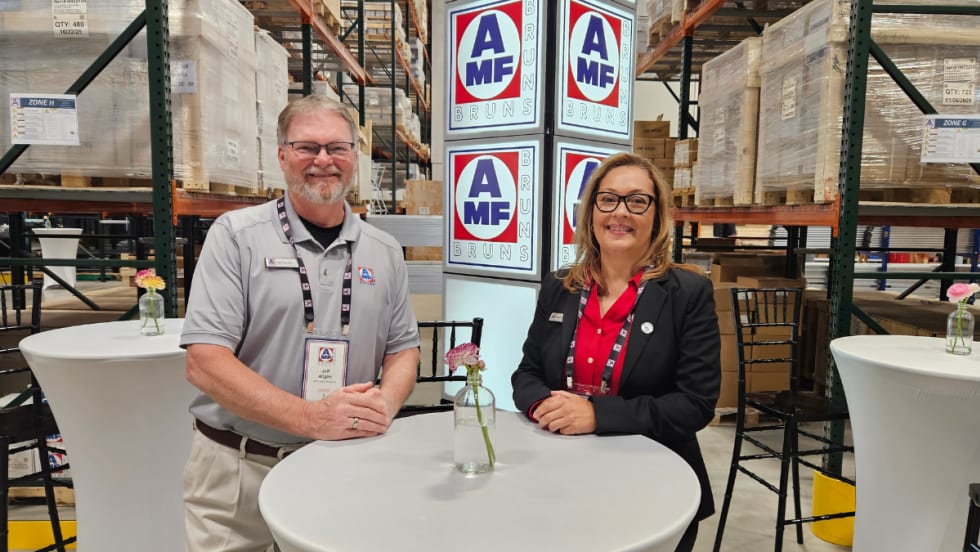
AMF Bruns Expands in Ohio, Investing in Growth and Community
With expanded production space, local investment, and a growing workforce, AMF Bruns is scaling its U.S. presence. Here’s an exclusive first look inside the new Stow, Ohio, HQ.
Read More →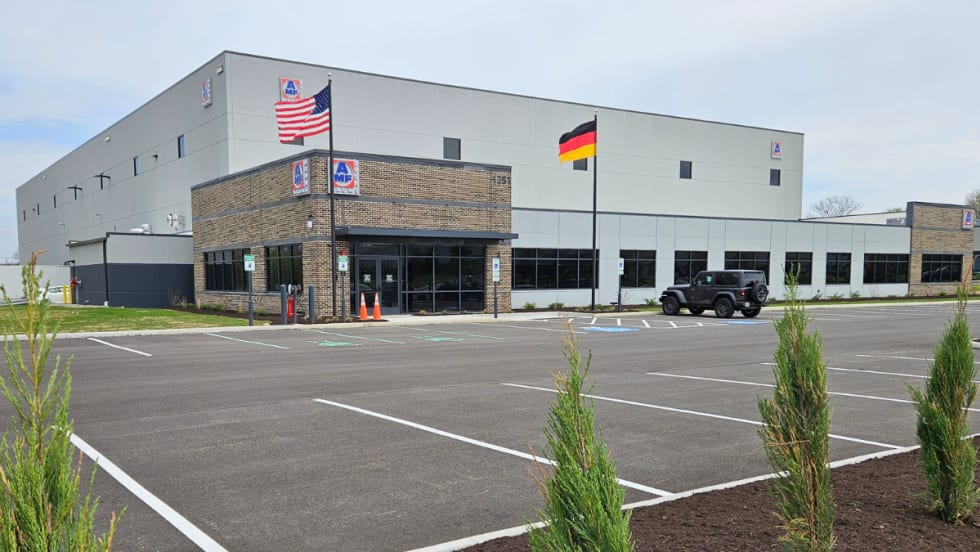
Inside AMF Bruns of America’s New Ohio Manufacturing Facility [Photos]
Take a behind-the-scenes look at AMF Bruns of America’s new 41,000-square-foot Stow, Ohio, headquarters, featuring advanced manufacturing, expanded space, and future-ready mobility solutions.
Read More →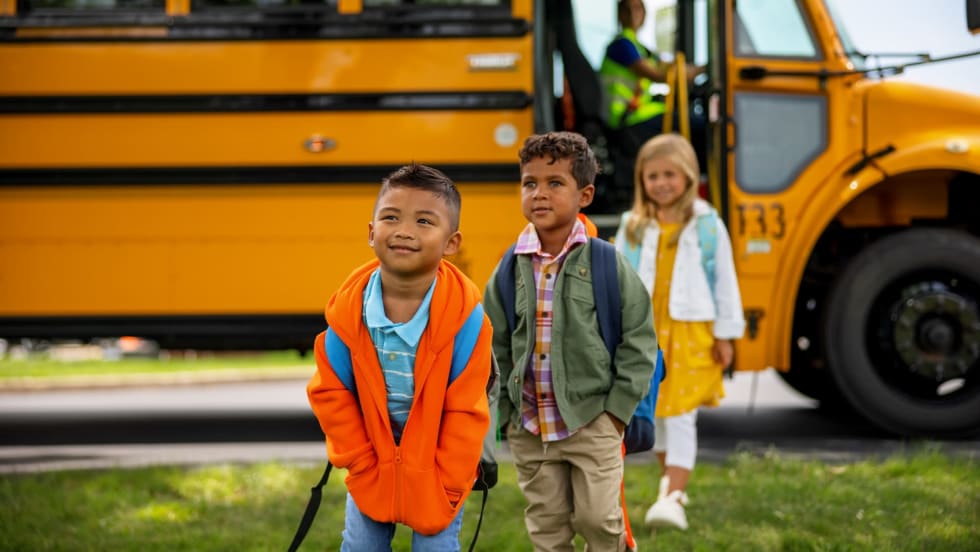
First Student Boosts Student Support in Wichita & Texas
First Student and Wichita Public Schools are using behavioral support strategies to improve student ride experiences, while a separate initiative expands access to after-school programs through a bus donation.
Read More →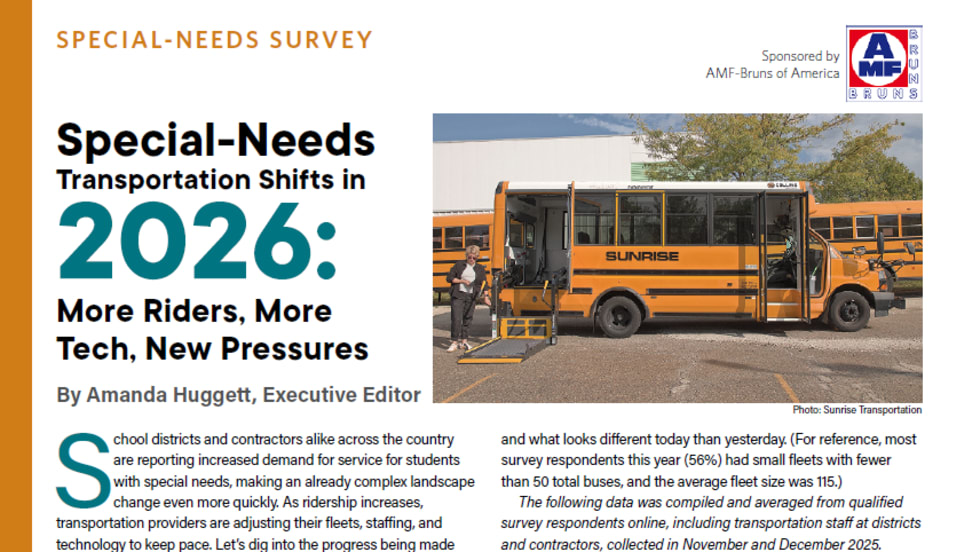
2026 Special-Needs Transportation Survey
What’s changing in special-needs transportation? This year, student transportation operators report a rising need, easing driver shortages, growing tech adoption, and evolving challenges. Sponsored by AMF Bruns of America.
Read More →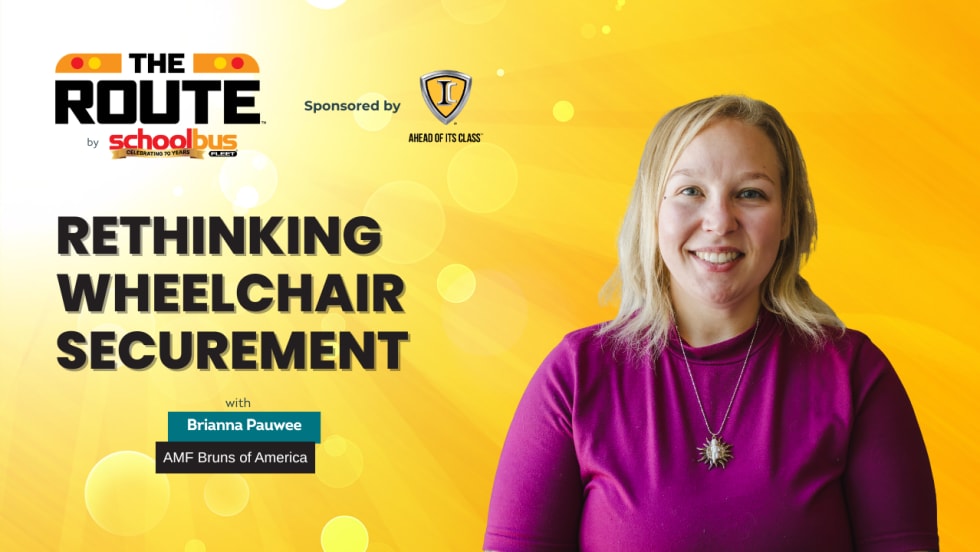
The Lived-Experience Gap in Mobility Tech: An Expert Take on Safe Student Transportation
Brianna Pauwee, a product application specialist at AMF Bruns of America and a wheelchair user, drops in to The Route to share practical securement and training insights, plus the story behind the new “Beyond Mobility” podcast. The Route is sponsored by IC Bus.
Read More →