




Occupant Restraint for Children with Special Needs: Part 1
In Part 1 of a three-part series, tips on effective restraint of children who need head/trunk support.
Effectively securing preschool children and those with special needs in a school bus can be challenging due to the diverse requirements of this population and the extensive equipment options available. The National Highway Traffic Safety Administration’s "Guideline for the Safe Transportation of Pre-school Age Children in School Buses" should be followed closely when selecting equipment. However, the guideline does not recommend specific equipment because transportation departments must choose equipment to meet the particular needs of their passengers. Because these needs change from year to year as preschool children advance through the school system, selecting equipment that offers flexibility while meeting the needs of the population is vital in providing a safe, efficient transportation program. In this three-part series, we will describe some common problems or challenges of securing preschool children and those with special needs and offer what we have found to be effective equipment options. Within each problem/challenge category, if there is more than one available option, we will discuss the options in order from least restrictive (appropriate for typically developing preschoolers or those children needing mild intervention) to most restrictive (for children needing more support or intervention). Planning for transportation of children with special needs must always proceed with this in mind. Providing the least restrictive option must be the goal from the outset. That starts with the spec’ing of buses and continues through the formation of the Individualized Transportation Plan, which typically takes place at the IEP (Individualized Education Program) meeting. The 1997 Reauthorization of IDEA (Individuals with Disabilities Education Act) identifies providing the least restrictive option as being a vital part of any transportation plan and advises that team members should begin with the assumption that each student will utilize traditional transportation services with their non-disabled peers.
Belt, non-belt options
Preschool child safety restraint systems can generally be divided into two categories, those which require installation of certified lap belts attached to seat belt-ready or reinforced seats and those which can be used without a lap belt. (Please note that a lap belt alone is not a suitable occupant restraint for a preschool passenger.) There are some specially designed child safety seats that come with their own reinforced bus seat and associated certified belt systems that allow for partially equipping a bus for preschool students. However, installation of lap belts on a school bus (for the sole purpose of securing child safety restraint systems) most likely designates that bus for preschool passengers because bus manufacturers advise that the entire bus be fitted with lap belts. For many, installation of lap belts means that their preschool students must utilize a specialized form of transportation as routing makes it difficult and costly to operate buses specifically for younger students. The category of child safety restraint systems that does not need installed lap belts offers both permanent and temporary options. These can be especially beneficial for districts that transport both preschoolers with special needs and those who are typically developing. One option, integrated child safety seats, can be used to partially equip a bus for younger passengers but is quite permanent. Some safety vests have been dynamically crash tested on non-reinforced bus seats without use of a lap belt and have been authorized for use on traditionally designed buses. They are secured to the bus seat with use of a portable seat mount that can be installed quickly and easily without tools. Although a thorough Individualized Transportation Plan must be established and well documented to use this option and to assure appropriate adult supervision, it allows for integration of preschool students on traditional transportation services. Many districts hope to be able to keep the bulk of their equipment inventory consistent because it helps to keep costs down and eases personnel training. However, to provide flexible and least restrictive transportation scenarios to preschool students, school districts must have a variety of available options.
Providing head control
The first challenge, poor head control, is common among children with disabilities. In its mildest form, it is seen in a child whose special medications or underdeveloped nervous system (similar to an infant’s) causes them to fall fast asleep with their heads hanging down on their chests. Although many children fall asleep in vehicles, the angle of the bus seat causes a child in a safety seat or safety vest to be fully upright. For some children with already compromised breathing and decreased respiratory strength, some head support may be necessary. Other students may experience poor head control when awake due to delayed development or an orthopedic condition. If the student is using a child safety seat, the least restrictive option might be to use a seat that allows for a degree of recline in a forward-facing position. When selecting the seat, it is important to ensure that the manufacturer specifies that the seat can be used reclined in a forward-facing position. Although all convertible child safety seats allow for recline when used for an infant, who is rear facing, the same is not typically true for forward-facing usage. By design, a convertible child safety seat "converts" for use from an infant seat to a toddler seat; however, most require the seat be moved into the fully upright position for the toddler. For many students, a small amount of recline allows them to rest their heads against the seat back and better align their airway. Another child safety seat that may offer better head positioning is a seat which is certified to be used rear facing. Presently, some child safety seats allow for children up to 35 pounds to be rear facing. Although close seat spacing may limit this option, it can assist even the more involved child, as it allows for support of the entire neck and spine in a forward-impact crash. This concept is why we rear face infants whose decreased neck and upper body control makes it unsafe for them to be thrown forward against a harness in a crash force.
Free-floating collar
If neither of these options offers enough support or for the child in a harness or integrated child safety seat, there is another option to consider — a free floating neck collar. It is important that the collar fits well and will not in any way impede the child’s breathing. It is also very important that the collar is free floating and allows for the child’s head to come forward in a force. No straps or other positioning aids that secure the head or neck to the child safety seat, safety vest or bus seat back separately from the torso should be used.
Positioning pads
For the child with severe head control problems, a child safety seat designed for a child with special needs that incorporates a wedge and/or special positioning pads may be needed. The wedge positioned under the front of the child safety seat slightly reclines the seat. This is a very restrictive option as these seats are very large and expensive. In addition, most require special tethers. They may be needed for the child who has significant alignment problems and for whom support is needed from the sides of the head as well as a more reclined posture. For some, adequate head control may not be achieved in a sitting posture. The only occupant restraint that can be used while lying down is the Modified E-Z-On Vest. This vest is secured through use of two seat belts. The bus seat must support the child’s entire body as they lie with their head toward the aisle.
Controlling the trunk
Another challenge common to this population is that of poor trunk control. Many neurological or orthopedic conditions may promote poor trunk alignment while positioned in a child safety restraint system. If the child is transported in a child safety seat, towel rolls are a quick and easy way to facilitate proper alignment. It is vital that all positioning aids are made of firm materials and do not interfere with the working parts of the child safety restraint system. No padding should be placed beneath or behind the child. For some children, a safety vest with a crotch strap may offer more postural support. A crotch strap should be used for smaller passengers, especially on traditionally designed buses without lap belts. When properly adjusted, it helps keep the child from "submarining" under the vest. Again, a child safety seat designed for children with special needs that incorporates positioning pads may assist the child with severe trunk control problems. Some children require more substantial padding afforded by these specialty seats to better position their torso, pelvis and lower extremities to achieve proper alignment. With the above interventions, it may be helpful to seat the child over a wheel well. Feet that are supported assist in maintaining good hip position and also give the child an improved feeling of "groundedness," both of which contribute to improved control of the muscles of posture. If trunk control cannot be achieved in the sitting position, a Modified E-Z-On Vest can be used. This very restrictive option may be necessary for a severely involved child who has deformities and contractures that do not allow for seated posture. In the first part of this series, we attempted to give some suggestions for dealing with typically developing preschoolers and those with control problems of the head and trunk. In Part 2, other seating and positioning issues will be discussed.
Sue Shutrump is supervisor of occupational and physical therapy for the Trumbull County (Ohio) Educational Service Center. Kentin Gearhart is project manager for the Mobile School Bus Project at Riley Hospital in Indianapolis.
More Special Needs Transportation
Kelli Goterba Named 2026 Special-Needs School Bus Driver of the Year
Through building trust with students and strengthening her transportation team, Goterba exemplifies the impact special-needs drivers can make.
Read More →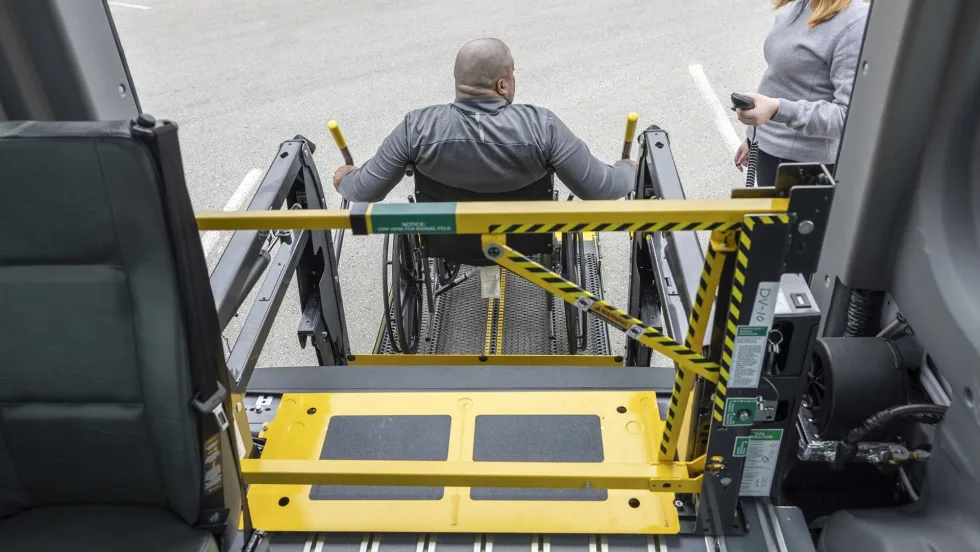
BraunAbility Introduces New Safety Barrier for Wheelchair Lifts
LiftSentinel is designed to add another layer of protection during wheelchair loading and unloading and can be retrofitted to many existing commercial lift installations.
Read More →
HopSkipDrive Launches New Safety, Driver Consistency Features for 2026-27 School Year
The company’s free ride recording, live ride tracking, and consistent driver assignments aim to improve safety and continuity for diverse student transportation needs.
Read More →
The Most Common Wheelchair Securement Mistakes on School Buses (and How to Fix Them)
Small missteps in wheelchair securement can have serious consequences. Here are 32 tips from experts to reduce risk and increase student safety on the bus.
Read More →
Inside AMF Bruns’ New Showroom: School Bus Securement Solutions Explained
Go inside AMF Bruns America’s new Ohio showroom with Maritza Valentin to see its FutureSafe technology, driver training tools, securement systems, and seating innovations.
Read More →
What AMF Bruns’ New Facility Means for Customers [Video]
Inside AMF Bruns’ new Stow, Ohio, operations: See how expanded space and innovation will enhance customer support and operations.
Read More →
AMF Bruns Expands in Ohio, Investing in Growth and Community
With expanded production space, local investment, and a growing workforce, AMF Bruns is scaling its U.S. presence. Here’s an exclusive first look inside the new Stow, Ohio, HQ.
Read More →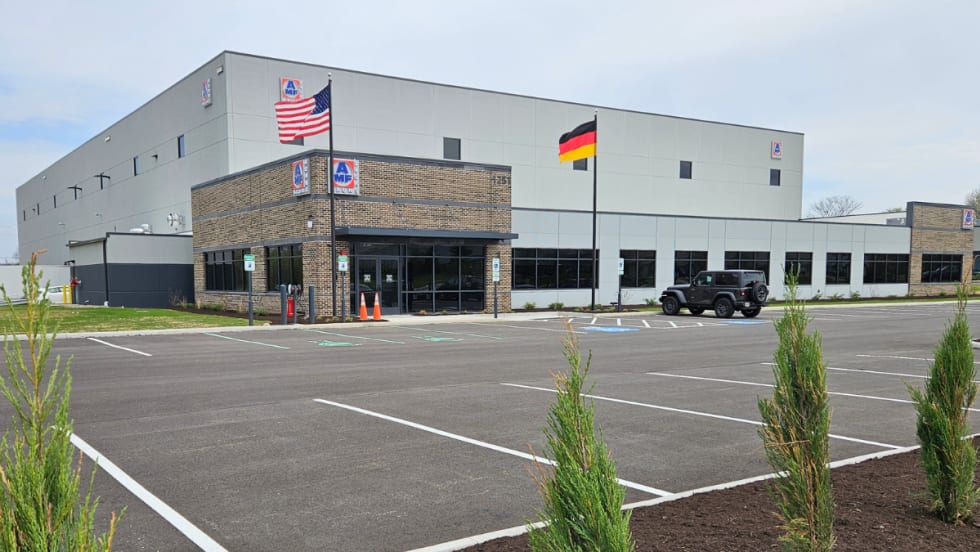
Inside AMF Bruns of America’s New Ohio Manufacturing Facility [Photos]
Take a behind-the-scenes look at AMF Bruns of America’s new 41,000-square-foot Stow, Ohio, headquarters, featuring advanced manufacturing, expanded space, and future-ready mobility solutions.
Read More →
First Student Boosts Student Support in Wichita & Texas
First Student and Wichita Public Schools are using behavioral support strategies to improve student ride experiences, while a separate initiative expands access to after-school programs through a bus donation.
Read More →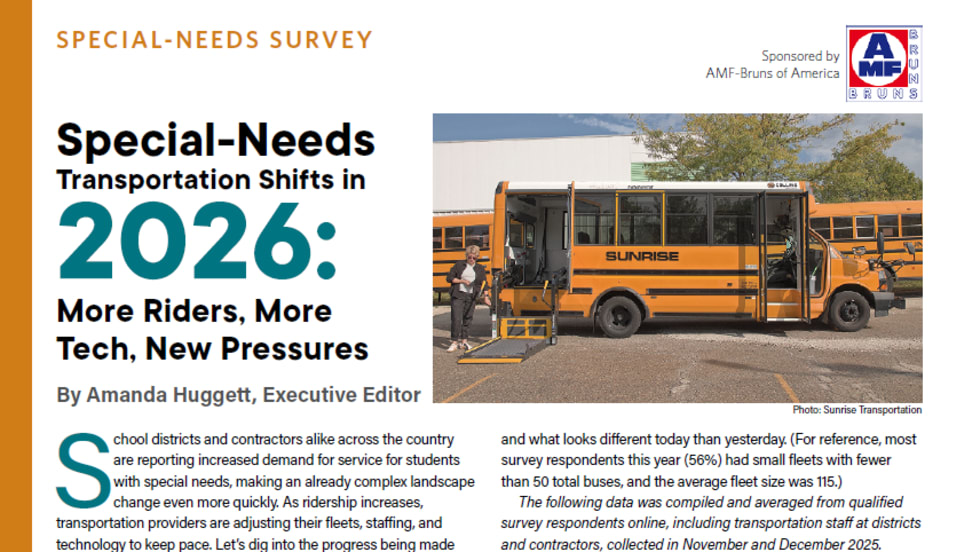
2026 Special-Needs Transportation Survey
What’s changing in special-needs transportation? This year, student transportation operators report a rising need, easing driver shortages, growing tech adoption, and evolving challenges. Sponsored by AMF Bruns of America.
Read More →