




News from the World of Pupil Transportation
Final report issued on Tennga bus-train crash WASHINGTON, D.C.— The National Transportation Safety Board (NTSB) determined that the sc...

Final report issued on Tennga bus-train crash
WASHINGTON, D.C.— The National Transportation Safety Board (NTSB) determined that the school bus driver’s failure to follow standard rail crossing safety procedures was the probable cause of the March 28, 2000, grade crossing tragedy that claimed the lives of three Georgia schoolchildren. In its final report, the NTSB said driver Rhonda Cloer failed to stop the bus before crossing the railroad tracks. As a result, the bus was rammed by a CSX freight train traveling approximately 50 mph. Seven children were aboard the bus. Of the four who survived, three were seriously injured and one suffered only minor injuries. Cloer also was seriously injured. In addition to not stopping at the rail crossing, the NTSB reported that Cloer might not have heard the train because she had the radio on. An additional factor in the crash was the school district’s failure to monitor the performance of its drivers. The NTSB reported that the Murray County School District, which employed Cloer, did not identify or correct improper behavior. Cloer reportedly failed to stop at the rail crossing at least eight times before the day of the fatal incident, based on video provided by the camera on her bus. The NTSB report suggested that a stop sign placed at the crossing might have prevented the accident. (In the wake of the crash, flashing warning lights and a gate have been added to the crossing, which only had crossbucks at the time of the crash.) The NTSB also said the school district was deficient in its school bus route planning, failing to identify hazards on routes and to eliminate the necessity of crossing railroad tracks. In its final report, the NTSB issued a series of safety recommendations. To the states: In cooperation with the National Association of State Directors of Pupil Transportation Services (NASDPTS), develop and implement initiatives for passive grade crossings and school buses that include installation of stop signs and enhanced driver training and evaluation, including review of onboard videotape when available. To the National Highway Traffic Safety Administration: Implement a rulemaking to prohibit radio speakers used for music or entertainment from being placed adjacent to drivers’ heads. Evaluate the feasibility of incorporating automatic crash notification systems on school buses and, if feasible, proceed with system development. To NASDPTS: Encourage the association’s members to use the Federal Railroad Administration’s Web-based accident prediction system or the states’ hazard indexes for grade crossings when developing school bus routes. Notify members of how and why the driver’s lap-shoulder belt tore in this accident and of the potential consequences of large longitudinal distances between lap-shoulder belt anchor points. For the full report on the Tennga crash, visit the NTSB’s Website at www.ntsb.gov
.
Boy critically injured in bus accident surprises everyone with recovery
LINDON, Utah — Seven-year-old Jacob Lindow was not expected to live after he slipped in the snow and fell under the wheel of his school bus in December. The first-grader was listed in critical condition following the accident. But six weeks later, the youngster had been released from the hospital and was making a remarkable recovery — and this after doctors treating him for his accident injuries discovered a tumor on his spinal cord. “We call it a miracle, a series of miracles. He’s the answer to a lot of people’s prayers,” Ben Lindow, the boy’s father, told the Deseret News. The tumor growing against Jacob’s spinal cord affected the blood supply to his small intestines and kidneys. However, at the time of the accident, Jacob had experienced no symptoms of the tumor’s existence. Had it not been for the school bus accident, the tumor may not have been discovered before damage was done. Instead, surgeons were able to remove most of the tumor, which was benign. More surgeries are ahead for Jacob, including procedures to rebuild the facial bones around his eye. The bus crushed Jacob’s left eye, broke his pelvis and both legs, and did severe damage to his internal organs. While his left eye is still intact, the optic nerve was severed and he permanently lost sight in that eye. Doctors say Jacob’s face will heal so completely that it will be difficult to tell he was ever so badly injured. Jacob has been walking, albeit little, and his parents are optimistic about the future. Dick Belliston, transportation director for Alpine School District, said Jacob’s parents have been very supportive of the district and the driver, despite the tragedy they have endured. “They have been so wonderful through this process,” he said. “They’ve been extremely supportive and kind to the driver, and thoughtful and concerned about his feelings.” Belliston said that there have been many prayers and thoughts on Jacob’s behalf. “We’re just grateful that it’s turned out as well as it has,” he said.
Question of the month
What do you think is the most common workplace injury in the school bus industry? From the Forum at www.schoolbusfleet.com/forum. Manual strain leads to CTS
Carpal tunnel syndrome (CTS) seems to be the most common injury in the school bus field. I began having problems with carpal tunnel after only four years of driving a school bus. My arms would ache, especially at the wrist. My grandmother, who was a school bus driver for 30 years, was diagnosed with carpal tunnel syndrome several years ago. She has to wear arm braces at night because of the pain. People don’t seem to realize that the continuous action of opening and closing the door, shifting gears and reaching over to push the switches can cause this problem, but my grandmother is living proof.
Stephen Aadamson
School Bus Driver
Forest City (Ark.) Public Schools Slips and falls are most common
The number one injury contributing to missed time has to be slipping and falling on the steps of the bus. We don’t get a lot of snow and ice around here, but we do get lots and lots of rain. Water and mud can be just as slippery as snow and ice at times. Add in the fact that many lots are not lighted as well as they could be and many of them are not paved, and you have a really good prescription for injuries. CTS is less of a problem since the inception of automatic transmissions and powered door mechanisms. Most other injuries are caused from improper use of safety equipment or just plain carelessness.
Mark Obtinario
Owner
Cowlitz Coach Service
Castle Rock, Wash. Maintenance bumps and bruises
I think the most common injury is related to the field of school bus mechanics. I think that they get a lot of injuries like small cuts, bruises, fractures and broken bones from parts falling on them. If drivers or passengers were injured by the bus design, it would be from tripping over the doghouse on front-engine transits. That would lead to some bruising.
Steven Rosenow
School Bus Website Master
Shelton, Wash. 5 most prevalent injuries
1. Poorly designed driver seats and improper ergonomics in the driver area cause back, leg, ankle, hip and knee injuries. These problems can occur when the driver’s seat is not directly in front of the steering wheel or when there is a lack of adjustable steering wheel or foot controls. 2. We still hear complaints of CTS, even though almost all of our buses have air doors. 3. Slip and fall injuries. 4. Injuries caused by special-needs students (scratches and bruises, mostly). 5. Mechanic injuries occurring in the garage.
John Farr
Director of Transportation
Oceanside (Calif.) Unified School District
Baltimore district reinstates half of contractor’s suspended routes
BALTIMORE — Baltimore School District officials restored about 15 of the 30 suspended bus routes assigned to one of its private contractors after conducting a complete inspection of the 20 school bus companies that transport the city's students. The Allender Group had 30 of its 32 bus routes suspended last week after one of its school buses crashed into a house, injuring nine and prompting the district's inspections. The bus involved in the crash was not supposed to be carrying students because of a broken window on the right side. The vehicle had failed a Motor Vehicle Administration (MVA) inspection earlier that day and was ordered to stay off the road. However, there was an apparent misunderstanding between Allender and the school district. The bus had been repaired, but the driver didn't realize it had to be re-inspected before it could transport children. Driver James Fields Jr. told police he blacked out during the accident. Police are going to subpoena the driver's medical records for investigation. Both Fields and the Allender Group could face criminal charges related to the accident. Following the crash, the school district allowed the company to retain only two routes - a number it could comfortably monitor. After the investigation, however, district officials said they feel it's now safe to reinstate some of Allender's routes. "We feel more comfortable with increasing the number of [Allender] buses because many of the problems with them have been corrected," Edie House, a district spokesperson, told the Baltimore Sun. "We felt based on information we've been getting from our investigation that it's safe to start increasing the company's routes." Still, the MVA announced that it would destroy license tags of 17 Allender buses as a result of the inspections. Allender, one of the city's largest contractors, owns 34 buses in all. Representatives of the company were unavailable for comment. The district's investigation of private contractors was aimed at verifying bus maintenance and inspection documentation. Said Vanessa Pyatt, Baltimore School District spokesperson, "The district expects the companies and buses will meet the city and state regulations and is unable to say what the consequences will be should a company not meet them.”
Summary of 2000-2001 ‘danger zone’ fatalities
TOPEKA, Kan. — Nine children were killed by their own school bus or by a passing vehicle during the 2000-2001 school year, representing a 59 percent drop from the previous year and the lowest total in more than a decade. Twenty-two students were killed in loading/unloading zone accidents last year. The statistics, gathered annually by the Kansas State Department of Education, indicate that five children were killed by their own school bus, while four were fatally injured by passing motorists. Five of the nine deaths involved students who were 6 years old or younger. The following descriptions summarize the circumstances of the fatal incidents.
A 5-year-old girl exited the school bus. The driver checked, thought the area was clear, and began to leave for the next stop. The girl was run over by the rear wheels of the bus and killed.
A 5-year-old girl was struck and killed by a passing motorist while attempting to cross the road to meet her bus.
A 6-year-old boy exited the bus, crossed in front of the bus and then came back because he had lost his shoe. The driver pulled away and ran over the boy. The driver stated that the bus was noisy, and he lost his concentration but felt a bump.
A 6-year-old boy was struck and killed by his own school bus. The boy had crossed the street and reached the other side, then came back toward the bus. The driver had begun to pull away after the children had crossed the street and was checking traffic, and did not see the child in the rear of the bus.
A 6-year-old boy exited the bus. The boy fell under the front of the bus and was struck and killed.
A 9-year-old boy had exited the bus and was crossing the street when he was struck and killed by a passing vehicle.
A 13-year-old boy exited the school bus, crossed in front of the bus and stepped in front of a cement truck, which struck and killed him.
A 15-year-old boy exited the bus. He walked slowly, due to a muscle disorder. The driver did not see the boy as he was crossing in front of the bus. The right front wheel struck the boy and killed him.
A 15-year-old girl exited the bus, crossed in front of the bus, and was struck and killed by a passing motorist.
Ex-felon crashes bus, tests positive for drugs
LITTLE ROCK, Ark. — Seventeen students were injured when a school bus driver who was recently released from prison drove his loaded bus off an interstate highway and into a tree. The driver, Mark Marbley, has since been returned to prison, where he will undergo a drug treatment program. According to the Arizona Central, drug tests administered after the accident indicate that Marbley, 48, had used cocaine and marijuana. Marbley had just finished working a night job before beginning his school bus route. He told authorities that he’d fallen asleep at the wheel as he reached over to turn off the bus’ heater, causing the bus to veer off the road. Marbley was released from prison last summer after serving 15 years of a 40-year sentence for burglary, robbery and property theft. He was hired as a driver by the Pulaski County Special School District pending the results of a routine background check. The criminal background check had been submitted to state investigators, but the state had not yet returned the results. According to district policy, new employees can begin work before criminal background check results are in. Following the accident, Marbley resigned from his position with the district and underwent a hearing, during which his parole was revoked. He was then turned over to the prison system’s Technical Violators Program, where he was to undergo a 60-day rehabilitation program. If no new charges are filed against him, he will be released upon completing the rehab program.
VIDEO REVIEWS: 'The Safety Squadron Rides the School Bus'
“The Safety Squadron Rides the School Bus” is an eight-minute instructional video provided by the Minnesota Association for Pupil Transportation aimed at teaching school bus safety to young audiences. The video, featuring cartoon characters Molly, Joey, Zip, Pat and Busby, offers school bus safety tips in an entertaining manner that is easy to understand. The video emphasizes safety rules in four major areas - walking to the bus, at the bus stop, aboard the bus and getting off the bus. Each area of bus safety has a short, easy-to-digest set of guidelines to accompany it. For instance, while walking to the bus, the video reminds children to always stay on the sidewalk, to plan on getting to the bus stop at least five minutes in advance and to keep all items zipped away in a backpack with a name tag on it. Before crossing the street, it is always important to “stop, look and listen.” In the segments on loading and unloading, the video discusses the “danger zone” around the school bus. Children are told that they can judge the danger zone as anywhere within “10 giant steps” of the front, sides and rear of the bus. They should stay out of the danger zone at all times except when getting on and off. The video also briefly talks about the rules to obey while riding the school bus. It lists the following three basic rules to follow for onboard safety. Remain seated and faced forward, with your hands and all objects inside the windows. Keep noise and commotion down so that the driver can concentrate. Finally, observe the golden rule - treat others as you wish to be treated. For more information on the video, visit the MAPT Website atwww.mnapt.org.
'School Bus Extrication'
Published by PennWell’s Fire Engineering Books and Videos, “School Bus Extrication” is a technical video explaining the step-by-step approach to successful rescues at school bus crash sites. It stresses the idea that, although vehicle accidents occur at an alarming rate every day, most people never consider the possibility of buses being involved in accidents. The video states that there are approximately 16,000 school bus collisions annually, causing more than 12,000 injuries and 130 deaths. Emergency responders who may be well trained in car and light truck extrication techniques will be confronted with a much different challenge at a school bus accident. As an instructional tool, “School Bus Extrication” is designed to teach firefighters and other emergency rescue personnel specific methods of school bus extrication. The video was developed and hosted by Leigh T. Hollins, battalion chief with Cedar Hammock Fire and Rescue in Manatee County, Fla. Hollins introduces viewers to common situations that happen at bus accidents, problems that arise and the potential for multiple casualties. There is also a technical evaluation of bus types and construction that make school bus extrication different from other vehicles. Hollins outlines various rescue and extrication techniques and ends the video with considerations on incident preparation. The video is approximately 40 minutes long. For more information on the video, visit PennWell’s online store at www.pennwell-store.com.
U.S. flags return to Indiana’s school buses
INDIANAPOLIS — After a state committee outlawed the display of patriotic emblems, including flags, on school buses, State Superintendent Suellen Reed overruled the decree, stating that the timing for it was “inappropriate.” The ruling was set to go into effect after Jan. 1, but was rescinded amid widespread protests by school transportation professionals throughout the state. The flag prohibition was ordered by a committee composed of representatives from several state authorities, including the Department of Education, the School Boards Association, the Health Department and the School Transportation Directors Association.
Bill would close van loophole
WASHINGTON, D.C. — A U.S. lawmaker has proposed legislation that would make it illegal for schools to purchase used 15-passenger vans for school transportation. Congressman Mark Udall of Colorado introduced the measure, called the School Bus Safety Act of 2001, to close a longstanding loophole that allows schools to buy used vans from auto dealers. Currently, federal law only prohibits the sale of new 15-passenger vans to schools. The bill, HR 3296, was introduced on Nov. 14 and later referred to the House Subcommittee on Highways and Transit. In addition to K-12 schools, colleges and universities would be covered under the proposed law. The bill would also increase the penalty for an infraction from $1,000 to as much as $25,000. Any fines collected under the legislation would be pooled into an account for use in enforcing the new provisions. The following is Udall’s speech to Congress in introducing the bill: Mr. Speaker, Today, I am introducing the School Bus Safety Act of 2001, legislation designed to close a loophole in federal regulations that can threaten the safety of children who ride a bus to and from school. As my colleagues may know, the sale of new 15-passenger vans to carry school-age children has been banned since 1974 because they do not have the same safety features as school buses and because the vans are more likely to roll over when carrying many passengers. However, current regulations allow schools to purchase used 15-passenger vans - the loophole my legislation addresses. School buses and 15-passenger vans are radically different vehicles. A school bus must meet numerous mandated federal safety standards. School buses have multiple horizontal and vertical steel beams bonded together in such a manner that essentially wraps the passengers in a cage of steel. The inside and outside of the bus is further reinforced by thick sheets of steel. A school bus is generally heavier than a comparably sized passenger vehicle and has exit doors, superior roof structure, an interior aisle, significant interior seat padding, driver visibility, fuel system integrity and a far superior center of gravity and stability. In addition, school buses have special warning light and pedestrian control systems and are generally painted a bright yellow, which are all significant safety features. The traditional 15-passenger van is structurally and generally a significantly different vehicle. These vans were originally rated as “light trucks” and, as such, were not required to meet passenger safety standards. Therefore, the area behind the driver is anticipated only to carry cargo and does not have side bar protection which accompanies normal passenger vehicles, including minivans. The numbers tell the whole story. When evaluating the relative safety of all passenger vehicles and school buses per road mile, studies show that school buses are markedly safer vehicles. In 1994, there were 21,813 deaths in passenger vehicles, which translates to .86 deaths every 100 million miles. In school buses, there were two occupant deaths, which translate into .005 deaths per 100 million road miles. In other words, passenger vehicles per road mile had a fatality rate 170 times higher than school buses. School buses are the safest form of mechanized transportation that exists. School buses are 34 times safer than train travel and four times safer than commercial aviation. My legislation removes the nearly 30-year-old loophole in the federal regulations that allows used vans to be purchased while new vans are banned. In addition, this bill extends the ban from sale of vans to leasing, renting and buying, thereby making the buyers accountable as well as the seller. These changes will insure that the intent of the 1974 law is finally realized. The bill also would strengthen the penalties against those who violate this safety provision. In light of numerous high profile cases involving colleges and universities, my bill extends the definition of “schools” for these provisions to include post-secondary institutions. The legislation raises the prescribed penalty for breaking this law from “not more than $1,000” to “not more than $25,000,” thereby giving the enforcement agencies something to make it worth their while to pursue. This provision is important because from 1974 until 1997, the National Highway Traffic Safety Administration, which had responsibility for administering the law, did not initiate one single enforcement proceeding in the entire country. Finally, the bill mandates that fines collected under this legislation would be pooled into an account under the Secretary of Transportation for use in enforcing these provisions. Mr. Speaker, as a nation, we long ago decided that the means by which we transport our children to and from school and school-related activities, should be as safe as possible. This bill will go a long way in ensuring that safety for our children.
Register online for special-needs roadeo
SYRACUSE, N.Y. — The Pupil Transportation Safety Institute (PTSI) has added an online registration form for the 2002 National Special-Needs Team Roadeo, scheduled March 1-3 in Fort Worth, Texas, to its Website. The address is www.ptsi.org/roadeo2002.htm. The Website also includes free downloadable information on how to plan a roadeo in your local area, roadeo news from across the country, highlights and sponsors of the 2001 event and contact information. The Special-Needs Team Roadeo is an annual event for school bus driver and attendant teams from across the country. Teams come together, demonstrate their skills and learn from one another, thus improving the safety of the special children they transport. The roadeo is held in conjunction with the annual National Conference and Exhibition on Transporting Students with Disabilities. PTSI continues its role as coordinator/facilitator of this annual event, now in its fifth year. PTSI is the leading nonprofit school bus safety education, training, and consulting organization in North America, serving the school bus community since 1990. For more information on the roadeo, contact Jim Ellis at jim@ptsi.org or call (800) 836-2210. For more information on the conference and exhibition, visit www.serifpress.com/conference.htm.
Driver fired for stranding disabled boy for 6 hours
ORANGE, Calif. — A 15-year-old boy with Down syndrome was left on his school bus for six hours, according to the Orange County Register. Jonathan Darling, who is reported as having a mental age of 5, was found sitting on the floor of his bus in the transportation yard. Driver James Jiminez, who claims to have watched the student safely enter his home after dropping him off that afternoon, was later fired by the district. District policy requires drivers to search the bus for students and forgotten articles at the end of the route and mark a card, which is placed in the rear window of the bus. Though the card was put in the proper place at the end of the route, Darling, at 5 feet 2 inches tall and 140 pounds, was somehow overlooked. Ellen Johnson, the district’s transportation supervisor, said that Jiminez had been on the job for four months and was still on probation at the time of the incident, though she’d had nothing but good reports about him up to that point. Following the incident, the district established a team to work with each bus driver on inspecting buses after each shift.
More Safety
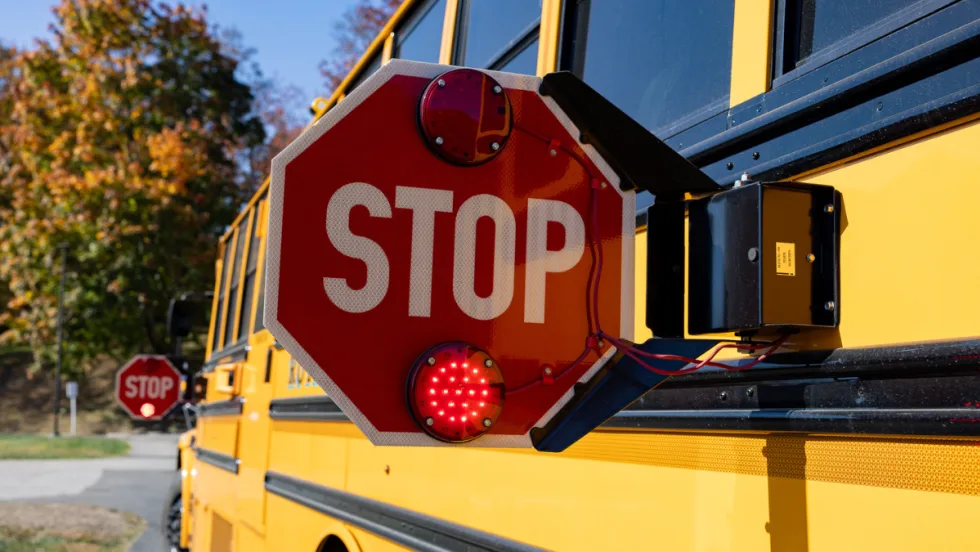
Illegal School Bus Passing Drops 24% in New York Districts
With fewer than 5% of citations involving repeat offenders, Westchester County officials said enforcement, education, and community partnerships are helping change driver behavior.
Read More →
School's Back. Here's What Happened to Traffic, Speeding & Distraction
What happens to traffic when school resumes? New data analysis examines changes in distracted driving, congestion, and speeding around schools.
Read More →
Geotab Expands Fleet Safety Tools With Video Coaching, Risk Insights
New safety and video capabilities aim to help fleet managers assess risk, support drivers, and take targeted action through video coaching, red-light violation detection, and more.
Read More →

How to Build a Better School Bus Driver Training Program
Is it time to strengthen your driver training? Here’s how to pick the right talent and improve recruitment, retention, and safety. This video is brought to you by IC Bus.
Read More →
Recent School Bus Accidents Leave 2 Dead, 2 Injured
Four school bus crashes in Florida, Illinois, and Georgia highlight risks in transportation lots, at bus stops, and during student loading and unloading.
Read More →
When Every Second Matters, Clarity Keeps Routes Moving
From routine delays to urgent incidents, strong communication practices help drivers, dispatchers, schools, and families respond with confidence.
Read More →
What Happens When a School Bus Catches Fire — and What Can Help
School bus fires are rare but can be devastating. Learn how advances in fire suppression and asset protection help fleets detect fires earlier, reduce damage, and improve safety.
Read More →
Geotab Launches Tool to Help Fleets Investigate Road Incidents
Geotab Investigations combines telematics data, video, documents, and other evidence to help fleets reconstruct incidents, resolve claims, and determine what happened.
Read More →
Texas Sixth Grader Wins 2026 National School Bus Safety Poster Contest
Sai Darshana Yekolu of Moseley Middle School in Prosper, Texas, was named the newest winner for her artwork, bringing the theme of “Safe Rides, Everyday Heroes” to life.
Read More →
Doing More With Less: How Transportation Directors Can Prioritize Safety Amid Budget Uncertainty
With diesel prices soaring and nearly one-third of transportation directors expecting budget cuts, maintaining student safety has never been more challenging. Download this guide to learn how leading districts are prioritizing risk, funding critical safety technology, and building stronger budget cases with data.
Read More →