




News from the World of Pupil Transportation
'GMA' broadcasts report on school bus diesel exhaust NEW YORK — On Feb. 7, ABC’s “Good Morning America” broadcast a r...

'GMA' broadcasts report on school bus diesel exhaust
NEW YORK — On Feb. 7, ABC’s “Good Morning America” broadcast a report on potential health hazards caused by diesel exhaust from school buses. The study was conducted by John Wargo, a Yale professor who concluded that federal regulators and local officials should take strong action to prohibit bus idling, minimize time children spend on the bus, retrofit buses with clean diesel technology and install interior air filters. Charlie Gauthier, executive director of the National Association of State Directors of Pupil Transportation Services, was interviewed for the segment and briefly appeared during the report to assure parents that school buses are the safest way to get to and from school. Other key points made by Gauthier that were not included during the telecast:
The study is not new. A similar study was conducted last year that allegedly showed that school bus diesel exhaust fumes were endangering children’s health. The study was subsequently discredited.
Why is it that the school bus is the focus of environmental advocacy? Millions of passengers each year ride in diesel-powered transit buses and motorcoaches.
The biggest danger to schoolchildren is getting to and from school by some means other than a yellow school bus. The school bus industry has a safety record second to none. The study is available on the Website of nonprofit group Environment and Human Health Inc., at www.ehhi.org/pubs/children_diesel.html.
Connecticut enacts school bus idling policy
HARTFORD, Conn. — The Connecticut Department of Environmental Protection (DEP) and Connecticut School Transportation Association (COSTA) signed an agreement on Jan. 4 aimed at reducing the level of bus emissions in school zones. The new policy requires that drivers turn off their engines immediately upon arriving at school and idle no longer than necessary to get buses running properly. COSTA Executive Director Robin Leeds told the The Hartford Courant that current state air-quality rules already limit idle time for all vehicles to three minutes. The new idling policy is more stringent, but also allows for exceptions like the need to keep diesel engines running when temperatures drop below 20 degrees. DEP representatives explain that school buses emit diesel exhaust close to the ground, and that schoolchildren may be inhaling high concentrations of pollutants for short periods of time on school days. The new legislation on school bus idling time is meant to reduce the level of fumes that children may inhale outside of the school, while also minimizing the chance that harmful bus exhaust gets drawn into the school’s ventilation system. The policy applies to all buses, but specifically targets diesel buses that emit high levels of nitrogen oxide and particulate matter, which can cause respiratory diseases.
Bus hijacking prompts GPS inquiries
OLEY, Pa. — Had the Oley Valley (Pa.) school bus that was hijacked in January been equipped with a GPS tracking device, the bus could have been located and rescued. Though school bus hijackings are rare, the incident has triggered nationwide inquiries into GPS systems. “We’re already working on something that will aid to some degree in such scenarios,’ said Brian Loncar, supervisor of transportation for the Wilson County (Pa.) School District. Even before this incident, Loncar was outfitting his district’s 30 buses with the HereComesTheBus GPS-enabled tracking system. Located in Berks County, which neighbors the Oley Valley School District, Wilson County’s transportation department fielded numerous calls after the bus kidnapping from reporters and other districts asking about its system. Joe Winkler, president of Everyday Wireless in West Lawn, Pa., the company that produces HereComesTheBus, said he too was immediately contacted by schools all over the Northeast immediately after the incident. “Pennsylvania and the surrounding area is very much in tune with this issue, and we had national inquiries trickling in as well,” said Winkler. Winkler said Pennsylvania legislators have jumped on the issue, drafting bills to explore installing automatic vehicle location (AVL) devices on the state’s school buses. But the relatively high cost of GPS systems is a primary deterrent. Tracking systems can range from $350 per bus for a standard LoJack system to a few thousand dollars per bus for a sophisticated GPS-enabled system. HereComesTheBus is a notably affordable system, because while most GPS systems employ cellular networks that require a recurring fee to transmit data, the HereComesTheBus system sends the bus’ information via radio frequency. Once the radio equipment is installed, the information is free. However, radio limits the system’s radius to 10 miles. “For the most part, the radius will cover all the areas where our buses travel,” said Loncar. In addition to transmitting bus location and speed to operators via the Internet, the system also serves parents’ interests. It tells parents how many miles and minutes the bus is from their house via pager-sized notification devices they can rent. Wilson County received the system free, with the cost to Everyday Wireless being recovered through $85-per-year subscriptions that parents pay for the receivers. “We’re trying to lower the effective cost to schools by bringing the parents into the picture and subsidizing the cost through them,” said Winkler. Tracking systems are also commonly used to investigate parental complaints. When parents call to say a bus was late, a bus never came or even that they saw a bus speeding, the complaints can be substantiated or refuted based on the system’s records. “The system does as much, if not more, than what one employee in our office would do,” said Wayne Reese of Cache County School District in North Logan, Utah. Milpitas (Calif.) Unified School District purchased @Road Inc.’s FleetASAP more than two years ago to use as a time management and driver management tool. “There were so many discrepancies between what parents and drivers were saying about buses being on time or even reaching a planned stop,” explained Brian Shreve, Milpitas supervisor of transportation and safety. “Now we can know what actually happened, and that eliminates a lot of calls.” Buses at St. John’s Parish Schools in New Orleans are equipped with Atlanta-based Discrete Wireless’ GPS system, which stores information for three months. With this system, St. John’s schools can also set a speed parameter. If a bus exceeds that speed, the district office receives an e-mail alert, according to Johnny Owen, transportation director. The district paid $53,700 to install the system on 60 buses, plus a monthly fee to access the Internet-based information. A big problem that Linda Yenzer, supervisor of transportation for Hunterdon Central/Flemington Raritan (N.J.) Regional High School District, experiences is students getting on the wrong bus. She anticipates being in a better position to solve that problem once her tracking system is in place this May. Hunterdon Central is piloting new tracking technology from VersaTrans Solutions Inc., a transportation software provider. Six buses will be loaded with GPS equipment and onboard computers that report information back to the VersaTrans database. Yenzer will know exactly who rode which bus, as students will carry identification cards with magnetic strips that they have to scan upon boarding and exiting a bus.
– JOAN HONGMissing Pennsylvania school bus driver charged with kidnapping
OLEY, Pa. — The school bus driver who drove an Oley Valley School District bus filled with 13 children 150 miles off course while carrying a loaded rifle will face federal kidnapping charges. Otto Nuss, 63, turned himself in to police after the bus was found in Prince George County, Md. Nuss, who has a reported history of psychiatric problems, appeared briefly in a Greenbelt, Md., court before agreeing to have his case heard at a federal court in Philadelphia. According to a federal public defender, Nuss told the court that he was “set up” and “not totally involved in [the incident].” On Jan. 24, police in cruisers and a helicopter searched for the bus in rainy, foggy weather for six hours while worried parents gathered to await word of the missing children. Nuss took the students, ages 7 to 15, from their usual route in Oley to Landover Hills, Md., just outside Washington, D.C. According to the Philadelphia Inquirer, Nuss told the children he was taking them to Washington to see the White House and the Smithsonian. Authorities reported that he warned students to stay away from the gun, an M-1A .308-caliber semiautomatic rifle with five rounds in it. When a girl asked about the gun, Nuss replied it was a “symbol to bin Laden,” and did not elaborate. Police later found 48 weapons in the driver’s house, including three dozen handguns and 75 rounds of ammunition on the bus. Initially the students were frightened, said Josh Pletscher, one of the children who spoke to reporters, but they calmed down after stopping for bathroom breaks and a meal at Burger King. According to police, Nuss told the children, “This is going to be one day we’ll never forget.” Trooper Ray Albert of the Pennsylvania State Police said Nuss stopped the bus in a Landover Hills shopping mall and told Milton Chabla, a uniformed, off-duty police officer, he wanted to turn himself in. He said, “I know you’re looking for me. I want to give up,” Albert reported. Chabla handcuffed and secured Nuss and searched the bus, where he found the hidden rifle and ammunition. Nuss was then taken into custody. Authorities said Nuss, reportedly a meticulous individual, may have been upset about a minor accident recently and fearful of losing his job. Oley Township Police Chief George Endy said Nuss’ intentions are still in question. However, a friend of Nuss told the Associated Press he and his wife had taken Nuss for psychiatric help in the 1970s and he had admitted himself to Reading (Pa.) Hospital. The friend, Earl Derr, said Nuss recently quit his prescribed medication. The incident began on a Thursday morning when Nuss picked up 13 children at Oley High School to transport them to nearby Berks Christian School. They were scheduled to arrive at 8:10 a.m. and had still not arrived at 8:30 a.m. when the roll call was taken. Nuss had worked for James S. Quigley Chevrolet, which contracts to provide bus service to the Oley district, for over a year. He cleared criminal and child-abuse background checks.
Las Vegas district converts to multi-purposes buses
LAS VEGAS — Rapid, drastic population growth in the Las Vegas area has brought about a metamorphosis in the school bus fleet at Clark County School District, particularly when it comes to special-needs buses. “We were growing so fast that we needed a bus that was completely versatile,” explained Ronald Despenza, director of transportation. The solution: a 50-passenger bus conversion. “I got with the bus manufacturers and my coordinator of bus operations, and we came up with a design that is totally suitable to just about any special-needs situation you could encounter,” he said. The downsized 50-passenger bus has a flat floor, accommodated by air-ride suspension in the rear. There are no wheel wells in the rear, allowing for seating capacity of six wheelchair passengers or 36 seated passengers. Despenza said that the buses can be converted quickly, with only hours’ notice, so that they can be used for varying purposes within the same day. The bench seats in the first two rows of the bus are not removable, but all of the other seats are. “They just pop out of the tracks and you can go with the wheelchair hold-downs,” said Despenza. The first two benches in each bus are equipped with CE White seats and a three-point belt system so they can be used to transport preschool students in car seats or larger students on the regular bus seat. Though not technically a “small bus,” said Despenza, these specialized buses have a tight turning radius and can get in and out of just about anyplace a 16- or 20-passenger vehicle can. Each bus has air conditioning, sound-deadening ceiling, air-ride driver’s seat, power steering, power brakes, automatic transmission and electronic, heated mirrors. Clark County currently has about 250 of these multi-purposes buses, but the fleet just keeps growing. “We buy about 30 to 40 a year,” noted Despenza.
PTSI releases Head Start training package
SYRACUSE, N.Y. — The Pupil Transportation Safety Institute (PTSI) and the National Head Start Association have released a new training curriculum designed to help operators who transport Head Start students comply with the new in-service requirements of the Head Start Transportation Final Rule. The Head Start Driver and Monitor Final Rule In-Service Training Curriculum Package includes an 80-page trainer’s guide, a CD PowerPoint presentation of 100-plus slides, 10 72-page trainee workbooks and 10 four-color trainee certificates. The curriculum, which is designed to be taught in a minimum of eight hours, comprises the following four training modules and subtopics: 1. The importance of drivers and monitors to Head Start’s mission
New Head Start Final Rule
Loading and unloading children
Preparing children for kindergarten bus
Custody of children
Communication skills 2. Emergency readiness
Importance of emergency preparation
Know your vehicle
Evacuation tips and cautions
Driver and monitor responsibilities in an accident
First Aid on a bus (mini-refresher) 3. Occupant restraints, special equipment and safety checks
Seat belts
Safety seats
Transporting children in wheelchairs
Pre-trip inspection
Post-trip inspection 4. Special driving skills
The changing traffic environment
Defensive driving: a refresher
Preventing intersection accidents
Backing dangers
Railroad crossings
Severe weather driving For more information on the manual, visit the PTSI Website at www.ptsi.org or call (800) 836-2210.
School bus safety speech contest goes national
ALBANY, N.Y. — High school students nationwide will compete this year in the first national school bus safety speech contest, sponsored by the National Association for Pupil Transportation (NAPT) and the National Association of State Directors of Pupil Transportation Services (NASDPTS). A similar contest in the state of Oklahoma has been highly successful since its inception two years ago. “It has been very well received in Oklahoma, so it seems logical to take it to the next level,” said Randy McLerran, Oklahoma state director of pupil transportation and designer of the contest model. NAPT and NASDPTS representatives say that the speech contest is a means of getting the older students to think about school bus safety, much like the school bus safety coloring contest gets the younger kids interested in the topic. “By challenging teenagers to speak out on the subject, we hope they will all come away with a better understanding of transportation safety issues that affect their lives,” said NASDPTS President Pete Baxter. NAPT President Donald Paull adds that the contest may also help teenagers overcome the stigma attached to riding the school bus. “Riding in a yellow school bus may not be the ‘cool’ thing to do in high school, but it’s the safest way to go. Teens need to hear the facts from other teens,” he said. The contest is open to all U.S. students in grades nine through 12. Participants must research and write a four- to six-minute speech on school transportation and deliver it without notes. State contests will feed regional competitions, from which five finalists will be selected to compete in the national finals at the annual NAPT and NASDPTS conferences. This year’s conferences will be held in November in Greensboro, N.C. “I’m looking forward to watching these students compete and perform,” said Michel Corbeil, president of school bus manufacturer Corbeil, whose company has signed on as a financial backer of the competition. For speech contest criteria and other information, visit the NAPT Website at www.napt.org.
Blue Bird ends deal with Ford
FORT VALLEY, Ga. — Blue Bird Corp. officials have confirmed that the company has dissolved a chassis agreement with Ford Motor Co. for Blue Bird's conventional school bus. Under the deal, which was consummated last year, Ford was to have provided Blue Bird with a Type C chassis for the 2002 Blue Bird Conventional. Blue Bird officials said the conventional school bus will continue to be built on International's 3800 chassis and GM's B-7 chassis. However, the B-7 agreement expires at year's end because GM has decided to discontinue that chassis line.
Mayor forms ‘school bus stop patrol’
MANGILAO, Guam — Nito Blas, the mayor of Mangilao, Guam, is looking for new recruits for the “Mangilao Militia,” a group of volunteers who supervise children waiting for their buses at the village’s school bus stops. “A lot of parents have been concerned about the safety of the kids at their bus stops,” said Blas. “A couple of years ago one student got killed when somebody ran over the bus shelter. Two months ago, another student got hit by a car.” Blas’ local volunteers monitor the bus stops, help students cross the street and help maintain safety at the stops. In addition to supervising the children, volunteers help prevent litter, graffiti, and fighting among the students. The ‘Mangilao Militia’ is currently comprised of people who work for the mayor and parents who stay at the bus stops after they have dropped off their kids. “Right now I have four people who are helping from time to time who are on my staff, and I have a couple of parents,” said Blas. But he hopes to add other members to the group. “I’m looking for people who will go out and be committed,” he explained. “Parents can volunteer, but you don’t have to be a parent; just someone who will have the heart to go and help out.” The village of Mangilao has 14 school bus stops, and Blas is seeking volunteers to monitor the shelters during morning and afternoon routes. “We’re looking at maybe three hours a day. It’s not much time at all,” he explained. Blas is also exploring other options for improving school bus stop safety. He has created the Youth Crime Watch of Guam, a group of students who will be trained like the junior police cadets. “They’ll be like the eyes of the community,” he said. “They can keep a lookout for who is doing the graffiti and who is doing anything out of the ordinary.” So far, eight students have volunteered for Mangilao’s Youth Crime Watch.
- Amy CarterQuestion of the month
Does school transportation provide a clear and reasonable path for career advancement? From the Forum at www.schoolbusfleet.com/forum. Funds for training are lacking
School bus transportation is growing faster than the rate at which school districts are willing to fund it. A shortage of adequate staff and drivers reveals a need for qualified persons to be trained and move up the industry ladder. At some point, school districts are going to have to make funding available for all the necessary staff training and when that happens, there should be more room for advancement.
Evelyn Perrault
Transportation Supervisor
Pawling Central (N.Y.) School District Outside hires have advantage
Upper management always comes from the outside. However, it is possible to become a supervisor, but I feel the process is very slanted with too great an emphasis placed on interviewing. It seems that your work record and knowledge should play a big part in the selection process for supervisors, but I have seen persons that have only been at an operation a short period of time get the job. Many people capable of doing an excellent job are not considered because they don’t interview well. And yet, some people interview well but don’t do a very good job. There seem to be a lot of politics inside the department that determine the most important job qualifications. Also, who you know or who you are related to plays a big part. In fact, there is a lot of nepotism in the industry. The previous two transportation directors here came from within the system, but they were not school bus drivers. As a matter of fact, neither of them had any background in school transportation. So, I guess my response to the question is that it is difficult to move into a supervisory position from the lower ranks, and it certainly appears to be impossible for upper management positions.
Debbie Moore
Special Needs Team Leader/Bus Driver
Gwinnett County (Ga.) Public Schools Strong workers can advance
My district promotes from within, so I feel that yes, there is room for advancement. I plan on moving up in my career eventually. People who actually work in the industry and know what’s going on should fill management jobs, instead of people from the outside just because they have a title next to their name.
Jason Laroche
School Bus Driver
East Syracuse-Minoa (N.Y.)School District Get involved, seek certifications
Regarding moving up in the ranks of school transportation, I found that networking with others involved in the industry and getting involved in transportation associations will help to clue you in on the needs of the industry. You may also get involved in any certifications offered at the state or national level. This may be an added expense to you, but it’s worth it. And you may also find that you have to relocate if there are no opportunities for you where you are.
Suzan G. Atkinson
Route Coordinator
Carthage (Texas) I.S.D.
More Alternative Fuels
Bipartisan Bill Seeks to Extend Clean School Bus Program Through 2031
The proposed legislation would renew federal support for cleaner school buses as districts navigate funding uncertainty, rising fuel and infrastructure costs, and fleet replacement needs.
Read More →
Alt-Fuel Moves: Electric Bus Rollouts, Bidirectional Charging & Propane Growth
See which fleets are adding electric and propane school buses as districts and operators invest in charging infrastructure, bidirectional technology, and alternative-fuel expansion.
Read More →
Nobody Told Diesel Prices They Were Supposed to Come Down
With diesel prices surging, school bus fleets have new reason to stress-test fuel costs, consider diversification, and calculate what each route really costs to operate.
Read More →
Why Gasoline School Buses Are Making a Comeback
Gasoline is gaining ground in full-size school buses. See how today’s options stack up against diesel on cost, maintenance, emissions, performance, and more.
Read More →
EPA Opens $180M DERA Funding Round for Diesel Upgrades
The 2026 Diesel Emissions Reduction Act program seeks applications from eligible organizations to accelerate the retirement of legacy diesel vehicles.
Read More →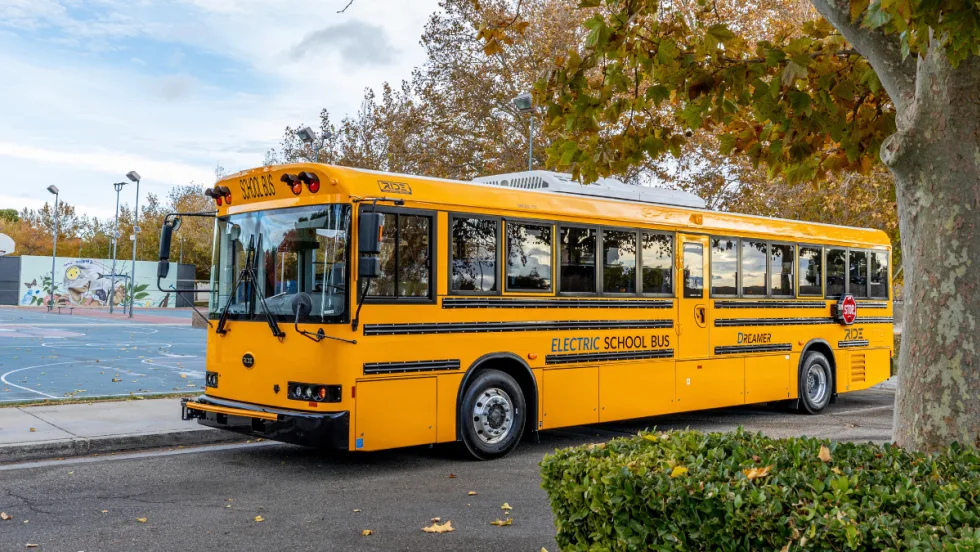
The Secret Life of an Electric School Bus Battery
Batteries change throughout years of daily routes, but degradation doesn’t necessarily mean the end. Here’s what operators should know about performance, safety, and second life.
Read More →
CALSTART and Forth Combine to Form Catalyst Mobility
The new name represents a renewed vision for the nonprofit focused on advancing clean, equitable, and affordable transportation solutions that move people and goods.
Read More →
Alt-Fuel Moves: New Buses, Charging Hubs & Real-World EV Testing
Propane and electric school bus deployments continue to grow as districts add new vehicles, expand charging infrastructure, and gather more real-world operating data.
Read More →
Fewer Electric School Bus Models Reshape the U.S. Market
WRI’s latest buyer’s guide points to a consolidating electric school bus market, but fewer options may reflect a maturing industry rather than fewer meaningful choices for school bus operators.
Read More →
The Fuel Budget You Can Actually Predict: How Propane Autogas Keeps Money in the Classroom
Learn how propane autogas helps school districts manage fuel costs with predictable pricing, lower maintenance, and reduced emissions from former transportation director Joel Stutheit.
Read More →