




NAPT 2003 Marked by a Trade Show to Remember
With five extraordinary professional speakers, 55 workshops and multiple training programs, the educational opportunities at the 2003 National Associa...

This is the Caption~~
With five extraordinary professional speakers, 55 workshops and multiple training programs, the educational opportunities at the 2003 National Association for Pupil Transportation (NAPT) conference were ample. But it was the trade show, spectacular in both size and scope, that commanded the lion’s share of attention during this year’s event, held at the Salt Palace in Salt Lake City.
In fact, this year’s exhibition featured more than 140 vender booths manned by approximately 1,100 representatives. Thomas Built Buses and IC Corp. both held festive ceremonies to introduce new bus models, while Corbeil also presented a new bus and dozens of other companies unveiled new product lines. Moreover, the floor space was, in square footage, the largest in the 29-year history of NAPT’s trade show. These impressive feats were not lost on the estimated 750 conferees, as several told SBF staff members that demonstrations of new products and advancing technologies imparted the most important lessons of the conference.
“Pupil transportation is continually growing,” said David Pace, transportation director at Virginia Beach (Va.) City Public Schools, when asked what he learned from the show. “Technologies are constantly changing, and products are constantly improving.”
New conventional unveiled
With laser lights, dramatic music and a christening from President John O’Leary, Thomas Built Buses dropped the curtains on its Saf-T-Liner C2 school bus before a captivated crowd at the trade show.
Attendees were invited to explore the new conventional-style bus and its features. Many remarked on its distinctive design, which boasts a 2,700-square-inch sloping windshield for improved driver visibility. A low, sloping hood and front A-pillar windows also add to the overall visibility by increasing sight lines to the roadway and entrance zone.
Additional features on the C2 include recessed warning lights, ergonomic driver cockpit and interior devices and one multiplexed wiring system shared by the body and Freightliner chassis. The body assembly system uses welds, structural adhesives and self-piercing rivets — all with the goal of providing greater durability.
The new bus also allows the option of a Mercedes-Benz MBE 900 series engine, with up to 250 horsepower, or a Caterpillar C7 diesel engine, which utilizes ACERT (advanced combustion emission reduction technology).
“The Saf-T-Liner C2 doesn’t look like any other bus on the market today because we started with a clean sheet of paper,” said O’Leary. “We listened to what school transportation directors, technicians and drivers told us they wanted in a school bus.”
The C2 will be built in Thomas’ recently opened 275,000-square-foot manufacturing facility in High Point, N.C.
IC follows suit
Also among the flashier segments of the trade show was IC Corp.’s presentation of its new CE series school bus line. The bus model, initially unveiled at the IC Corp. dealer meeting in late September (see pg. 18 of the November issue for full coverage), was unveiled after a countdown that culminated with a speech by Tom Cellitti, VP and general manager of IC Corp.’s Bus Vehicle Center, as well as balloons and streamers. The new bus offers upgraded features that include enlarged side and door windows, wipers that cover a larger windshield surface, a wheel cut of up to 50 degrees, 78-inch headroom, faster warm-up times, Diamond Logic™ electrical system for simpler diagnostics and increased heating capability.
Cellitti commented to the trade show crowd that the CE series bus was created based on an extensive gathering of customer feedback. “While developing this new product, our conversations with owners and maintainers made it clear that any new technologies needed to be manageable, user-friendly and risk free.”
The CE series was not the only new product put on display by IC Corp. The company also presented its ISIS Internet-based management program, which is available for the first time to all IC Corp. school bus owners. Previously limited to dealers, the program gives access to a wealth of information, including maintenance dates for all IC Corp. bus models, recall information, vehicle manuals and warranty information. IC Corp. also displayed its new 3300 bus chassis. (Please see pg. 61 for a photo and information on this product.)
Propane bus revealed
Corbeil launched another ground-breaking vehicle at the trade show with its new dedicated propane 60-passenger school bus. Designed specifically for the General Motors Family-2 Commercial Cutaway Chassis, the bus features an 8.1-liter gasoline engine that was engineered to a propane system using an Allison transmission. The width of the frame accommodates a three-tank manifold with a total capacity of more than 50 gallons of propane fuel. The manifold is positioned between the frame rails for safety and durability.
Corbeil and Pro Con, a consortium of propane providers and equipment manufacturers, also plan to release a Family-3 version of the propane bus, with a capacity of more than 72 passengers and standard equipped air brakes.
Conception of the propane school bus was funded by the U.S. Department of Energy, with additional support from ProCon, the Propane Vehicle Council and the Propane Education and Research Council. ProCon is now accepting orders for the Family-2 version, with delivery expected around May 2004.
Solid legal advice
Despite the fun and flashiness of the trade show’s product unveilings, door prizes, light shows and free candy, the conference’s function to spread information and inspire professional growth was not abandoned. Some of the more respected figures in school transportation, including state directors and federal officials, conducted sessions on topics such as the No Child Left Behind Act, diesel emissions, improving staff morale and communication on the bus with speakers of foreign languages.
Peggy Burns, in-house counsel for Adams 12 Five-Star Schools in Thornton, Colo., and Mark Hinson, assistant superintendent of the district, conducted two very informative and well-received presentations on labor issues at transportation operations. The second session, titled “Lordy, Lordy the Importance of 40,” gave an explanation of how the Fair Labor Standards Act applies to hour and wage entitlements and limitations for school transportation employees.
Noting that employers are responsible for paying overtime to drivers and other staff members who work more than 40 hours per week — even if they work in more than one department or non-traditional hours — this workshop offered eye-opening legal insight. Several examples of worst-case scenarios in which school districts paid back wages, penalties and attorney fees were provided.
“Peggy Burns and Mark Hinson’s sessions were outstanding,” said Mark Lindstrom, director of transportation at Troup County Public Schools in LaGrange, Ga. “The many facets of legal liability as they pertain to school transportation was the most helpful part of the conference to me.”
For more information on labor issues or these sessions, contact Burns by e-mail at myroadmap@legalroutes.com.
Special-needs discussion
Burns was involved in another informative session. The “dynamic duo” of Linda Bluth, chief of the community and interagency services branch of special-education services at the Maryland Department of Education, and Burns led a workshop covering hot topics in special-needs transportation.
On the subject of IDEA, the pair presented several special-needs scenarios to help interpret the least restrictive environment (LRE) policy. For instance, in the case of a deaf student who attends a school specifically for the deaf, the child does not need to be integrated with regular-education students on the bus or in the classroom.
Discussing how bus stops play into LRE, Bluth and Burns stressed the importance of determining whether a student will be able to get to his or her stop safely. Door-to-door service should be provided for those that may have difficulty, though the pair recognized that such service must be allotted prudently due to budget constraints.
“Each situation should be evaluated individually with regards to the disability of the student,” said Bluth.
Another hot topic the duo discussed was the precedent-setting Susavage case, in which a 6-year-old girl with a musculo-skeletal disorder was strangled by an improperly positioned harness on her school bus. “It is probably the most horrific transportation case that I am aware of,” said Burns.
In that case, the court determined that the intermediate unit that supplied the harness should have provided specific training for the driver and that it showed “deliberate indifference” by ignoring what could have happened. Bluth and Burns used this example to emphasize how crucial it is that pupil transporters know all the details about each special-needs student and his or her disability.
“It is sheer foolishness to not share behavioral management plans, allergy info, seizure info, etc., with transportation,” said Burns.
Case study time
A lineup of educational workshops wouldn’t be complete without a few sessions discussing actual events and programs that have helped to shape the student transportation landscape. This year’s show featured case studies on Medicaid and transportation funding, environmental advocacy and emergency preparedness, among others.
One such workshop was conducted by Dr. Stephen Raucher, director of transportation for Montgomery County Public Schools in Rockville, Md., and centered on the school district’s comprehensive code of conduct for school bus attendants and drivers. Raucher told attendees that the system was developed with input from the local drivers’ union in response to myriad concerns raised by Montgomery County employees about what’s expected of them. The session, which drew a large crowd, delineated a three-category point system used by the transportation department, wherein each category contains a list of infractions. Drivers who commit offenses under each category receive a corresponding point total. Every point total has accompanying penalties, and a total of 24 or more points in a 12-month period will result in a recommendation for termination.
Another popular case study session focused on how the North Carolina Department of Public Instruction created a statewide school bus safety training program involving Buster the Bus, a talking robot manufactured by Robotronics. The program makes a pool of state-owned Buster models available to give training to young students and also allows funding options for districts that want their own models. Conducted by Derek Graham, state pupil transportation director of North Carolina, and Deborah Graham of the Rowan-Salisbury (N.C.) School Systems, the workshop gave a demonstration of how a safety lesson can utilize the capabilities of Buster. Deborah Graham also gave an emotional account of the recent death of a 5-year-old student who was struck by a passing motorist as she was crossing the street to board her bus.
For more information on any of the workshops offered at the NAPT conference or for inquiries about the trade show, e-mail the association at info@napt.org or call (800) 989-NAPT.
More Management

EverDriven Launches Route Consolidation Calculator to Estimate Diesel Savings
As diesel prices hit record highs, the largest alternative transportation provider says a 10% route consolidation could save a 120-route district more than $78,000 a year in fuel alone.
Read More →
Zum Secures Continued Financing Support for School Bus Expansion
Generate Private Credit has financed approximately $75 million in school bus deployments across three states, supporting more than 500 buses as Zum expands across the county.
Read More →
Beyond Discipline: A Different Approach to Student Behavior on the Bus
After implementing a dean of students program in Oregon, North Clackamas is seeing positive improvements. Here’s how it worked. The Route is brought to you by IC Bus.
Read More →
A Dean of Transportation's Different Approach to Student Behavior on the School Bus
After implementing a dean of students program in Oregon, North Clackamas is seeing positive improvements on the bus. Here’s how it worked.
Read More →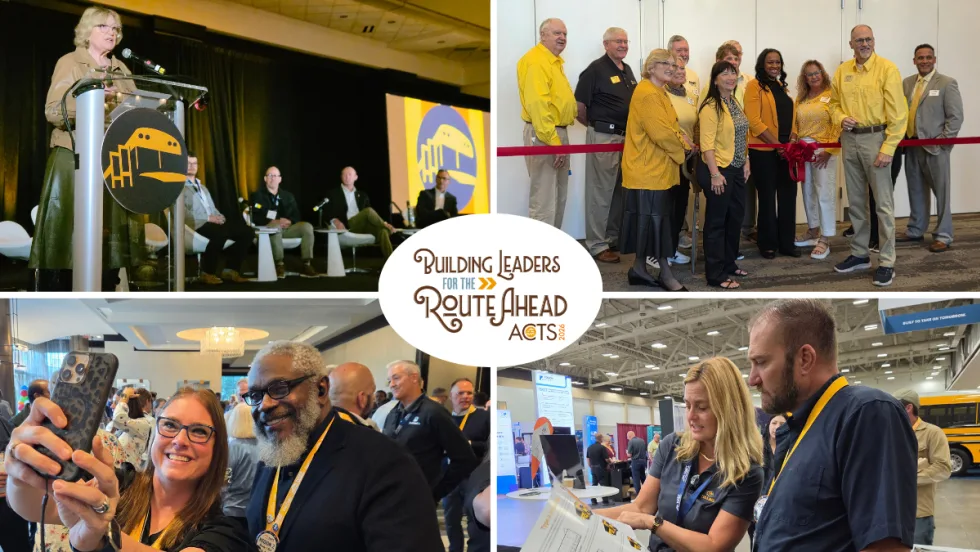
Inside NAPT ACTS 2026: Highlights from Louisville
From federal updates and student behavior strategies to new school bus technology and industry awards, see highlights from NAPT ACTS 2026 in Louisville.
Read More →
Meet the 2025 School Bus Driver Hero Winner: Annette Brown
We caught up with Wa-Nee Community Schools' Annette Brown on site at SBFX, where she was named the 2026 School Bus Driver Hero Award winner. Hear about her reaction, what she loves most about being a school bus driver, and more!
Read More →
Predictability Is Like Ketchup (According to 6-Year-Olds)
To students, a different school bus can feel like a full-blown crisis. One driver reflects on why familiar routines, showing up on time, and being reliably boring matter more than we think.
Read More →
Samsara Launches Free Driver Rewards Program
The new Driver Perks program gives eligible professional drivers access to discounts and offers without adding a cost for participating fleets.
Read More →
How Tax-Exempt Municipal Leases Can Help Finance School Buses
Let’s explore school bus financing options, including municipal leases, vendor payable accounts, and balloon payments, and how they can help stretch fleet budgets.
Read More →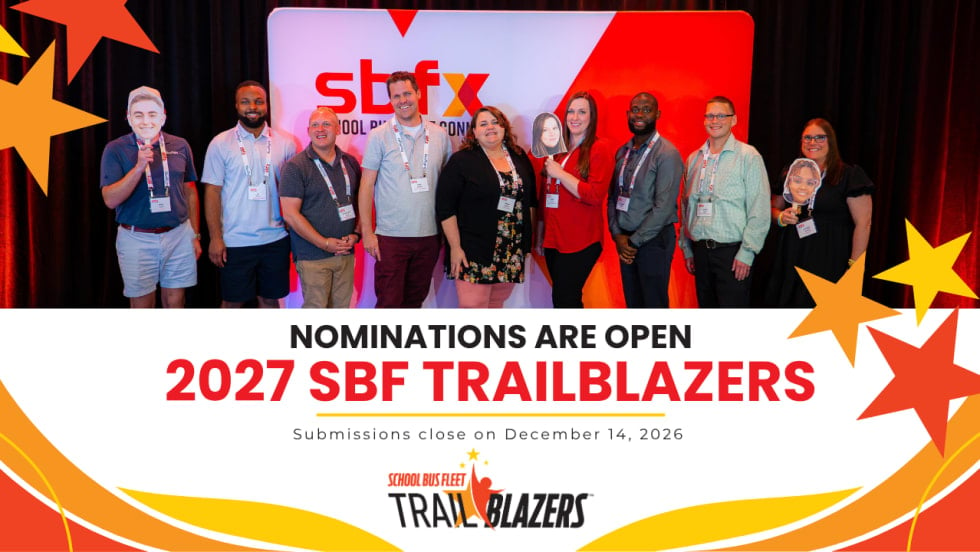
Nominate Rising School Transportation Pros Under 40!
We’re searching for the next generation of leaders making an impact across the K-12 student transportation industry to recognize as SBF’s 2027 Trailblazers. Nominations are open now!
Read More →